
Logo   Banner   TopRight
TopUnder
Transparent
Velocity Micro Edge Z55 Gaming System
Transparent
Date: Aug 07, 2008
Section:Systems
Author: Daniel A. Begun
Transparent
Introduction & Specifications


Unlike the enthusiast system manufacturers, Alienware and VoodooPC, Richmond, Virginia-based Velocity Micro is still an independent, privately held company. In fact, Velocity Micro is doing well enough on its own to have even purchased the enthusiast, boutique system maker, Overdrive PC last year. On top of that, Velocity Micro is one of the few (if only) independently owned, U.S.-based, high-end gaming systems manufacturers that--in addition to selling direct--also sells its systems at Best Buy and Circuit City. That's a claim that even Velocity Micro's competitors, Oregon-based Falcon Northwest, New Jersey-based Maingear, and California-based Vigor Gaming, can't make.

As do most enthusiast system manufacturers, Velocity Micro makes hand-built, high-end gaming rigs using top-of-line components. What Velocity does not do, however, is outsource its support--all non-on-site support, including phone and e-mail-support are manned by Velocity Micro's own in-house techs (for sheer geographic practicalities, on-site support is handled by third-party companies).

Velocity Micro offers a well-rounded catalogue of systems, including notebooks, home theater PCs, as well as more traditional home PCs. But the company's bread and butter are its gaming rigs--its Raptor and Edge series desktops. The Raptor series is the higher-end of the two models, with more hardcore specs, customization, and tweaking. Velocity Micro currently offers two models in the Raptor line, the Raptor Signature Edition (starting at $5,995) and the Raptor Z90 (starting at $3,199). The Edge series is also geared toward enthusiasts, but is focused more on finding a balance between high-end components and affordability. As such, the Edge series doesn't receive the same level of customization and tweaking that that Raptor series does, and its component options might not be quite as bleeding edge. The Edge is available in five models, ranging from the Edge Z5 (starting at $949), and up to the Edge Z55 (starting at $2,099).

We received the highest end model in the Edge series, the Z55. Velocity Micro configured it with a few options, taking the system price up to $2,664. We put the system through the usual level of rigorous HotHardware testing and hands-on evaluation. Read on to see how the Edge Z55 faired.


 Velocity Micro Edge Z55 Gaming System
 System Specifications - As Reviewed

Processor
Intel Core 2 Quad Q9450 (2.66GHz , 12MB L2, 1,333MHZ FSB) *

Motherboard
Asus P5N-D nForce 750i SLI, Socket 775
 
Operating System
Genuine Microsoft Windows Vista Home Premium 32-bit, with Service Pack 1

Memory
4096MB Corsair XMS2 DDR2-800 Low Latency Extreme Memory with Heat Spreader (2x2048)
 
Graphics Cards
Dual 512MB EVGA GeForce 9800 GTX in SLI, PCIe 2.0 *

CPU Cooling
Arctic Cooling Freezer 7 Pro Heatsink, Ultra Quiet Fan, Copper Heat Pipes

Audio
On-Board Integrated High Definition 7.1 Channel Sound
 
Hard Drive
500GB Hitachi 7200rpm 16MB Cache SATA 300 w/ NCQ
 
Optical Drive 1
Lite-On Blu-ray DVD-ROM Drive
 
Optical Drive 2
20x Lite On DVD+/-RW Dual Layer Burner with LightScribe Labeling Technology
 
Floppy Drive
1.44MB Floppy Drive

Case
LXe-W Black - Velocity Micro Signature Aluminum Case - removable front door, side window
Power Supply
850-Watt Velocity Micro Power Supply - Nvidia SLI Certified

Expansion Slots
2 x PCIe 2.0 x16
2 x PCIe x1
2 x PCI 2.2

External Ports
6 x USB 2.0 ports (2 front, 4 rear)
2 x 1394a Firewire port (1 front, 1 rear)
1 x RJ45 Ethernet (10/100/1000) port
1 x S/PDIF Optical
1 x S/PDIF Coaxial
6x 1/8-inch programmable, jack-detecting audio ports (back)
1 x 1/8-inch headphone port (front)
1 x 1/8-inch stereo line-in (microphone) port
1 x PS/2 Mouse Port
1 x PS/2 Keyboard Port
1x Parallel
1x COM

Bundled/Installed Software
CyberLink PowerDVD 7.3 (BD edition)
FutureMark 3DMark Vantage - Velocity Micro Basic Edition
Norton Internet Security 2007
Corel Snapfire Plus SE 1.2
Intervideo DVD Copy 5 (trial)

Warranty and Support
1-year parts and labor, depot repair (upgradeable to 4 years, on-site repair)
1 year phone support, business hours (upgradeable to 4 tears, 24/7 phone support)

Price: $2,664 USD (as configured) *


* Note
: As were about to publish this review, we discovered that Velocity Micro was no longer offering the Edge Z55 with either the 2.66GHz Intel Core 2 Quad Q9450 processor or Dual 512MB GeForce 9800 GTX graphics cards. Instead, the relative options for the Edge Z55 would be a 2.83GHz Intel Core 2 Quad Q9550 CPU and Dual 512MB GeForce 9800 GTX+ (Plus) graphics cards. Not only did the level of components improve, but the price even came down from what was originally $2,954.


The Velocity Micro Z55 we tested was powered by a 2.66GHz Intel Core 2 Quad Q9450 processor, which resides in the Socket 775 of an Nvidia nForce 750i SLI-based Asus P5N-D motherboard. The front-side bus runs at 1,333MHz, while the 4GB of Corsair XMS2 DDR2 low-latency memory runs at 800MHz. The system's graphics are powered by a pair of 512MB EVGA GeForce 9800 GTX cards in SLI mode. Our configuration includes a 500GB Hitachi 7200rpm hard drive, but for those looking to maximize their storage, you can order the system with up to 3TB of hard disk storage space (for an additional $1,030). The system we tested came with two optical drives: a Blu-ray drive and a 20x Dual Layer DVD-/+RW drive. Sound is powered by the 7.1-channel, integrated audio; but upgrade options are available for Creative SoundBlaster X-Fi-based cards (from $45 to $75). The CPU is cooled by a massive heat sink, with copper heat pipes, and air cooled; for another $105 you can opt for liquid cooling the CPU. Also, an additional $35 will add a positive-pressure airflow cooling system for the graphics cards.

The standard warranty covers depot-based, parts and labor for one year, plus tech support during business hours. Various warranty options are available, ranging from 2 to 4 years parts and labor. You can choose between depot-based service or on-site support, and business hours phone support or 24-hour phone support. A four-year warranty with depot service and business hours support costs $299, or $369 for on-site service and 24/7 phone support. Velocity Micro also offers what it calls a "Lifetime Upgrade Plan." Whether your system is under warranty or not, you can send it back to Velocity Micro for "basic interior cleaning, general maintenance, driver and BIOS updates, operating system updates, discounted component hardware upgrades, and standard performance tuning and benchmarking." This service starts at $99 and does not include shipping, out-of-warranty repairs or parts, or the cost of component upgrades.
 
Transparent
Design & Build Quality

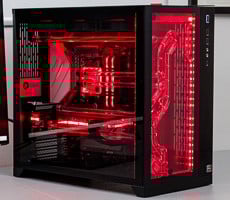
The Edge Z55 comes in a variety of different full-sized desktop cases, with or without removable front doors or side windows, and in either black or silver color schemes. Our system came configured with the "LXe-W Black - Velocity Micro Signature Aluminum Case - removable front door, side window." 


The case's black matte finish tended to attract fingerprints, but they were fairly easy to wipe away. A fan mounted in the front of the system--located behind the Velocity Micro logo cutout--contains a blue cold-cathode light. The light is barely noticeable when viewed from the front and does very little to light up the inside of the case. Those looking for a little more visual wow, might want to consider one of the case light upgrade options ($20 for one light, $40 for two).


The case is well built and strong. While it is not light, it could conceivably be carted to and fro LAN parties. If that's how you roll, then we would suggest also investing in the optional $30 wheel set for the case.


The Edge Z55's ports include two PS/2 ports, which are becoming less and less common on systems these days. Also less widespread of late are the inclusion of both parallel and COM ports. How quaint. Four USB 2.0 ports are located on the back of the system, and another two on the front bottom edge of the case—note, however, that the motherboard actually supports up to eight USB connections (more on this later). There are also two 1394a Firewire ports--one on the back and one on the front. In addition to the six, programmable, "jack-detecting" audio connectors on the system's backplane, there are also both coaxial and optical S/PDIF connectors. The front of the system has standard 1/8-inch mic and headphone jacks. Rounding out the ports on the back of the system is a single RJ45 Ethernet 10/100/1000Mbps port. The system is also available with gaming-specific Killer NIC card options from Bigfoot Networks ($189 to $265), and Velocity Micro also offers a $25, 802.11g PCI-based WiFi adapter option as well.


The front door of the case opens to reveal four 5.25-inch drive bays, two of which are populated with the optical drives. Below them are two 3.5-inch bays, one of which houses a 1.44MB floppy drive. You can choose to populate the 3.5-inch bay instead with an 8-in-1 media reader/floppy drive combo at no additional cost. Assuming you choose to leave the removable door on the case, the door includes a lock, which prevents access to the drive bays, power button, and reset switch. Two keys are included with the system. A little WD-40 would probably do the trick, but we were somewhat annoyed by the squeaking noise the front door made whenever it closed.
 
Transparent
Interior Design & Layout

The interior of the Edge Z55's case is roomy and neat, which helps promote effective airflow through the system. The cramped design of the motherboard and particular choice of components, however, makes accessing some parts of the system's internals tricky. At the very least, Velocity Micro took great care in routing the cables as efficiently and out of the way as possible so that the cables play a minimal role in impacting component access. At least the honking heatsink/fan assembly is mounted vertically so as to not block access to the motherboard.


The side panel slides offs easily with the removal of two thumb screws. The graphics cards' cables are routed tightly over the motherboard's power connector, which might make trying to populate the closest memory slot a tight fit. If you were to add more memory, you might need to cut a few of the zip-ties that hold the graphics cards' power cables in place.


There is room for three additional 5.25-inch drives in the internal drive cage. Additional drives, however, would likely impact the effectiveness of the system's front-mounted fan. Also, as the fan's blue cold-cathode light is the only source of internal illumination, additional drives would also cut down on the little internal light that the system has. Additional cooling is provided by a fan mounted on the back of the case, cooling fans attached to the CPU heatsink and the motherboard chipset's heatsink, and fans on each of the two graphics cards. Even with all of the fans running, the system is relatively quiet with a low hum--it is noticeable but not obnoxious.

The motherboard includes a single IDE port, which is connected to the DVD+/-RW drive. Of the motherboard's four SATA connectors, one is connected to the hard drive, and one to the Blu-ray drive. Although two of the SATA connectors are unpopulated, access to them is blocked by one of the graphics cards. The system supports RAID 0, 1, 0+1, 5, and JBOD.

The two GeForce 9800 GTX cards are double-wide cards and are sandwiched snugly together. The cards populate both PCIe 2.0 x16 slots, and block access to one of the two PCIe x1 slots and one of the two PCI 2.2 slots. Even though one PCI slot is technically accessible, there is so little clearance between it and one of the graphics cards that it would be a crapshoot figuring out if you could actually fit a card into the slot or not. It should be noted, however, that PCI-based sound cards are available options for this system, so at least Creative Labs' SoundBlaster X-Fi cards will fit in the slot.
 
Transparent
Peripherals & Accessories


Velocity Micro goes to great pains to point out that each system is built by hand and gets individual attention. In fact, each system includes a document that states: "This system has been built according to our highest standards of quality and craftsmanship and has been thoroughly tested to ensure peak performance and reliability." The document is signed by the system technician who built the system and the production manager who inspected it.


All the system documentation and software were neatly assembled together in a blue folder. This included a generic user guide, warranty details, a quick setup guide, and the original motherboard manual. The original motherboard and graphics card driver discs were included, as well as a custom "drivers and updates" disc with the specific audio, chipset, and video drivers for our configuration. Also included were the Windows Vista disc, the CyberLink PowerDVD disc, and the software disc that comes bundled with the Asus motherboard. (By the way, Blu-ray movies looked amazing during our testing when we viewed using an Asus MK241H widescreen 24-inch display.) The applications on the Asus disc include Norton Internet Security 2007, Corel Snapfire Plus SE 1.2, and a trial version of Intervideo DVD Copy 5--but none of these apps come pre-installed on the system. In fact, the only software that comes preinstalled is PowerDVD and FutureMark 3DMark Vantage - Velocity Micro Basic Edition. In a time when vendors tend to pile on as much bloatware as seems humanly possible, we find this minimalist approach a breath of fresh air, as it gives us that much more available hard disk space to install the apps and games we want and not the ones the vendor thinks we might want.

The Edge Z55 also came with an accessory bag that included the following:

  • Two VGA-to-DVI adaptors
  • Two S-Video cables
  • Two component-video cables
  • Two LP4-to-6-pin PCIe power adapter cables
  • One LP4-to-15-pin SATA power adapter cables
  • Two SATA interface cables
  • AC power cable
  • Two keys for the system lock
  • Five Velcro cable ties
  • One 2-port USB 2.0 backplane
As we mentioned earlier, the system supports up to 8 USB 2.0 ports, but it is only configured with six ports. You could install the 2-port USB backplane into an available slot location  on the back of the system and connect it to the motherboard's USB header to get a total of 8 USB 2.0 ports.


The Edge Z55 also comes with Velocity Micro-branded version of the Creative Spectre Gamer Keyboard. The keyboard's color is black, which matches well with the system's black and silver color scheme. The keyboard feels solid, as opposed to the flimsy, low-end keyboards that often ship with new systems. The keyboard includes five programmable hotkeys and a full set of multimedia controls. Instead of printing the characters onto the keys, the characters are actually cutouts, which allow the keyboard's blue backlight to illuminate the keys. A toggle switch on the keyboard allows you set to set the brightness to one of two levels or turns off the backlight. Unfortunately, we found that unless the room was very dark, the characters on the keyboard were often difficult to see. As not all of us are touch typists, some of us need to peer down at the keyboard periodically to get our bearings. There is also a button that toggles on and off a light at the bottom of the keyboard, meant to illuminate the space in front of the keyboard. We see the merits of the keyboard for gaming scenarios in a darkened room, but find the approach lacking for us hunt-and-peck typists during non-gaming computer use in a well-lit room.


The system comes with a Velocity Micro-branded Creative Gamer HD7600L mouse, which is also black in color; although the mouse comes with replaceable silver and blue covers as well. The HD7600L has a number of innovative features, including two additional programmable thumb buttons and blue LED backlighting. Most impressive, however, is that the mouse's resolution can easily be changed on the fly using the top-mounted DPI Resolution dial. A set of four LEDs indicate which of four resolution modes the mouse is currently set to: 400, 800,1600, or 2400 dpi. We found having such easy and quick access to the mouse's resolution quite a boon during game play.
 
Transparent
Test Setup & SiSoft SANDRA


We tested the Edge Z55 system exactly as it came configured from Velocity Micro. 

HotHardware's Test Systems

 Performance Comparisons
System 1:
Velocity Micro Edge Z55

Intel Core 2 Quad Q9450
(2.66GHz  - Quad-Core, 1333MHz FSB)

Asus P5N-D
(nForce 750i SLI)

4GB Corsair XMS2 DDR2-800
 
2x 512MB GeForce 9800 GTX
(SLI)

1x 500GB Hitachi HDD
(7,200rpm, 16MB Cache, SATA 300 w/NCQ)
 
Windows Vista Home Premium 32-bit, SP1

Nvidia Forceware v175.16
System 2:
Dell XPS 730 H2C

Intel Core 2 Extreme QX9770
(3.2GHz @ 3.8GHz - Quad-Core, 1600MHz FSB)

Nvidia nForce 790i Ultra SLI
 
2GB Corsair Dominator DDR3-1333
(overclocked to 1600MHz)

2x 1024MB ATI Radeon HD 3870 X2
(Quad-Crossfire)

2x160GB Western Digital HDD
(10,000RPM, SATA)
1x1000GB Hitachi HDD
(7,200 RPM, SATA)

Windows Vista Home Premium

ATI Catalyst v8.3

Preliminary Testing with SiSoft SANDRA XII SP2

 Synthetic Benchmarks

We began our testing with SiSoftware's SANDRA XII, the System ANalyzer, Diagnostic and Reporting Assistant. We ran three of the built-in subsystem tests that partially comprise the SANDRA XII suite (Processor Arithmetic, Processor Multi-Media, and Memory Bandwidth).


SiSoft SANDRA's various benchmark modules reported scores for the Edge Z55 that are right in-line with expectations. The Processor Arithmetic test measures almost pure raw CPU power, as is evidenced by the scores' parity with the processors' clock speeds (with the exception of the Athlon X2 6400 64+, which is the only dual-core processor in the bunch--the rest are all quad core CPUs). The Processor Multi-Media test is also heavily influenced by raw processor speed, but it is also impacted by the amount of CPU cache. The Edge Z55's Q9450 has 12MB L2 cache versus the QX6850's 8MB L2 cache--which is why the Edge Z55 does better on this test than the QX6850 system, even though the Edge Z55's Q9450 is slower than the QX6850. It is not immediately obvious why the Edge Z55 falls behind on the Memory Bandwidth test until you take into account that all of the Intel-based systems here are utilizing faster 1333MHz DDR3 memory, and the AMD-based systems are using faster 1066MHz DDR2 memory. The Edge Z55's memory is clocked at a slower 800MHz. Although, once again the Edge Z55 edges ahead of the QX6850 because of the Edge Z55's larger L2 cache size and updated CPU core architecture.
 
Transparent
Futuremark PCMark Vantage


For our next round of benchmarks, we ran the complete Futuremark PCMark Vantage test suite. This integral component of our testing toolbox provides a solid assessment of a system's overall performance.

"The PCMark Suite is a collection of various single- and multi-threaded CPU, Graphics and HDD test sets with the focus on Windows Vista application tests. Tests have been selected to represent a subset of the individual Windows Vista Consumer scenarios. The PCMark Suite includes CPU, Graphics, Hard Disk Drive (HDD) and a subset of Consumer Suite tests."

Futuremark PCMark Vantage
 Simulated Application Performance


Similar to the SANDRA tests, the Edge Z55's performance on Futuremark's PCMark Vantage test falls into expectations based on the system's configuration relative to the comparison systems. The Edge Z55's Gaming score is lacking somewhat, but this is understandable considering the higher-end graphics cards in the comparison systems--the Gaming test is highly-dependent on the performance of a system's GPU.
 
Transparent
LAME MT & Kribibench


In our custom LAME MT MP3 encoding test, we convert a large WAV file to the MP3 format, which is a popular scenario that many end users work with on a day-to-day basis to provide portability and storage of their digital audio content. LAME is an open-source mid to high bit-rate and VBR (variable bit rate) MP3 audio encoder that is used widely around the world in a multitude of third party applications.

 
 LAME MT
 Audio Encoding

In this test, we created our own 223MB WAV file (a hallucinogenically-induced Grateful Dead jam) and converted it to the MP3 format using the multi-thread capable LAME MT application in single and multi-threaded modes. Processing times are recorded below, listed in seconds. Once again, shorter times equate to better performance.


Not only is our LAME MT test a measure of almost pure processor speed, it is not impacted significantly by L2 cache size or the presence of more than two cores. As such, the results for this particular test show the 3.0GHz E6850, dual-core processor-based system outperforming the Edge Z55's 2.66GHz Q9450 quad-core CPU. Even though quad-core processors have been around for a little while now, you'd be hard-pressed to find many mainstream applications that support multi-threading with more than two cores. As such, when it comes to pure encoding--such as with audio or video encoding--the results here are fairly indicative of the performance you can expect from other similar applications. Sometimes four cores are not necessarily better than two.

 
 Kribibench v1.1
 CPU-Bound 3D Rendering

For this next batch of tests, we ran Kribibench v1.1, a 3D rendering benchmark produced by the folks at Adept Development.  Kribibench is an SSE aware software renderer where a 3D model is rendered and animated by the host CPU and the average frame rate is reported. We usually use two of the included models with this benchmark: a "Sponge Explode" model consisting of over 19.2 million polygons and the test suite's "Ultra" model that is comprised of over 16 billion polygons. The "Sponge Explode" model can sometime produce anomalous results that defy explanation, and that is what we experienced with the Edge Z55. As such, we are only including the results for the "Ultra" model here.


Unlike the LAME MT test, our Kribibench test is influenced by more than two processor cores. Other than the dual-core E6850 brining up the rear, the rest of the scores of the quad-core systems fall into place based on raw processor speed, with the Edge Z55 and its 2.66GHz Q9450 sitting exactly in between the 3GHz QX9650 and the 2.5GHz Phenom X4 9850-based systems.
 
Transparent
Cinebench & 3DMark06 CPU


Cinebench R10 is an OpenGL 3D rendering performance test based on Maxon's Cinema 4D--a 3D rendering and animation tool suite used by 3D animation houses and producers like Sony Animation and many others. It's very demanding of system processor resources and is an excellent gauge of pure computational throughput.


 Cinebench R10
 3D Rendering


This is a multi-threaded, multi-processor aware benchmark that renders a single 3D scene and tracks the length of the entire process. The final scores produced by each test system to render the scene is represented in the graph below.


The Edge Z55's performance in our second 3D rendering test was very similar to its performance in Kribibench. Once again, raw processing speed and the number of processor cores are the driving force of the processor-intensive test. The results for Kribibench and Cinebench should be a good indication of the kind of performance you can expect to see from CPU-bound applications as they start to become available with multi-threading support for four cores (or more).


 Futuremark 3DMark06 CPU
 Synthetic DirectX Gaming


3DMark06's built-in CPU test is a multi-threaded DirectX gaming metric that's useful for comparing relative performance between similarly equipped systems. This test consists of two different 3D scenes that are processed with a software renderer that is dependent on the host CPU's performance. Calculations that are normally reserved for your 3D accelerator are instead sent to the CPU for processing and rendering. The frame-rate generated in each test is used to determine the final score.


We're beginning to sound like a broken record here, but 3DMark06's CPU test is also most-heavily influenced by raw processor speed and the number of processor cores. As such, once again the Edge Z55's quad-core 2.66GHz Q9450 readily outguns the 3GHz E6850 dual-core-based system.
 
Transparent
3DMark06 Standard Test


Over the next few pages, we'll focus on a few gaming specific benchmarks, starting with the rest of 3DMark06's modules.  


 Futuremark 3DMark06
 Synthetic DirectX Gaming

3DMark06 is a hard-core, forward-looking 3D rending benchmark that pushes a system and its GPUs to the limits. The test includes Shader Model 2.0, Shader Model 3.0, and HDR tests. Scenes are rendered with very high geometric detail and shader complexity, and with extensive use of lighting and soft shadows. The maximum shader length 3DMark06 supports is 512 instructions. The 3DMark06 Overall Score is a weighted average based on the SM 2.0 and HDR / SM3.0, and CPU scores.


A score of 14,104 3DMarks is nothing to sneeze at, but it doesn't quite measure up to the level of performance we saw from systems with higher-end GPUs. Of course, since CPU speed is a factor in these scores (as it should be, as real-world 3D game play is heavily influenced by processor speed), it needs to be mentioned that these comparison scores were generated on systems with a faster CPUs (3GHz QX9650) than the Edge Z55's 2.66GHz Q9450. 


Here is where things start to get a little weird. You'll notice that the dual-9800 GTX SLI-based Edge Z55 actually performed noticeably slower than a system with a single 9800 GTX card. What's up with that? To investigate, we turned off the Edge Z55's SLI and re-ran this test. The results did not change, which led us to first think that SLI wasn't working. But when we set the resolution up to 1920x1200 with 4X AA, we saw a noticeable difference between SLI and non-SLI scores. It turns out that at the default resolution for this test (which is how we ran it), the test is CPU bound. Combine that with the fact that SLI mode chews up some CPU overhead, and the Edge Z55's score on the SM 2.0 test starts to make sense. The lower SM 2.0 score here also helps put the 3DMark06 Overall score into further perspective.


The Edge Z55 fareed a bit better on the SM 3.0 test, but is still bested by a system with a single GeForce 9800 GX2. Mind you, you could easily pay for a 9800 GX2 what you would spend on two 9800 GTXs. At higher resolutions, where the workload is less CPU bound, we would expect the Edge Z55's dual 9800GTXs to do better. Unfortunately, we didn't have comparison scores available at higher resolutions. But before you lament how good an indicator 3DMark06 is or isn't of the relative graphics capability of a system, we'll next look at a few real-world gaming tests to see how the Edge Z55 performs with some blockbuster retail titles.
 
Transparent
HL2 Episode 2


 Half Life 2: Episode 2
 DirectX Gaming Performance

Thanks to the dedication of hardcore PC gamers and a huge mod-community, the original Half-Life became one of the most successful first person shooters of all time. And thanks to an updated game engine, gorgeous visual, and intelligent weapon and level design, Half Life 2 became just as popular. Episode 2 offers a number of visual enhancements including better-looking transparent texture anti-aliasing. These tests were run at a resolution of 1920 x 1200 with 4X anti-aliasing and 16X anisotropic filtering enabled concurrently. Color correction and HDR rendering were also enabled in the game engine as well. We used a custom recorded timedemo file to benchmark all cards in this test.


The Edge Z55 put in a very respectable showing of 100.82 fps on our Half-Life 2: Episode 2 test at 1920x1200 with 4X AA and 16 AF. However, as expected, it didn't fare so well when compared to higher-end configurations, such as the single-card-based 9800 GX2 system that scored almost 30 fps faster. The single-card 9800 GTX-based system, however, scored 19 fps less than the Edge Z55. The takeaway here is that while you're not going to get the fastest gaming performance from the Edge Z55, it is still very fast and capable of pleasing the vast majorty of gamers. Also keep in mind that the dual-9800 GTXs in our Edge Z55 rig, just happen to be the way our unit was configured. Velocity Micro offers plenty of graphics card options for the Edge Z55, going as high-end as a pair of GeForce GTX 280s in SLI mode for an additional $1,080.

Transparent
Crysis


 Crysis v1.2
 DirectX 10 Gaming Performance

If you're at all into enthusiast computing, the single player, FPS smash-hit Crysis, should require no introduction. Crytek's game engine visuals are easily some of the most impressive real-time 3D renderings we've seen on the computer screen to date.  The engine employs some of the latest techniques in 3D rendering like Parallax Occlusion Mapping, Subsurface Scattering, Motion Blur and Depth-of-Field effects, as well as some of the most impressive use of Shader technology we've seen yet. In short, for those of you that want to skip the technical jib-jab, Crysis is HOT. We ran the full game patched to v1.2 with all of the game's visual options set to 'High' to put a significant load on the systems' graphics engines being tested.


On our Crysis test the Edge Z55 put up more of a fight than on some of the other 3D gaming tests. With a demanding game like Crysis, an average frame rate of 36.47 fps is considered playable. Of note is that the Edge Z55's score is less than 4 fps faster than the single-card-based 9800 GTX system. In fact, you'll notice for nearly all of the systems here that have both single- and dual-card versions, that the dual card solutions provide only a very modest performance boost.
 
Transparent
Performance Analysis & Conclusion


Performance Summary:  Overall the Edge Z55 gave a very respectable showing on our benchmark tests. The CPU- and system-based test results showed us the system's performance is in line with its specs. The 3D gaming results did not necessarily wow us, but then again the graphics cards were not exactly the fastest available. There were plenty of other systems that performed better on all our tests, but these were also higher-end gaming rigs with faster components and much higher price tags. The Edge Z55 is not meant to be a screamer--it is meant to offer a smart balance between performance and cost--it is what you might think of as a value-minded, high-end gaming rig. It should also be noted that while the Edge Z55 doesn't take the checkered flag for speed, the system's performance was more than enough for whatever we threw at it. If you want top-notch performance, you usually have to pay through the nose to get it--that's not what the Edge Z55 is about (for the highest-level performance, check out Velocity Micro's Raptor series gaming desktops). The Edge Z55 offers decent performance at a relatively affordable price.

As we mentioned earlier, the Edge Z55 is no longer available is this exact configuration. The most-comparable alternatives would be a 2.83GHz Intel Core 2 Quad Q9550 CPU instead of the 2.66GHz Intel Core 2 Quad Q9450, and Dual 512MB GeForce 9800 GTX+ (Plus) graphics cards instead of the Dual 512MB GeForce 9800 GTX cards. Based on published reports, we would expect to see about a 4 to 7 percent performance improvement with the updated processor and about a 5 to 8 percent speed bump with the graphics cards.


We spent a full month testing and using the Edge Z55 as a workstation and gaming rig. We never ran into any major glitches with the system--not even an application crash or BSOD. If there is one word we would choose to describe the system it would be reliable. That's saying a lot these days when so many vendors are quick to shove products out the door without putting them through the paces to test reliability and compatibility. As such, we never did have an opportunity to put Velocity Micro's in-house tech support to the test. For what it is worth, Velocity Micro won a Readers' Choice award in PC Magazine's 2007 tech support survey. On the other hand, a few readers at Geek.com were not thrilled with their experience with Velocity Micro's tech support.

We liked the look and sturdy feel of the Edge Z55's chassis and were at first impressed with the seemingly roomy nature of the inside of the case. Upon closer inspection, however, we realized that the combination of the motherboard design and choice of peripherals blocked or partially blocked almost of all of the expansion slots and SATA ports. We did appreciate the plethora of upgrade options Velocity Micro offers for the Edge Z55 and therefore would rather choose our upgrades at the time of purchase to let Velocity Micro figure out how to cram the extra components we'd want into the system.

It's not often that you hear the word "value" applied to an enthusiast system, but that is exactly what the Edge Z55 represents. Yes, there are cheaper systems that will probably give you comparable performance, but they probably won't be built with the same attention to detail as the Edge Z55. And yes, you could also pay a lot more and get a hard-core, top-of-the-line gaming rig with custom painting. The old adage still applies: you get what you pay for. But not everyone has money burning a hole in their pockets--especially in today's economy. If you want a system that you can play any of today's games and also run any mainstream app, the Edge Z55 will meet your needs.


  • Lots of upgrade options
  • Blu-ray drive
  • Well-built, strong case
  • Neatly-routed cables
  • Extensive documentation and driver discs
  • No bloatware installed
  • Variable-resolution gaming mouse
 
  • Standard warranty includes phone support only during business hours
  • Most of the expansion slots are blocked
  • Keys on keyboard are difficult to see


Content Property of HotHardware.com
