|
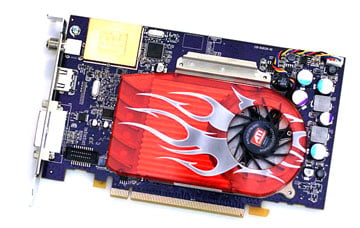
* ATI All-in-Wonder™ HD - GPU Specifications
- 378 million transistors on 55nm fabrication process
- PCI Express 2.0 x16 bus interface
- 128-bit DDR2 memory interface
- Ring Bus Memory Controller
- Fully distributed design with 256-bit internal ring bus for memory reads and writes
* Microsoft® DirectX® 10.1 support
* Unified Superscalar Shader Architecture
- 120 stream processing units
- Dynamic load balancing and resource allocation for vertex, geometry, and pixel shaders
- Common instruction set and texture unit access supported for all types of shaders
- Dedicated branch execution units and texture address processors
- 128-bit floating point precision for all operations
- Command processor for reduced CPU overhead
- Shader instruction and constant caches
- Up to 40 texture fetches per clock cycle
- Up to 128 textures per pixel
- Fully associative multi-level texture cache design
- DXTC and 3Dc+ texture compression
- High resolution texture support (up to 8192 x 8192)
- Fully associative texture Z/stencil cache designs
- Double-sided hierarchical Z/stencil buffer
- Early Z test, Re-Z, Z Range optimization, and Fast Z Clear
- Lossless Z & stencil compression (up to 128:1)
- Lossless color compression (up to 8:1)
- 8 render targets (MRTs) with anti-aliasing support
- Physics processing support
* Dynamic Geometry Acceleration
- High performance vertex cache
- Programmable tessellation unit
- Accelerated geometry shader path for geometry amplification
- Memory read/write cache for improved stream output performance
* Anti-aliasing features
- Multi-sample anti-aliasing (2, 4, or 8 samples per pixel)
- Up to 24x Custom Filter Anti-Aliasing (CFAA) for improved quality
- Adaptive super-sampling and multi-sampling
- Temporal anti-aliasing
- Gamma correct
- All anti-aliasing features compatible with HDR rendering
* Texture filtering features
- 2x/4x/8x/16x high quality adaptive anisotropic filtering modes (up to 128 taps per pixel)
- 128-bit floating point HDR texture filtering
- Bicubic filtering
- sRGB filtering (gamma/degamma)
- Percentage Closer Filtering (PCF)
- Depth & stencil texture (DST) format support
- Shared exponent HDR (RGBE 9:9:9:5) texture format support
* OpenGL 2.0 support
|
* ATI Avivo™ HD Video and Display Platform
- Dedicated unified video decoder (UVD) for H.264/AVC and VC-1 video formats
- High definition (HD) playback of both Blu-ray and HD DVD formats2
- Hardware MPEG-1, MPEG-2, and DivX video decode acceleration
- Motion compensation and IDCT
- ATI Avivo Video Post Processor
- Color space conversion
- Chroma subsampling format conversion
- Horizontal and vertical scaling
- Gamma correction
- Advanced vector adaptive per-pixel de-interlacing
- De-blocking and noise reduction filtering
- Detail enhancement
- Inverse telecine (2:2 and 3:2 pull-down correction)
- Two independent display controllers
- Drive two displays simultaneously with independent resolutions, refresh rates, color controls and video overlays for each displayFull 30-bit display processing
- Content-adaptive de-flicker filtering for interlaced displays
- Fast, glitch-free mode switching
- Hardware cursor
- Integrated 400 MHz 30-bit RAMDAC
- Supports analog displays connected by VGA at all resolutions up to 2048x15361
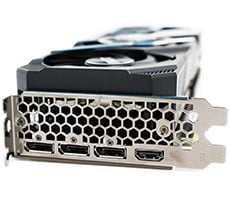
- HDMI output support
- Supports all display resolutions up to 1920x1080
- ntegrated HD audio controller with multi-channel (5.1) AC3 support, enabling a plug-and-play cable-less audio solution
- Integrated AMD Xilleon™ HDTV encoder
- + Provides high quality analog TV output (component/S-video/composite)
- Supports SDTV and HDTV resolutions
- Underscan and overscan compensation
- MPEG-2, MPEG-4, DivX, WMV9, VC-1, and H.264/AVC encoding and transcoding
- Seamless integration of pixel shaders with video in real time
* ATI PowerPlay™
- Advanced power management technology for optimal performance and power savings
- Central thermal management – on-chip sensor monitors GPU temperature and triggers thermal actions as required
1 Some custom resolutions require user configuration
2 Playing HDCP content requires additional HDCP ready components, including but not limited to an HDCP ready monitor, Blu-ray or HD DVD disc drive, multimedia application and computer operating system .
ATI Radeon™ HD graphics chips have numerous features integrated into the processor itself (e.g., HDCP, HDMI, etc.). Third parties manufacturing products based on, or incorporating ATI Radeon HD graphics chips, may choose to enable some or all of these features. If a particular feature is important to you, please inquire of the manufacturer if a particular product supports this feature. In addition, some features or technologies may require you to purchase additional components in order to make full use of them (e.g. a Blu-Ray or HD-DVD drive, HDCP-ready monitor, etc.).

|