WD Caviar & RE2 GreenPower 1TB HDs


We wish the current "green" trend would have happened a long time ago, and we actually hope that it results in a permanent mentality adjustment rather than fading like so many trends do. We are happy to see that companies are now expected to be somewhat environmentally-conscious. We love to see companies compete on metrics like performance per watt and we know we aren't the only ones who have an affinity for new architectures and designs that result in both efficiency improvements and performance gains. It wasn't so long ago that efficiency and performance were almost always inversely related. In the end, we (including the planet itself) all benefit when people and companies try to be more green.
However, we know you didn't come here to read just about recycling, carbon footprints or hugging trees, so we'll move on to the topic of this review. Many PC hardware manufacturers are taking steps to become greener or at least help their customers green up, and Western Digital (WD) is one such company. You might wonder how a storage company like WD can do that. Well, it's quite simple really: they offer a whole line of hard drives that use significantly less power than other drives on the market. WD gives the drives in this line the "GreenPower" label to indicate their reduced environmental impact. The nice thing about going green in this case is that the power reduction could lead to lower electricity bills. According to WD, "WD’s GreenPower platform is the first 3.5-inch hard drive platform designed with power savings as the primary attribute. GreenPower drives from WD deliver average drive power savings of 4-5 watts over competitors’ drives, ultra-cool, quiet operation and solid performance."
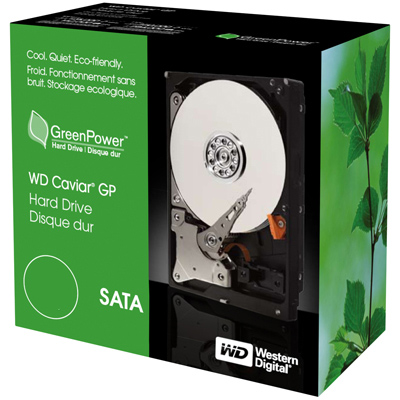
We are fortunate enough to have two of WD's GreenPower drives, the 1TB Caviar GP and the 1TB RE2-GP, on the test bench for this article. With its high MTBF (mean time between failures) rating of 1.2 million hours and RAID-specific optimizations, the WD RE2-GP is aimed at the enterprise market, while the WD Caviar GP is marketed towards the consumer desktop segment. A very interesting feature of the GreenPower drives is IntelliPower, which is a "fine-tuned balance of spin speed, transfer rate, and caching algorithms designed to deliver both significant power savings and solid performance" according to WD. What this means to potential users is that WD isn't telling us the exact spindle speed of these drives. We know that they are likely spinning at a speed between 5400 and 7200 RPM and that each GreenPower model may use a different, invariable RPM. So, while WD made power the priority with the GreenPower platform, it did so without disregarding solid performance, a wise choice in our opinion.

In addition to IntelliPower, the Caviar GP and the RE2-GP feature perpendicular recording technology and some unique WD features, such as IntelliSeek (which tweaks seek rates to decrease power utilization, noise and vibration) and IntelliPark (which also helps decrease power utilization). Because of its likely home in a large, enterprise-level storage environment, the RE2-GP also sports WD's RAFF (Rotary Acceleration Feed Forward) technology. RAFF's intent is to ensure that RE2-GP drives operate optimally even when installed in rackmounted servers that are prone to high levels of vibration. To many of you, these features don't mean much if performance gets sacrificed along the way, and the enthusiast in us has to agree. On the following pages, we'll see how well both of these GreenPower drives perform in an assortment of benchmarks.
 |
|
| WD Caviar GP 1TB (MODEL: WD10EACS)
PHYSICAL SPECS Capacity: 1 TB (1000 GB) Interface: SATA 3Gb/s Spindle Speed: N/A Cache Buffer: 16 MB Number Of Platters: 4 (250 GB each) Bytes Per Sector: 512 Height: 26.1 mm (Max) Length: 147 mm (Max) Width: 101.6 mm Weight: 0.73 kg PERFORMANCE SPECS Seek Times Average Read (msec): 8.9 Average Write (msec): N/A Latency Average Latency (msec): 5.6 Transfer Rate Buffer To Disk (Mb/s): 1156 Sustained to Disk (Mb/s): N/A Acoustics Idle Mode (dBA): 25 (average) Seek Mode (dBA): 25-27 (average) Power Consumption Read/Write: 7.50 Watts Idle: 4.0 Watts Standby: 0.97 Watts WARRANTY LENGTH 3 Years FEATURES
|
WD RE2-GP 1TB (MODEL: WD1000FYPS)
PHYSICAL SPECS Capacity: 1 TB (1000 GB) Interface: SATA 3Gb/s Spindle Speed: N/A Cache Buffer: 16 MB Number Of Platters: 4 (250 GB each) Bytes Per Sector: 512 Height: 26.1 mm (Max) Length: 147 mm (Max) Width: 101.6 mm Weight: 0.73 kg PERFORMANCE SPECS Seek Times Average Read (msec): 8.9 Average Write (msec): N/A Latency Average Latency (msec): N/A Transfer Rate Buffer To Disk (Mb/s): N/A Sustained to Disk (Mb/s): 672 Acoustics Idle Mode (dBA): 24 (average) Seek Mode (dBA): 25-29 (average) Power Consumption Read/Write: 7.40 Watts Idle: 4.0 Watts Standby: 0.97 Watts WARRANTY LENGTH 5 Years FEATURES
|
;) |
;) |
;) |
The physical appearance of the WD Caviar GP and RE2-GP is 99% identical, as you can see in the three images above. Besides some of text and bar coding, the drives look the same. Both sport a big, green GreenPower label to let you know that these drives will help you reduce power consumption. The two drives also feature the same connectors: one SATA power connector and one SATA data connector.
;) |
In addition to the connectors, both drives sport a set of eight pins that can be jumpered to change the drive's configuration. The close-up of the label above shows you the three jumper settings: jumpering pins 1 and 2 enables SSC (Spread Spectrum Clocking), jumpering pins 3 and 4 enables PUIS (Power Up In Standby), and jumpering pins 5 and 6 enables 1.5GB PHY.