Logo   Banner   TopRight
TopUnder
Transparent
Intel Core 2 Duo E6750 Performance And Overclocking
Transparent
Date: Jun 24, 2007
Section:Processors
Author: Marco Chiappetta
Transparent
Introduction and Related Information

intel_logo.jpg

Over the last year or so, since Intel's Core microarchitecture and Conroe core were ready to be unveiled at the Intel Developers Forum in early March '06, Intel has been more open and has allowed the media a view into more details regarding upcoming products much earlier than they had before.  You don't have to take our word for it, however.  Simply look around at all of the early performance previews out of IDF, and the steady flow of announcements regarding Intel's 45nm manufacturing process, metal gate transistors, the Terascale project, Larrabee, Penryn, Nehalem, and a number of other projects, and it becomes readily apparent that Intel wants to get the word out regarding their future products early and often.

Today's news falls into the category of an early announcement as well; a sneak peek, so to speak.  In the coming weeks - sometime later this summer - Intel will be officially launching a whole line of desktop processors that feature 1333MHz front side bus frequencies, which is a healthy boost from the current desktop standard of 1066MHz.  We've actually got one of these new 1333MHz FSB-equipped chips in house, the Core 2 Duo E6750, and while we can't disclose all of the details regarding this processor just yet, we can talk about its performance and overclockability.  And that's is exactly what we're going to do here today, but first let's get some of the particulars out of the way.
 

Intel Core 2 Duo E6750 Processor
Specifications & Features

  • 2.66GHz Dual Core Processor
  • 1333MHz "Quad-Pumped" front side bus
  • .065-micron manufacturing process
  • Shared Smart Cache Technology
  • 4MB on-chip, full-speed L2 cache - Shared across each core
  • Intel EM64T Extensions - 64-bit computing
  • Execute Disable Bit - For enhanced security
  • Streaming SIMD Extensions - SSE2, SSE3
  • Supported by the Intel P3x / G3x Series chipsets
  • LGA775 Packaging - Land Grid Array

  • .85 - 1.3625v operating voltage range
  • 65 - 75 watts TPD (Thermal Design Power)
  • Die Size: Approximately 143mm2
  • Approximately 291M Transistors

Core 2 Duo "Conroe" Die


We've posted a wealth of information related to Intel's Core microarchitecture and Core 2 Duo and Extreme family of processors here at HotHardware.com. For more background on the technologies employed by the Core microarchitecture and Intel's platform as a whole, we suggest taking a look at few of these related articles.  They contain detailed explanations of some of the features common to Intel's legacy products, compatible chipsets, and the new Core 2 Duo and Core 2 Extreme processors:

We cover some specifics regarding Intel's 65nm manufacturing process in our 955XE / i975X evaluation and outline Intel's AMT (Active Management Technology) and IVT (Intel Virtualization Technology), among other things inherent to the Core microarchitecture, in our Core 2 Duo E6700 & Extreme X6800 Evaluation .  The other articles listed above will also give you some background as to how the Core 2 has matured, leading up to today.

Beyond the increase in FSB speed, there really isn't too much more to know about the E6750, other than the fact that the chip is based on a new stepping and revision of the Conroe core and that it will require a motherboard and chipset capable of supporting the new 1333MHz FSB, i.e. Intel Bearlake (P3x, G3x) or NVIDIA's nForce 6.

Transparent
Vital Signs and Overclocking

intel_logo.jpg 

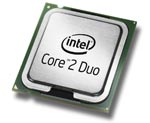
As you probably expect, the Core 2 Duo E6750 looks just like any other Core 2 Duo CPU thanks to the processor's integrated heat spreader.  But the underside too looks just like the first batch of Conroe-based processors that hit the market last year. 

       
The Intel Core 2 Duo E6750

The Core 2 Duo E6750 uses Intel's LGA775 (Land Grid Array) packaging, just like all of Intel's desktop processors for the past three years, and while built using Intel's 65nm manufacturing process, underneath that IHS lies a new revision of the Conroe core.

       
Core 2 Duo E6750 CPU-Z Information

As you can see in the CPU-Z screenshots above, this particular processors has a core clock speed of 2.6GHz, with a default multiplier of 8 and an actual front side bus frequency of 333MHz (1333MHz quad-pumped). This is particularly important because Intel's previous generation of chipsets do not officially support an FSB frequency that high, even though most of them are capable of running in that range through overclocking.  With this new line of processors, Intel is hoping to speed up the adoption of their new P3x and G3x desktop chipsets

Also of note according to CPU-Z are the new E6750's revision and stepping. The version of Conroe at the heart of the E6750 is stepping B revision G0.  If you recall, the first Conroe-based processors to hit the market had a stepping of 5 and a revision code of B1. We asked for details on what specifically had been changed in the new stepping / revision, but have not gotten an answer just yet.  If Intel discloses the changes, we'll be sure to update the article and let you know.


Core 2 Duo E6750 Overclocked to Almost 4GHz

As is typically the case, we like to overclock every new processor to land in the lab to see just how much clock speed headroom it has.  In our initial look at Conroe, we were able to take a Core 2 Extreme X6800 processor up to about 3.5GHz using nothing but a slight bump in voltage and the stock air cooler, which is nothing to scoff at.

This time around, however, our results were nothing short of spectacular.  By bumping the processor's core voltage to 1.45v and increasing the front side bus speed via our Asus P5K Deluxe motherboard's BIOS, we were able to take the Core 2 Duo E6750 up from its default clock speed of 2.6GHz to an impressive 3.92GHz (multiplier=8x / Front Side Bus Frequency=490MHz. This was done using the stock Intel CPU cooler on an open-air test bench.  At that speed, the CPU completed a Cinebench rendering pass in just 18 seconds and it blew past the Core 2 Extreme X6800 in SANDRA's Processor Arithmetic benchmark.

We should also note that throughout all of our overclocking experiments, the CPU barely hit 48°C and it seemed to heat up and cool down very quickly.  We've only spent a limited amount of time with this chip and haven't experimented with multiple motherboards just yet, so we're not certain these temperature readings are accurate, but this early data suggests that this new revision of Conroe runs quite cool and has excellent overclocking potential.

Transparent
Test Systems and SiSoft SANDRA

intel_logo.jpg

How we configured our test systems: When configuring our test systems for this article, we first entered their respective system BIOS and set each board to its "Optimized" or "High performance Defaults". We then saved the settings, re-entered the BIOS and set memory timings for DDR2-800 with 4,4,4,12 timings. The hard drives were then formatted, and Windows XP Professional (SP2) was installed. When the Windows installation was complete, we installed the drivers necessary for our components, and removed Windows Messenger from the system. Auto-Updating and System Restore were then disabled and we set up a 1024MB permanent page file on the same partition as the Windows installation. Lastly, we set Windows XP's Visual Effects to "best performance," installed all of our benchmarking software, defragged the hard drives, and ran all of the tests.

HotHardware's Test Systems
AMD & Intel Inside!
System 1:
Core 2 Duo E6750
(2.66GHz - Dual-Core)

Asus P5K Deluxe
(P35 Chipset)

2x1GB Corsair PC-6400
CL 4-4-4-12 - DDR2-800

GeForce 8800 GTX
On-Board Ethernet
On-board Audio

WD740 "Raptor" HD
10,000 RPM SATA

Windows XP Pro SP2
Intel INF 8.0.3.1013
NVIDIA Forceware v158.22
DirectX 9.0c (June 2007)

System 2:
Core 2 Extreme QX6800
(2.93GHz - Quad-Core)
Core 2 Extreme X6800 / E6700
(2.93GHz & 2.66GHz)


Intel D975XBX2
(975X Express)

2x1GB Corsair PC-6400
CL 4-4-4-12 - DDR2-800

GeForce 8800 GTX
On-Board Ethernet
On-board Audio

WD740 "Raptor" HD
10,000 RPM SATA

Windows XP Pro SP2
Intel INF 8.0.3.1013
NVIDIA Forceware v158.22
DirectX 9.0c (June 2007)

System 3:
AMD Athlon X2 6000+
(3.0GHz)

Asus CrossHair
(NVIDIA nForce 590 SLI)

2x1GB Corsair PC-6400
CL 4-4-4-12 - DDR2-800

GeForce 8800 GTX
On-Board Ethernet
On-board Audio

WD740 "Raptor" HD
10,000 RPM SATA

Windows XP Pro SP2
nForce Drivers v9.35
NVIDIA Forceware v158.22
DirectX 9.0c

 
Preliminary Testing with SiSoft SANDRA XI
Synthetic Benchmarks

We began our testing with SiSoftware's SANDRA XI, the System ANalyzer, Diagnostic and Reporting Assistant. We ran six of the built-in subsystem tests that partially comprise the SANDRA XI suite with the Core 2 Duo E6750 ( CPU Arithmetic, Multimedia, Multi-Core Efficiency, Memory, Cache, and Memory Latency) .  All of the scores reported below were taken with the processor running at its default clock speed of 2.6GHz.

 
Core 2 Duo E6750 @ 2.6GHz
CPU Arithmetic


Core 2 Duo E6750 @ 2.6GHz
MultiMedia

 
Core 2 Duo E6750 @ 2.6GHz
Multi-Core Efficiency


Core 2 Duo E6750 @ 2.6GHz
Memory Bandwidth


Core 2 Duo E6750 @ 2.6GHz
Cache and Memory

 
Core 2 Duo E6750 @ 2.6GHz
Memory Latency

The results reported by the various SANDRA test modules we ran fell right in line with our expectations. Considering the fact that the E6750 is clocked at the same speed as the E6700, their performances were quite similar according to SANDRA. The additional bandwidth afforded by the E6750's higher clocked FSB give it a slight edge in a couple of the tests, but where its advantage is most apparent is in the Memory Bandwidth benchmark. In the Memory Bandwidth test, the E6750 / P35 / DDR2 combo hit 6.3GB/s, whereas an E6700 / P965 / DDR2 combo typically hovers in the 5.6GB/s range. Somewhat surprisingly, the Cache and Memory and Memory Latency tests, the E6750 doesn't fare all that well against the E6700.

Transparent
PCMark05: CPU and Memory

intel_logo.jpg

For our next round of synthetic benchmarks, we ran the CPU and memory performance modules built into Futuremark's PCMark05 suite.
 

Futuremark PCMark05
More Synthetic CPU and Memory Benchmarks


"The CPU test suite is a collection of tests that are run to isolate the performance of the CPU. The CPU Test Suite also includes multithreading: two of the test scenarios are run multithreaded; the other including two simultaneous tests and the other running four tests simultaneously. The remaining six tests are run single threaded. Operations include, File Compression/Decompression, Encryption/Decryption, Image Decompression, and Audio Compression" - Courtesy FutureMark Corp.

The upcoming Core 2 Duo E6750 finished just slightly ahead of the similarly clocked Core 2 Duo E6700 in PCMark05's CPU performance test.  The processors higher front side bus frequency doesn't allow it to catch the faster Core 2 Extreme X6800, and the quad-core QX6800 is simply in a league of its own.


"The Memory test suite is a collection of tests that isolate the performance of the memory subsystem. The memory subsystem consists of various devices on the PC. This includes the main memory, the CPU internal cache (known as the L1 cache) and the external cache (known as the L2 cache). As it is difficult to find applications that only stress the memory, we explicitly developed a set of tests geared for this purpose. The tests are written in C++ and assembly. They include: Reading data blocks from memory, Writing data blocks to memory performing copy operations on data blocks, random access to data items and latency testing."  - Courtesy FutureMark Corp.


PCMark05's memory performance module does show that the E6750's 1333MHz front side bus frequency gives it a marked advantage over the similarly clocked E6700. Once again the chip wasn't able to catch the X6800, but the higher FSB does result in better memory performance overall.

Transparent
Office XP and Photoshop

intel_logo.jpg

PC World Magazine's Worldbench 5.0 is a Business and Professional application benchmark.  The tests consist of a number of performance modules that each utilize one, or a group of popular applications to gauge performance.
 

Worldbench 5.0: Office XP SP2 and Photoshop 7 Modules
Real-World Application Performance


Below we have the results from WB 5.0's Office XP SP2 and Photoshop 7 performance modules, recorded in seconds.  Lower times indicate better performance here, so the shorter the bar the better.


There's not much to report in regard to Worldbench 5.0's Office XP and Photoshop tests.  The Core 2 Duo E6750's higher-clocked FSB does allow it to nudge ahead of the Core 2 Duo E6700, but these tests aren't very bandwidth limited and scale proportionally with core clock speed.

Transparent
LAME MT and Sony Vegas

intel_logo.jpg

In our custom LAME MT MP3 encoding test, we convert a large WAV file to the MP3 format, which is a very popular scenario that many end users work with on a day-to-day basis to provide portability and storage of their digital audio content.
 

LAME MT MP3 Encoding Test
Converting a Large WAV To MP3


In this test, we created our own 223MB WAV file (a never-ending Grateful Dead jam) and converted it to the MP3 format using the multi-thread capable LAME MT application in single and multi-thread modes. Processing times are recorded below. Once again, shorter times equate to better performance.

The Core 2 Duo E6750 and E6700 finished right on top of each other in our custom LAME MT MP3 encoding benchmark in both the single- and multi-threaded version of the test. Technically, the E6700 finshed the MT test 1 second faster, but since this benchmark doesn't report fractional differences in the encoding time, that actual difference is likely to be less than 1 second, which falls well within the margin of error in this test.

Sony Vegas Digital Video Rendering Test
Video Rendering Performance


Sony's Vegas DV editing software is heavily multithreaded as it processes and mixes both audio and video streams. This is a new breed of digital video editing software that takes full advantage of current dual and multi-core processor architectures.

The Core 2 Duo E6750's faster bus speed allowed it to finish our Sony Vegas video rendering benchmark about 5 seconds faster then the E6700.  Once again though, the faster FSB doesn't give the chip enough of a boost to catch the X6800 and the quad-core QX6800 simply can't be touched.

Transparent
Kribibench v1.1

intel_logo.jpg


For this next batch of tests, we ran Kribibench v1.1, a 3D rendering benchmark produced by the folks at Adept Development.  Kribibench is an SSE aware software renderer where a 3D model is rendered and animated by the host CPU and the average frame rate is reported.

Kribibench v1.1

Details: www.adeptdevelopment.com

We used two of the included models with this benchmark: a "Sponge Explode" model consisting of over 19.2 million polygons and the test suite's "Ultra" model that is comprised of over 16 billion polys.


We had another photo-finish in our Kribibench tests. While rendering and animating the 'sponge explode' model, the Core 2 Duo E6750 and E6700 finished with the exact same framerate of 5.38FPS. While rendering the more taxing 'ultra' model, the E6750 fell just slightly behind the E6700, but again the difference falls within the margin of error in this benchmark.

Transparent
Cinebench and 3DMark06

intel_logo.jpg

The Cinebench 9.5 benchmark is an OpenGL 3D rendering performance test, based on the commercially available Cinema 4D application. Cinema 4D from Maxon is a 3D rendering and animation tool suite used by 3D animation houses and producers like Sony Animation and many others.  And of course it's very demanding of system processor resources.
 

Cinebench 9.5 Performance Tests
3D Modeling & Rendering Tests


This is a multi-threaded, multi-processor aware benchmark that renders a single 3D scene and tracks the length of the entire process. The time it took each test system to render the entire scene is represented in the graph below (listed in seconds).

Whether run in single- or multi-threaded mode, Cinebench 9.5 reported very similar results for the E6750 and E6700.  Both processors rendered the scene in the same amount of time in the multi-threaded test and in the single-threaded test only 1 second separated the two processors.

Futuremark 3DMark06 - CPU Test
Simulated DirectX Gaming Performance


3DMark06's built-in CPU test is a multi-threaded "gaming related" DirectX metric that's useful for comparing relative performance between similarly equipped systems.  This test consists of two different 3D scenes that are generated with a software renderer that is dependent on the host CPU's performance.  This means that the calculations normally reserved for your 3D accelerator are instead sent to the central processor.  The number of frames generated per second in each test are used to determine the final score.

It seems that 3DMark06's built-in CPU benchmark benefits from the additional memory bandwidth afforded by the E6750's higher-clocked front side bus.  In this test, the Core 2 Duo E6750 finished 111 points ahead of the Core 2 Duo E6700, a difference of 4.7%.

Transparent
Quake 4 and F.E.A.R.

intel_logo.jpg

For our last set of game tests, we moved on to some in-game benchmarking with Quake 4 and F.E.A.R. When testing processors and motherboards with Q4 or F.E.A.R, we drop the resolution and reduce all of the in-game graphical options to their minimum values to isolate CPU and memory performance as much as possible.  However, the in-game effects, which control the level of detail for the games' physics engines and particle systems, are left at their maximum values, since these actually do place some load on the CPU rather than GPU.

Benchmarks with HL2: Episode 1 and F.E.A.R. v1.08
DirectX 9 and OpenGL Gaming Performance


Both Quake 4 and F.E.A.R. reported similar performance gains for the Core 2 Duo E6750.  In both games, the E6750 finished roughly 5% ahead of the E6700. Once again, the difference wasn't enough to catch the higher clocked Core 2 Extreme X6800 but it did give the E6750 an marked edge over the Athlon 64 6000+ that the E6700 didn't enjoy.

Transparent
Power Consumption

intel_logo.jpg

We have one final data point we'd like to cover before bringing this article to a close. Our goal was to give you all an idea as to how much power each of the system configurations we tested used while idling and while running under load.
 

Power Characteristics
Processors and Platforms


Please keep in mind that we were testing total system power consumption here at the electrical outlet, not just the power being drawn by the processors alone.  In this test, we're showing you a ramp-up of power from idle on the desktop to full CPU load.  We tested with a combination of Cinebench 9.5 and SANDRA XI running on the CPU.

Before reading too far into these power consumption numbers, we need to clarify the results. The Core 2 Duo E6750 was tested on an Asus P5K Deluxe P35-chipset based motherboard that is chock full integrated peripherals.  The remaining Core 2 processors were all tested on an Intel D975XBX2 motherboard which is based on the 975X Express chipset and isn't nearly as loaded at the P5K Deluxe. The P35 chipset has shown to consume more power than the 975X and the additional integrated peripherals on the P5K all need power as well.  These differences account for the overall power consumption deltas represented above.

Putting aside that information, we see the E6750 consumed 39 more watts under load than it did while idling.  In comparison the E6700 consumed 34 more watts under load, and the X6800 45 more.  So while the E6750 / P35 platform consumed more power as a whole, the processor itself was right on-par with the older E6700.

Transparent
Summary and Conclusion

intel_logo.jpg

Performance Summary: Throughout our entire benchmark suite, the Core 2 Duo E6750 performed on-par or slightly faster than the similarly clocked Core 2 Duo E6700. The E6750's higher-clocked front side bus equated to more memory bandwidth in the synthetic tests, which resulted in performance gains of roughly 1% - 6% in our real-world tests.


Other than the chip's performance and overclockablity, there isn't much more we can report in regard to the Core 2 Duo E6750. Intel will be talking about pricing and availability sometime in the not too distant future.  Our performance and overclocking data reveals some interesting information, however.  As we've already mentioned the E6750's higher-clocked front side bus frequency resulted in more memory bandwidth which in turn resulted in somewhat higher performance overall versus the similarly clocked E6700.  More interesting - at least in our opinion - is the E6750's new core revision and stepping, which resulted in massive overclocking headroom.  Overclocking isn't a given of course, but if our sample is any indication of what retail-ready E6750's can do, these chips are going to be quite popular when they are released, as long as pricing is in line with Intel's current offerings.

  • Excellent Overclocker
  • Faster FSB
  • More Memory Bandwith 
  • Marginal Performance Gains
  • Compatible Chipsets Use More Power 


Content Property of HotHardware.com