|
|
| Introduction and Product Specifications | |||||||
Not long ago, when we reviewed MSI's GeForce 7600 GT, the closest ATI-based competitor available was the Radeon X1600 Pro. It was far from an apples-to-apples comparison from a technical standpoint, however. While both models sported the same number of Pixel and Vertex Shaders and had similar prices, the X1600 Pro's performance was hampered by fewer ROPs and DDR2 memory which was clocked significantly lower that the GeForce 7600GT's GDDR3 complement. With the recent release of the Radeon X1650 Pro, however, ATI now offers a card that matches up better to the GeForce 7600 GT, with faster GDDR3 memory and a higher GPU clock speed. The question remains, however, does the X1650 Pro incorporate enough improvements to better compete with the 7600 GT with regard to performance? Today, we aim to answer that very question with a review of the HIS X1650 Pro IceQ Turbo Dual DL-DVI 256MB PCI Express video card. Surely, no one will ever accuse HIS of having a concise naming convention, but we've established the quality of their products in numerous reviews here at HotHardware in the past. With the X1650 Pro IceQ Turbo, HIS tweaked the GPU with an additional 25MHz over ATI's reference specifications, giving it what appears to be a sizable clock speed advantage over the GeForce 7600 GT, as well as the X1600 Pro for that matter.
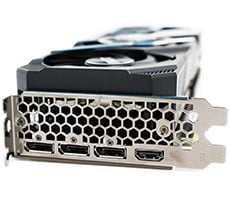
The retail package of the HIS X1650Pro IceQ Turbo Dual DL-DVI 256MB was similar to other HIS products we've evaluated. The card came with a brief User's Guide, "PowerUp, Gamers!" drivers CD and a complementary gaming DVD. The drivers CD came with ATI's Catalyst 6.7 drivers, so users will want to be sure and check ATI's site for the most current release. The HIS Bonus DVD 3.0 included a full version of Microsoft's Dungeon Siege and demos of such titles as Half-Life 2, RollerCoaster Tycoon 2 and more. HIS also included full versions of CyberLink PowerDirector 5 SE Plus, Power2Go 5 and Medi@Show 3, and trials of PowerDVD Copy, PowerBackup and other CyberLink products. Because the card features a double-wide cooler, HIS provides a perforated PCI slot cover to mate with to the card's custom cooling apparatus. Two DVI-to-VGA adapters are also offered for legacy support of older analog monitor connections. Lastly, an S-video cable was provided as well as an HDTV output cable for viewing video on a High-Definition Television. |
| HIS X1650Pro IceQ Turbo Dual DL-DVI 256MB | ||||
When we get down to brass tacks, the HIS X1650Pro IceQ Turbo Dual DL-DVI 256MB is essentially the same as an X1600XT with a higher GPU clock. Both cards are based on the RV530 core which is built on a 90nm fabrication process and comes equipped with 12 Pixel Shaders, 5 Vertex Shaders and a 128-Bit memory bus. Furthermore, both models support Shader Model 3.0, leaving the memory type and frequency as the only major differences between each model. The stock X1650 Pro comes with GDDR3 memory clocked at 700MHz (1.4GHz DDR) while the older X1600 Pro is outfitted with 400MHz DDR2 memory chips (800MHz). ATI's reference design specs the X1650 Pro's GPU speed at 600MHz, a full 100MHz faster than the X1600 Pro which runs at 500MHz. However, HIS took things a step further, and raised the GPU clock an additional 25MHz, to a default speed of 625MHz. We should note, however, that when the card was installed in our test system, we did find the clock speeds to be slightly lower than advertised. In actuality, the GPU runs at 621MHz while the GDDR3 memory was clocked at 688.5MHz (1.37GHz DDR). To keep the GPU temperatures in check, the HIS X1650 Pro comes with on of HIS' IceQ coolers. The IceQ cooler is an all aluminum design with an extremely quiet fan solution. The cooler is ported directly to outside air for maximum cooling, and it's also quieter than the stock reference cooler. As we mentioned earlier, the HIS X1650 Pro IceQ Turbo Dual DL-DVI 256MB comes with dual link DVI connections as well as a video out port for S-Video and HDTV out. The only thing "missing" is a CrossFire edge connector, but with this model, a dongle is not required. Lastly, HIS also offers the HIS X1650 Pro IceQ Turbo Dual DL-DVI in a 512MB version as well. |
| Test System & 3DMark06 v1.0.2 | ||||||||||||||
With its 121MHz and roughly 290MHz faster GPU and memory, the X1650 Pro holds a significant advantage over the X1600 Pro. The overall clock speed increase resulted in an increase of 35% in the default 3DMark06 test. THe Shader Model 2.0 test went up close to 40% and Shader Model 3.0/HDR 36%. Regardless, the GeForce 7600 GT outperformed both cards by a significant margin in all tests. |
| Performance Comparisons with Half Life 2: Lost Coast | ||||||
In this test, the X1650 Pro continued to outpace the X1600 Pro by a fair margin overall, but the GeForce 7600 GT was still the top performer. At 1024x768, the Geforce 7600 GT held a 22 FPS lead over the X1650 Pro, but as the resolution increased, the gap narrowed to 15 FPS at 1280x1024 and 10 FPS at 1600x1200. |
| Performance Comparisons with F.E.A.R | ||||||
With F.E.A.R.'s integrated benchmark, the GeForce 7600 GT managed to maintain its performance advantage over both RV530 based Radeons. The HIS X1650 Pro trailed the most at 1024x768, leaving a 16 FPS gap that dropped to 4 FPS at 1600x1200 resolution. |
| Performance Comparisons with Quake 4 | ||||||
With our custom Quake 4 timedemo, the HIS Radeon X1650 Pro pulled ahead of the X1600 Pro by a large margin, nearly equalling the X1600 Pro's 1024x768 results at 1600X1200. The GeForce 7600 GT still had a nominal performance advantage in all three resolutions, with 10 FPS at 1024x768 and 5 FPS at 1600x1200. |
| Performance Comparisons with Prey | ||||||
Once again, we see a familiar pattern with our Prey custom demo as we've reported in all previous tests thus far. The HIS X1650 Pro managed a healthy lead over the X1600 Pro thanks to its higher GPU clock and increased memory bandwidth, but the GeForce 7600 GT still ruled the roost with all three resolutions tested. |
| Overclocking the Radeon X1650 Pro | ||||
For our next set of performance metrics, we overclocked the Radeon X1650 Pro using ATI Tray Tools. Along with a manual option, this application can auto detect the highest stable GPU and Memory frequency by scanning for artifacts while slowly increasing the clock frequency. In the end, the peak GPU speed we could attain with our sample was 641MHz, an increase of 3.2%. The memory speed increased to 1450MHz DDR, 5.3% over the default clock speed. Next, we put these new gains to the test by re-running our custom Prey timedemo test again.
When comparing the overclocking results of the HIS X1650 Pro with its stock results, we registered a 6.27% increase at 1024x768. At 1280x1024, the gain increased to 11.52% while at 1600x1200, a boost of 4.5% was recorded. Across the board, the results were much closer to the GeForce 7600 GT but not enough to overtake it. |
| Performance Summary and Conclusion | ||||
Performance Summary: The HIS X1650 Pro IceQ Turbo performed as we expected it would. When compared to the ATI Radeon X1600 Pro, the HIS X1650 Pro showed measurable performance gains thanks to its higher-clocked GPU and faster GDDR3 memory. Higher clock speeds and increased memory bandwidth helped to narrow the lead of the GeForce 7600 GT as well, most notably at higher resolutions, but the GeForce 7600 GT was still the top performer in all tests.
We found the HIS X1650 Pro IceQ Turbo to be a decent step up when compared to the X1600 Pro, offering measurable performance gains in all tests. In fact, the card should be a slight improvement over the X1600 XT as well, which is virtually identical except for its lower 590MHz GPU clock. Another factor to consider it the HIS Radeon X1650 Pro's inability to overtake the GeForce 7600 GT in any test we threw at it. Using current street prices as a metric, the 7600 GT is the closest competitor to the HIS X1650 Pro, yet performance clearly leaned in favor of the GeForce 7600 GT, especially at lower resolutions. Once the resolution was increased, however, the HIS X1650 Pro scaled well. It took less of a performance hit than the GeForce 7600 GT, which helped it to narrow the NVIDIA card's lead significantly in most tests. Once we factor in cost, the MSI GeForce 7600GT, which also comes with an oversized cooler, weighs in at about $165 at a major online reseller. And many other 7600 GTs are available in the $150-160 range. The HIS X1650 Pro IceQ Turbo, on the other hand, came in slightly cheaper at about $145. We think the additional investment is worthwhile considering the 7600 GT's higher performance, however. If you can muster a few more dollars though, for roughly $199, you can get a CrossFire ready X1950 Pro graphics card with triple the number of Pixel Shaders and 8 Vertex shaders, which would bring with it a serious performance boost. Granted we've only seen one X1950 Pro offered for a price this low, but if you can afford to raise your budget, the added cost should pay handsome dividends in the end. And don't forget the GeForce 7600 GT is available for only a few more dollars. If you are on a strict budget without a penny to spare, and high resolution gaming is not a major priority, then the HIS X1650 Pro is a quality product that functions as advertised. But if you plan on gaming and want to run at higher resolutions, we strongly urge you to step up to something a bit more powerful. We give the HIS X1650Pro IceQ Turbo Dual DL-DVI 256MB GDDR3 PCIe a Hot Hardware Heat Meter rating of 7.
|