|
|
| Introduction, Specifications and Warranty Details | ||||||
|
Due to the fact that we're an on-line PC hardware enthusiast and technology news publication, the majority of our readers tend to be the do-it-yourself type that build their own custom systems. We cover the gamut of PC hardware, from high-end motherboards and graphics cards, to optical drives and speakers. And while we typically focus on the latest "hot" hardware here, we also like to diversify our content with mainstream hardware that has greater appeal to the masses as well. To that end, we've begun evaluating full production systems in addition to individual components here at HotHardware.com. We may be a team of DIY enthusiasts, but we know there are many of you out there that have a fondness for hardware and are not necessarily inclined to building your own rig. In fact, we often get questions via e-mail or through our forums from users with questions about how to configure a retail system they are contemplating, in an effort ensure it is outfitted with the best hardware they can afford. Our full system evaluations are for you. In this article we'll be taking a look at gaming rig from Systemax dubbed the "Wildcat". Actually, its full name is the Wildcat AMD Athlon 64 FX-60 SLI Gaming PC, but for the sake of brevity and our sanity we will refer to the system as the "Wildcat" for the remainder of this article. Some of you may remember Systemax as a budget and workstation-class PC builder, but rest assured, times have definitely changed. Currently, Systemax boasts a complete line-up of workstation and gaming PCs designed to fit virtually any budget. Furthermore, most models can be custom configured to suit each buyer's individual needs. As you can see in the specifications below, the "Wildcat" comes equipped with serious high-end components for the equally serious gamer. The Wildcat is loaded to the gills with performance equipment that's designed to deliver a solid gaming experience. In the pages ahead, we'll assess the "Wildcat" from an "Out-of-Box" perspective and compare it to a slew of comparable systems to see if it truly is as wild as its name implies.
When reviewing the specs above, you'll see that the "Wildcat" comes fully-loaded. Sporting 2GB of PC-3200 DDR memory, a dual-core Athlon 64 FX-60 processor, dual 512MB GeForce 7900GTX graphics cards in SLI mode, and a pair of 150GB Western Digital Raptors configured in RAID 0, this gaming PC has all the makings of a speed demon. Topping off the specifications is an Ageia PhysX Accelerator for enhanced physics effects in supported titles, while a Saitek Eclipse Illuminated Keyboard and Razer Copperhead mouse are included for better visibility and control. Please note that the Systemax Wildcat AMD Athlon 64 FX-60 SLI Gaming PC comes with a One Year Limited Warranty and a One Year On-Site Service Agreement. Additionally, Systemax offers a Toll Free support line with free support for in-warranty items. For out-of-warranty products a per incident charge of $39.95 per 30 minutes is offered. Gaining access to a support representative takes a bit of navigation through a call center menu, but each time we tried, a support agent picked up in approximately 4 minutes or less. |
| Systemax Wildcat - Up Close and Personal | ||||
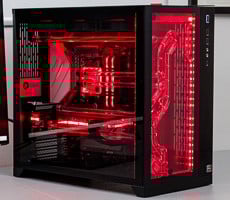
The Systemax ATX gaming case that houses the Wildcat's components is clean and attractive. The front bezel has a door to mask the front components while the side window panel offers a view into the Wildcat's interior. When the front door of the bezel is accessed, two DVD drives are revealed as well as a floppy drive. In the bay below the DVD drives is a switch that controls two blue cathodes. One minor issue is the switch operates in reverse of typical lighting, toggling the switch down powers the lights on while toggling up turns them off. On the front right side of the case are several convenient inputs/outputs such as two USB ports, one FireWire port, and Microphone and Headphone jacks. Also note the three 80mm case fans that are dedicated to cooling the Wildcat's side mounted internal hard drives while a fourth is added to the window of the case. The rear of the Wildcat reveals the unit's remaining inputs/outputs as well as other options. This is where we get our first glimpse of the Ultra X2 Connect 550w PSU as well as the beefy 120mm illuminated chassis fan. The ATX connections are all common fare, including four USB 2.0 ports, integrated 8.1 channel Audio, PS/2 and LPT1 ports and Dual Gigabit RJ-45 ports. One uncommon item in the port collection is an eSATA port for easily connecting an external SATA drive. When we say this machine is blue, we mean it -- very literally. Not only is the case blue, but all of the fans, the keyboard, the mouse and the cathodes emit the same blue color. While difficult to capture in pictures, the example images above give a good idea of how the system can bathe a room in cool blue light. |
| Systemax Wildcat - Interior Layout & Design | ||||
Removing the windowed side panel of the Wildcat provides a clearer picture of the unit's innards. The first thing that caught our attention was the cable management of the Wildcat. Systemax made an attempt to keep cable clutter under control, but did not make any efforts to beautify the overall presentation. This isn't to say the effort wasn't there, it was on a functional level, keeping cable clutter in check for the best airflow. However, from an aesthetics point of view, a better job could have been done. Built on an Asus A8N32-SLI gaming motherboard, the Wildcat is powered by an Athon 64 FX-60 dual core processor coupled with 2GB of Corsair XMS PC3200 memory sporting activity lights on the spine of each DIMM. Focusing on visuals, Systemax equipped the Wildcat with dual 512MB GeForce 7900 GTXs in SLI mode as well as throwing in an Ageia PhysX accelerator card with 128MB of GDDR3 memory. Storage requirements are handled by two Western Digital 150GB Raptors running at 10,000 RPMs in a RAID 0 configuration. Additionally, a 400GB Seagate Barracuda is installed as well, bringing the Wildcat's overall storage capacity to 700GB. Rounding out the storage features, the Wildcat also comes with a standard Floppy Drive and dual optical drives. The first optical drive is a Sony DW-Q120A 16X Dual Layer DVD +/-R/RW while the second optical drive is a Sony CRX320EE 52x32x52/16X Combo which offers DVD playback and CD burning capability. The UltraX2 550w PSU sports a modular design that really helps to keep excess cabling in check. In fact, there were no unused cables in the case, thanks in part to the UltraX2's design of only connecting what is needed. The package also includes plenty of extra cabling for future power needs. The PSU's mirrored finish was a solid touch that enhanced the look and feel of the Wildcat. |
| Saitek Eclipse Illuminated Keyboard & Razer Copperhead | ||||
Rounding out the Wildcat's feature set is the keyboard and mouse Systemax opted to team with their big blue gaming machine. For keyboarding needs, Systemax provided a Saitek Eclipse Illuminated USB Keyboard. The Eclipse is self contained, needing no additional drivers to function, making it a truly plug and play device. The keyboard's tactile feedback was just right, not too soft but not too hard. An add on wrist rest could be attached to the front of the keyboard as well, adding proper wrist support for those countless hours of gaming on the Wildcat. At the upper right of the tray was a dimmer switch that toggled a cool blue from off, low and high settings. As seen below, the illumination was crisp and will help when gaming in the dark, avoiding the need to search for a needed key when you are in the thick of the action. Rounding out the package is the Razer Copperhead gaming mouse that brings its own flavor of blue to the mix. The device has a comfortable feel along with a full array of side mounted buttons to get that added advantage in gaming situations. This too is a simple plug and play USB device, but in order to tap the full potential of the mouse, you'll need to install Razer's custom drivers. Once installed, the mouse options can be controlled for a myriad of combinations. The Copperhead's precision can be tweaked from 400 DPI to a whopping 2000 DPI in 400 DPI increments while the polling rate ranged from 125Hz, 500Hz, and 1000Hz. Razer also allows for custom configurations to be saved to a total of five separate profiles. We should also note that DPI can be adjust on the fly, with two buttons mounted on the right side of the mouse, making the Copperhead an extremely versatile and precise pointing device that will be useful in gaming as well as other situations, such as photo editing. |
| System BIOS and HH Testbeds | ||||||||||||||
When it comes to testing pre-configured PCs, we focus on the Out-of-Box experience. That was we can accurately explain what an end-user is going to experience when they unpack the system, plug it in and start gaming, working or doing whatever they want. Another item we assess is the system's added features, such as BIOS options, performance settings and overclocking options. Under that Advanced menu we found the Jumper Free Configuration section, which was home to many of the performance-related options of the Wildcat's BIOS. Here we could set ASUS' AI overclocking to dynamically adjust clock speeds, or follow a set of profiles that ranged from 1, 3, 5, 8, or 10% increases, or each item could be altered manually. CPU frequency was adjustable from 200-500MHz in 1MHz increments while PCIe Frequency ranged from 100MHz to 200MHz in 1MHz increments as well. Voltage options were more restrictive, with a simple Enable/Disable option. Enabling CPU Over-Voltage added and offset of 200mV to VCORE while NB VCORE was upped to 1.3v and SB VCORE to 1.6v. The Over-Voltage option for the HyperTransport raised from 1.2v or 1.3v while DDR voltage offered a full range of settings from 2.6v though 3.2v in .05 increments. Enabling FID/VID Change unveiled Processor Frequency Multiplier settings of 6x-25x in .5x steps. CPU voltage settings were broad and precise ranging from 1v - 1.5625v in .0125v increments. The CPU Configuration screen offered a view of the CPU's current configuration including Speed, L1 and L2 cache complements, Multiplier and core revision. Additionally, a Memory Settings sub menu offered advanced memory options for performance tweaking. The memory speed could be configured automatically or manually set from 100MHz - 250MHz in 33MHz increments. Timing options were also available with CAS Latency ranging from 2, 3, 1.5 and 2.5 as well as a whole host of advance features too numerous to list. Rounding out the BIOS features is a Hardware Monitor that reported CPU and Motherboard temperatures, CPU fan speeds and operating voltages.
To give a complete picture of how the Systemax Wildcat performed, we compared our benchmark results to a host of other systems in its performance class. Performance data was compiled from several recent reviews in an effort to paint a clear performance picture. Every effort was made to configure each system as closely as possible, however, variation in driver versions and other hardware differences should be considered when making comparison. With commercially available systems such as the Systemax Wildcat and Voodoo Omen, testing was performed with systems as they came configured from the manufacturer.
|
| Futuremark PCMark05 | |||||
"The CPU test suite is a collection of tests that are run to isolate the performance of the CPU. The CPU Test Suite also includes multithreading: two of the test scenarios are run multithreaded; the other including two simultaneous tests and the other running four tests simultaneously. The remaining six tests are run single threaded. Operations include, File Compression/Decompression, Encryption/Decryption, Image Decompression, and Audio Compression" - Courtesy FutureMark Corp.
In PCMark05's CPU performance module, the Wildcat was neither the fastest nor slowest of the bunch. In the end, the Wildcat ranked fifth, topped by the two Intel based reference systems, our custom testbed with an Athlon FX-60 and the Voodoo Omen clocked at 2.95GHz. The closest match is the Athlon 64 FX-60 reference system which topped the Wildcat by a mere 103 points.
"The Memory test suite is a collection of tests that isolate the performance of the memory subsystem. The memory subsystem consists of various devices on the PC. This includes the main memory, the CPU internal cache (known as the L1 cache) and the external cache (known as the L2 cache). As it is difficult to find applications that only stress the memory, we explicitly developed a set of tests geared for this purpose. The tests are written in C++ and assembly. They include: Reading data blocks from memory, Writing data blocks to memory performing copy operations on data blocks, random access to data items and latency testing." - Courtesy FutureMark Corp.
In regard to memory performance, the Systemax Wildcat ranked fifth, being out gunned by both Intel test beds as well as the Voodoo Omen, and our Athlon 64 FX-60 reference system which held a 156 point lead over the Wildcat. The next closest match was the Athlon 64 X2 4800+, which also shared the same motherboard and memory complement as the Wildcat, trailing by 72 points. |
| WorldBench 5.0: Office XP SP2 & Photoshop 7 Modules | ||||
|
With WorldBench 5.0, we run a series of pre-configured scripts that we believe gives a well rounded view of system performance. The tests we focus on are Office XP SP2, Photoshop 7, 3D Studio Max and multiprocessing tests with Windows Media Encoder 9 and Mozilla.
Below we have the results from our first tests, WorldBench 5's Office XP SP2 and Photoshop 7 modules, which are recorded in seconds. Lower times indicate better performance here, so the shorter the bar the better.
With the Office XP SP2 module, the Systemax Wildcat performed on par with our reference system running the same Athlon 64 FX-60 processor. To be more specific, the Systemax Wildcat lagged behind our in-house test bed by only 3 seconds. The Wildcat clearly outperformed the Pentium EE 965 and Athlon 64 X2 4800+ based systems, however.
With World Bench 5's Photoshop 7 module, we saw a similar trend to the Office XP SP2 testing. In this case, the Systemax Wildcat trailed our Athlon 64 FX-60 reference system by 7 seconds while topping the Athlon 64 X2 4800+ by 9 seconds. |
| WorldBench 5.0: 3ds Max, WME 9 & Mozilla Multi-Tasking | ||||||||
|
We continued our testing of the Systemax Wildcat with a few more tests that are part of the Worldbench 5.0 suite...
With 3D Studio Max, we continued to see the Systemax Wildcat compete on-par with our Athlon 64 X2 4800+ reference system, and managed to top the Pentium Extreme Edition 965 test system. Our reference Athlon 64 FX-60 based system completed the test 14 seconds quicker than the Wildcat, however, which can likely be attributed to slight differences in the systems' configurations.
We continued our testing, this time with Multi-Tasking being the focus. In this test, a video is encoded using Windows Media Encoder while an instance of the Mozilla browser is running and navigating through various cached HTML pages. Because the system is multi-tasking with two different applications, this test is more taxing on the system overall.
Multi-tasking performance was again on the same level as our Athlon 64 X2 4800+, although the 4800+ did complete this test two seconds faster overall. Our test bed running the Athlon 64 FX-60 weighed in a full 24 seconds faster than the Systemax Wildcat though. Clearly something was holding the system back in its "out-of-box" configuration, and its performance suffered in these past two tests because of it. |
| LAME MT MP3 Encoding Test | ||||
|
In our custom LAME MT MP3 encoding test, we convert a large WAV file to the MP3 format, which is a very popular scenario. In this test, we created our own 223MB WAV file (a never-ending Grateful Dead jam) and converted it to MP3 format using the multi-thread capable LAME MT application in single and multi-thread modes.
Processing times are recorded below. Once again, shorter times equate to better performance.
With our custom LAME MT benchmark the Wildcat's performance matched our in-house Athlon 64 FX-60 test bed exactly. The fastest of the systems was the Core 2 Duo E6700 while the Athlon 64 X2 4800+ came in as the slowest. |
| Kribibench v1.1 | ||||
|
For this next batch of tests, we ran Kribibench v1.1, a 3D rendering benchmark produced by the folks at Adept Development.
Kribibench is an SSE aware software renderer. A 3D model is rendered and animated by the host CPU and the average frame rate is reported. We used two of the included models with this benchmark: a "Sponge Explode" model consisting of over 19.2 million polygons and an enormous "Ultra" model that is comprised of over 16 billion polygons.
With both the Sponge Explode and Ultra models, the Systemax Wildcat trailed our Athlon 64 FX-60 system by .4 FPS at most. In the Sponge Explode test, the Athlon 64 X2 4800+ nudged past the Wildcat, but in the Ultra model, the Wildcat regained a slight lead. |
| Cinebench 2003 Performance Tests | ||||
|
The Cinebench 2003 benchmark is an OpenGL 3D rendering performance test, based on the commercially available Cinema 4D application.
This is a multi-threaded, multi-processor aware benchmark that renders a single 3D scene and tracks the length of the entire process. The time it took each test system to render the entire scene is represented in the graph below (listed in seconds).
Like we saw with Lame MT testing, our Reference Athlon FX-60 test bed and the Systemax Wildcat performed on the same level, with only minor differences in their overall scores. The fastest AMD system was the Voodoo Omen which runs an overclocked Athlon 64 FX-60 at 2.95GHz. The best performer overall is the newly released Core 2 Duo E6700 from Intel which easily beat all systems in this test. |
| Futuremark 3DMark06 | ||||
3DMark06's default test is a multi-threaded "gaming related" DirectX metric that's useful for comparing relative performance between similarly equipped systems. This test consists of different 3D scenes that are generated with a software and hardware GPU renderers, which are also dependant on the host CPU's performance. In its CPU tests, the calculations normally reserved for your 3D accelerator are instead sent to the central processor. GPU rendering tests employ a mix of SM2.0, SM3.0 and HDR techniques and effects.
The Systemax Wildcat returned the best scores of the AMD based systems, save for the overclocked Voodoo Omen. Compared to the Athlon 64 FX-60 test machine, the Wildcat came in 81 points higher. |
| Performance Comparisons with Quake 4 and F.E.A.R. | ||||||||||||
In our custom Quake 4 benchmark, the Voodoo Omen using Radeon 1900 XTs in Crossfire mode trailed the Systemax Wildcat by 24 FPS. Our custom Athlon 64 FX-60 test bed running GeForce 7900 GTXs in SLI mode also trailed the Wildcat, although by a lower margin of 4.5 FPS. Most notable was the Core 2 Duo E6700 Performance which was only slightly faster than the Systemax Wildcat, leading by 1.3 FPS overall.
We wrap up our benchmarks with F.E.A.R., where the results were relatively even when comparing the various hardware configurations. In this case, the Systemax Wildcat ranked third behind our Athlon 64 FX-60 SLI based system, by 3 FPS, and the Core 2 Duo E6700 SLI test bed, by 13 FPS. Neither of the ATI powered FX-60 based machines came close to the Wildcat in this test, however. |
| Performance Analysis and Conclusion | ||||
|
Benchmark And Performance Analysis: Overall, the performance of the Systemax Wildcat tracked closely to our in-house Athlon 64 FX-60 reference system. In most tests the two systems went back and forth, trading slight leads over the other depending on the particular application. We did see lower than expected performance with WorldBench 5's 3DStudio Max and WME multi-tasking tests, but the Wildcat made a good showing in the synthetic and game related tests. In benchmarks like Quake 4 and FEAR, the Wildcat managed to beat out the CrossFire-based Voodoo Omen PC which was clock at 2.95GHz and even gave the new Core 2 Duo E6700 a run for its money.
Systemax delivered a solid gaming system in the Wildcat AMD Athlon 64 FX-60 SLI Gaming PC. In most of our tests, the Wildcat offered comparable performance to other systems in its class. We did see a fair amount of give and take in each test scenario, but the deltas could be attributed to differences in each system's hardware and software configurations. The Wildcat performed well right out of the box, and we had no stability issues to speak of whatsoever. We do have a few gripes with the Wildcat in regard to its cable management and its inverted cathode switch, however. And we'd also like to see Systemax incorporate some fan filters to help keep the system's internal components clean, but these are relatively minor issues. Nonetheless, we found the Wildcat AMD Athlon 64 FX-60 SLI Gaming PC to be a competent gaming rig that offers solid performance along with excellent features and room for future expansion. Selling at major retailers such as TigerDirect, Office Depot and CompUSA to name a few, the Systemax Wildcat as you've seen it here is available for the starting price of $4499.00. If you purchased all of the same components and software licenses yourself, the parts come to roughly $3800 as of today, so it seems Systemax's labor, technical support, and warranty services cost consumers roughly $700. Some retailers do offer custom configurations as well, so hardware specifications and pricing may vary. However, for the price, those looking for a pre-built gaming rig should find that the Systemax Wildcat AMD Athlon 64 FX-60 SLI Gaming PC strikes a good balance between looks, function and quality. We give the Systemax Wildcat AMD Athlon 64 FX-60 SLI Gaming PC a HotHardware Heat Meter Rating of 8...
Discuss The Article In HotHardware's PC Hardware Forum Right Now!
|