|
|
| Intro, Specs & Related Info | ||||
Those rumors were, of course, unwarranted and simply the result of a major force in the industry hitting a few speed bumps during the development of a new, very complex product. In meetings and in conversations with representatives from ATI during the R520's development, we never got the impression that the company was desperate. Frustrated and disappointed sometimes, yes. But certainly not desperate. And during the X1K launch event, and subsequent discussion since then, we got the impression ATI was supremely confident. Which was surprising, considering the problems the company had to contend with during the second half of last year. Today though, we know why. This morning, less than four months since the introduction of the R520, ATI is unveiling a new GPU and four new products based upon that GPU, the Radeon X1900 XTX, the X1900 XT, an All-In-Wonder Radeon X1900 and an X1900 CrossFire Master card. The Radeon X1900 GPU was code-named R580 during its development. It is very similar to the R520 used on the Radeon X1800 XT, but with a couple of major changes. Specifically a threefold increase in the number of pixel shader processors, and some updates that'll increase performance at ultra-high resolutions and with a certain type of soft shadow. We'll go into more detail on the pages ahead.
There is a myriad of information related to the launch of the Radeon X1900 available on our site that will help you get familiar with the GPU's architecture and key features. The Radeon X1900 has a number of features in common with other cards in the Radeon X1K family of products, and we've detailed the features of the Radeon Xpress 200 chipset and CrossFire in a few past articles as well.
At a minimum, if you haven't already done so, we recommend reading our CrossFire Multi-GPU technology preview, the Radeon Xpress 200 preview, the X1K family review, and the Radeon X1800 CrossFire evaluation. In those four articles, we cover the vast majority of the features offered by the Radeon X1900. There is quite a bit of background information in those articles that laid the foundation for what we're going to showcase here today. |
| The Radeon X1900 Family |
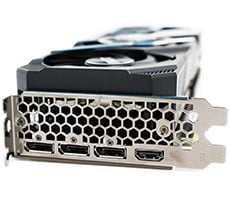
As we mentioned earlier, ATI is releasing four Radeon X1900 cards today. Pictured below are the new flagship Radeon X1900 XTX and a Radeon X1900 CrossFire Master card. A lower clocked Radeon X1900 XT and an All-In-Wonder Radeon X1900 256MB card are being introduced as well, but they haven't arrived in the lab just yet. The XT looks just like the XTX, though, and the All-In-Wonder X1900 is a dead-ringer, at least physically, for the AIW X1800 XL reviewed here.
The card pictured here is a 512MB Radeon X1900 XTX (MSRP $649). At its heart is an R580 GPU comprised of approximately 380 million transistors, built using a .09 micron manufacturing process. The GPU on this card is equipped with 48-pixel shader processors, 8-vertex shader processors, and a 256-bit 8-channel GDDR3/GDDR4 memory interface. The internal Ring Bus memory controller is 512-bits, however. The Radeon X1900 XTX's core is clocked at an impressive 650MHz and its memory is running at a robust 1.55GHz. To sustain these high clock speeds, the Radeon X1900 XTX sports the same beefy dual-slot cooler used on the Radeon X1800 XT. The PCB is much larger than X800 series Radeons, and this card is equipped with Volterra's multi-phase voltage regulator chipset (under the thin, red heatsink). The lower clocked Radeon X1900 XT (625MHz / 1.45GHz) will look similar, but will be priced initially with an MSRP of $549. We were curious to see how large the Radeon X1900 GPU really was after hearing that the core is composed of over 380 million transistors, so we popped the heatsink off of the Radeon X1900 Master Card to take a closer look. Using a trusty old ruler, we found the Radeon X1900 GPU to be roughly 18.5mm x 18.5mm, or 342mm2. Conversely, a GeForce 7800 GTX, which is built on TSMC's .11 micron line, is a bit larger. We measured a GeForce 7800 GTX (G70) at approximately 19mm x 18.5mm, or 351.5mm2. And we found an X1800 to be roughly 288mm2. If yields at TSMC are good, it could be more cost efficient for ATI to produce X1900s than it is for NVIDIA to currently make the GTX, which could push street prices down in time. Then again, packing 512MB of 1.55GHz GDDR3 RAM on a flagship card won't be cheap for the foreseeable future. NVIDIA also has plans to shrink the G70 down using a 90nm process, which would then give NVIDIA a significant edge. The Radeon X1900 Master Card looks very similar to the X1900 XTX on the surface. The GPU on our X1900 Master Edition card was clocked at 625MHz and its memory was clocked at 720MHz (1440MHz DDR), just shy of the 650MHz / 1550MHz of the Radeon X1900 XTX. The aproximate 100MHz memory clock disparity should have a relatively small effect on performance, so we won't dwell on it here. And CrossFire doesn't require a matched-pair of video cards to function, so the difference in memory clock speed shouldn't pose a compatibility problem either. The ATI Radeon X1900 CrossFire Edition
To bring CrossFire to the X1900, ATI used the same compositing engine introduced on the X1800. The second generation compositing engine used on the X1900, is similar but superior to the one used on the older Radeon X850 XT Master cards. If you remember, because X850 cards were equipped with single-link DVI outputs, X850 CrossFire was limited to a max resolution of 1600x1200 with a lowly refresh rate of 60Hz. Graphics cards in the X1K family of products are equipped with dual-link DVI outputs, however. Having dual-link DVI outputs means more bandwidth, which the new compositing engine capitalizes on to offer higher-resolutions than the first generation CrossFire implementation. The compositing engine on the Radeon X1900 XT CrossFire Edition Master card consists of a handful of chips. The biggest chip in the group, in the middle of the picture, is a Xilinx Spartan XC3S400 FPGA. The XC3S400 is a more capable FPGA (Field Programmable Gate Array) than the one ATI used to enable CrossFire on the X850 XT. The XC3S400 is the chip that's programmed to do the actual compositing work. In total, this chip has ~ 400K logic gates, which is fairly low-end by today's standards for an FPGA. And at a cost below $7, the overall retail price point of the board isn't affected too adversely. We should note that it's upgradeable via firmware as well, so ATI could theoretically incorporate more features into X1900 CrossFire moving forward. To the left of the Xilinx FPGA is the flash ROM chip, that actually contains the necessary programming and configuration code.
As you can see, although the Radeon X1900 has 48 pixel shader processors, it's raw pixel fillrate is only marginally higher than an X1800 XT, because it has the same number of ROPs (Raster Operation units) and texture units -- 16. The X1900 XTX's faster memory and core, should give it an advantage over the X1800 XT though, even when the 48 pixel shader processors aren't being fully utilized. |
| Architectural Details |
The Radeon X1900 (R580) is architecturally very similar to the Radeon X1800 (R520), so we recommend perusing this article for a more comprehensive look at the features common to both GPUs, like the 512-bit Ring Bus Memory Controller, Shader Model 3.0 support and AVIVO.
This high level architectural block diagram above highlights the main feature of the Radeon X1900 -- its 48 pixel shader processors. Unlike the Radeon X1800 which has 16 pixel shader processors, and the GeForce 7800 GTX which has 24, the Radeon X1900 has a full 48 pixel shader processors in the first stage of the 3D pipeline. With the R520, ATI de-coupled the individual stages in the 3D pipeline, which gave them the ability to have an asymmetrical number of pixel shader processors and ROPs, or "Render Backends". So basically, what ATI did with the R580, was take the existing R520 architecture and tripled the number of pixel shader processors in the first stage of the pipeline. But the rest of the chip is largely unchanged. The R580 still has the same 8 vertex shaders, 16 texture units, 16 ROPs, and the same memory controller. The large number of pixel shader processors gives the X1900 a ton of resources for executing pixel shader code, but the in situations where pixel shading is not a limiting factor in performance, the X1900 should perform similarly to the X1800 XT. Just about every new gaming title and many titles released over the last couple of years, make use of pixel shaders however, so the additional 60 million transistors used on the X1900 to increase the number of shader processors should certainly be put to good use, especially with newer gaming titles that make heavy use of longer, more complex shaders.
The pixel shader processors are grouped together in quads. The Radeon X1900 has twelve of these quads for executing pixel shader code. The components of each quad and their respective computational capabilities are outlined above. Over an above the number of pixel shader processors, ATI had made a couple of other advancements with the R580 as well. We'll talk about those changes next. |
| More On The Architecture |
You can't read about a new game these days, without hearing about the quality of the shadows produced by its engine. Doom 3 and Quake 4 immediately come to mind, as two games that make heavy use of shadows to produce a realistic looking game world. A widely used method for producing shadows is shadow mapping. This technique of rendering shadows works by first rendering the scene from the point of view of a light source. The results are not displayed, but instead stored in a special shadow map texture where each value represents the distance of the nearest object to the light source. The scene is then rendered from the gamer's viewpoint, and each pixel is checked against the shadow map to determine if there are any objects between it and the light source. If an object falls within the shadow map, the pixel is in shadow and will be darkened, otherwise it is lit normally. Basic shadow maps typically create hard-edged shadows, which isn't very realistic. In the real world, shadows usually have much softer edges. To create soft shadows in games, the shadow map is usually filtered in some way. The filtering can be done by taking X number of samples, and then combining them in a pixel shader. Generally, the more samples used, the better the resulting soft shadows. Doing this requires a large number of texture lookups, however, which can hurt performance.
To speed up the texture lookups necessary for using this technique for soft shadows, the Radeon X1900 includes a new texture sampling feature called Fetch4. It works by exploiting the fact that most textures are composed of color values, each with four components (Red, Green, Blue, and Alpha or transparency). The texture units are designed to sample and filter all four components from one texture address simultaneously. However, when looking up different types of textures with single-component values (such as shadow maps), Fetch4 instead allows four values from adjacent addresses to be sampled simultaneously. This effectively increases the texture sampling rate by a factor of 4. To exploit the Fetch4 feature though, specific code needs to be used in the game engine. Another enhancement made to the R580 should help with performance at ultra high resolutions, think 1920x1200 and above. All Radeon GPUs support a Hierarchical Z feature, that works by detecting and eliminating pixels that will be hidden in the final rendered image, and discarding them before any further pixel processing takes place. To function though, this feature requires high speed on-chip memory, or a buffer, and this memory is often of a limited size. Rendering at resolutions higher than this integrated buffer was designed to support can reduce the effectiveness of Hierarchical Z. The Radeon X1900 incorporates 50% more on-chip memory for Hierarchical Z than the Radeon X1800. This means that its performance should not drop off as dramatically at very high resolutions. |
| AVIVO: Video Performance | |||||||||||||
We've written specifically about the AVIVO video engine incorporated into ATI's new X1K family of products in a couple of articles before (here and here), so we won't go into the specifics again. We will however, re-evaluate its performance using an X1900 and ATI's latest software suite. When the X1800 launched, the AVIVO video engine wasn't being fully exploited. With the X1900 however, that is not the case.
For our first test, we used the HQV DVD video benchmark from Silicon Optics. HQV is comprised of a sampling of video clips and test patterns that have been specifically designed to evaluate a variety of interlaced video signal processing tasks, including decoding, de-interlacing, motion correction, noise reduction, film cadence detection, and detail enhancement. As each clip is played, the viewer is required to "score" the image based on a predetermined set of criteria. The numbers listed below are the sum of the scores for each section. We played the HQV DVD using the latest version of NVIDIA's PureVideo Decoder on the GeForce 7800 GT, and as recommended by ATI, we played the DVD on the X1900 using Intervideo's WinDVD 7 Platinum, with hardware acceleration enabled.
When the X1K family of products first hit store shelves, their score in this benchmark was below 40 points. With the latest set of Catalyst drivers though, video playback quality is vastly improved. The biggest boost to ATI's score comes by way of the eight individual film cadence test and the noise reduction tests. For playing back DVDs, or similar digital video files, ATI's X1K family of cards are the products to beat.
Microsoft's Windows Media Video 9 (WMV9) HD format was accepted by the SMPTE HD-DVD consortium as a new HD format. The Windows Movie Maker software, which comes bundled with Windows XP, makes it easy for consumers to edit and save their favorite videos. These videos are saved in the .WMV format. Most of today's high-end GPUs include dedicated hardware to accelerate the playback of WMV and WMV-HD content for fluid full frame rate video even on systems with entry-to mid level CPUs. Previous generations of GPUs were not able to support WMV9 decode acceleration, so often times HD WMV9 content would drop frames when being played back on legacy hardware. To document CPU utilization when playing back WMV HD content, we used the performance monitor built into Windows XP. Using the data provided by performance monitor, we created a log file that sampled the percent of CPU utilization every second, while playing back the 1080p versions of the "MP10 Digital Life" video available on Microsoft's WMVHD site. The data was then imported into Excel to create the graphs below. The graphs shows the CPU utilization for a GeForce 7800 GTX and a Radeon X1900 XTX using Windows Media Player 10, patched using the DXVA update posted on Microsoft's web site (Update Available Here).
With this particular video, ATI had a slight advantage in CPU utilization. The new Radeon X1900 XTX used just over 39% of our CPU's resources, while the GTX peaked at just a hair over 40%. Neither card had any trouble playing this video, and we didn't witness any dropped frames. We should note that CPU utilization will vary depending on the video being played back. Had we chosen a different video, NVIDIA could have come out on top here. The Radeon X1900 XTX and the rest of the X1K family are also capable of accelerating H.264 and VC1 video as well. This will be very important once Blu-Ray and HD DVD discs hit sometime this year. NVIDIA currently doesn't have this ability, but a future driver update should expose this feature in the PureVideo engine. |
| AA Image Quality Analysis | ||||||||||||||||||||||||||||
Prior to benchmarking the new Radeon X1900, we spent some time analyzing its in-game image quality versus a GeForce 7800 GTX. First, we used the "background 1" map in Half-Life 2 to get a feel for how each card's anti-aliasing algorithm's affected the scene.
In this first batch of screenshots, 16X anisotropic filtering was enabled in conjunction with the various levels of anti-aliasing offered by each card. As you can see, the "No AA" screen shots look quite similar on both cards, as do the 2X AA screen shots. In the 4X AA screen shots though, you can pick out some subtle differences. The cables at the top of the screen are softer and more realistic looking on the X1900, but the tree loses some detail. In contrast, NVIDIA seems to do a better job with the antennas on the top of the buildings. The ATI 6XAA vs. NVIDIA 8xS AA shots reveal similar differences, with NVIDIA having a clear edge in detail, especially in the trees where ATI's multi-sample only algorithm has minimal impact.
In this next batch of screen shots, our goal is to compare NVIDIA's and ATI's various single-card anti-aliasing modes when used in conjunction with each company's transparency or adaptive AA techniques. Please note that we used NVIDIA's super-sample transparency AA here, as we've been unable to find a clear in-game example where MSTAA has a measurable impact on image quality.
As you browse through each progressing level of AA, you'll see a similar trend to the images above. As the AA level increases, visible jagged edges are decreased. In these specific tests, NVIDIA clearly has an advantage, because fine detail just seems to disappear on the Radeon X1900. Hopefully a future driver update will resolve this issue on the Radeon X1900. |
| CrossFire AA Performance | |||||||||||||||||||
Here we have yet another set of screen shots for your inspection. In this batch of images, we want to compare NVIDIA's and ATI's dual-GPU anti-aliasing techniques. NVIDIA calls it SLIAA and ATI SuperAA. These modes are only enabled when using a pair of cards together, either in SLI or CrossFire modes, because each card renders the same frame before they are blended together. For more details on these anti-aliasing modes, take a look at this article on SLIAA and this one outlining the new features introduced with ATI's CrossFire.
There are three portions of the screen to focus on these screen shots - the cables, the tree, and the scaffolding under the bridge in the distance. Our favorite modes would unquestionably be ATI's 10X and 14X SuperAA modes because they do an excellent job in eliminating jaggies in the cables and preserving fine detail under the bridge, but the trees lose more and more detail as the level of AA is increased. We didn't perform a comprehensive test routine to assess the performance of all of ATI's CrossFire SuperAA modes with the X1900, but we did run a couple of tests to get a general idea as to how the various modes perform. The new revision of the compositing engine introduced on the X1800 XT Master Card, and used on the X1900, offers higher-performance in SuperAA modes than the engine used on the X850 XT, because the compositing engine can do the final blend with each individual card running at full speed.
As you can clearly see, as the level of anti-aliasing is increased NVIDIA's SLIAA has a much more dramatic effect on performance. SLI16X AA is playable in both games at 1280x1024, but ATI's 14X AA offers much better frame rates. Basically, if a single Radeon X1900 XT is capable of playable frame rates in a game with a certain level of anti-aliasing, adding a master card and running in CrossFire mode will offer the same frame rates with virtually double the amount of anti-aliasing applied to the scene.
As a final treat for the image quality fanatics among you, we snapped off two final screen shots with each platform configured for the best image quality. On our GeForce 7800 GTX SLI rig, we enabled 16X SLIAA, transparency anti-aliasing, and maxed out the anisotropic filtering. On the X1900 CrossFire rid we enabled 14X SuperAA with high quality adaptive anti-aliasing and high quality 16X anisotropic filtering. The SLI rig has the best fine detail under the bridge, and in the trees, but ATI does a better job with the aniso. Look at the sloping hill to the right and you'll see what we mean. Believe it or not, both platforms produced very good frame rates in Half Life 2 at these settings and resolution too. The CrossFire rig could run the game at 1280x1024 with these "ultra high quality" settings at over 125 FPS, whereas the SLI rig's performance hovered around 85 FPS. |
| Anisotropic Filtering Quality | |||||||||||||||||||
With this next set of screen shots, we followed a similar procedure outlined on the two previous pages to evaluate the effect of the ATI's new anisotropic filtering techniques on a given scene. The screen shots below are from Half-Life 2's "background 4" map. We've again compared similar settings using the GeForce 7800 GTX and a Radeon X1900 XTX. For this set of screen shots, anti-aliasing was disabled to isolate the effect each card's respective anisotropic filtering algorithms altered the images.
When perusing the images above, pay special attention to the road and the hill to the lower right, as these areas are where anisotropic filtering has the most impact. In the "No Aniso" shots at the top, which have only trilinear filtering enabled, the blurring in the road and on the hill is clearly evident. |
| Anisotropic Filtering Performance | ||||
When testing the performance of ATI's different Super-AA modes a couple of pages back, we stepped through each successive level of AA while benchmarking FarCry and Half Life 2 at a resolution of 1280x1024. The results on this page were attained using a similar methodology, but we altered the level of anisotropic filtering being applied to the images instead and used FarCry and F.E.A.R running at a much higher resolution. Anti-aliasing was disabled throughout this batch of tests to isolate the effect anisotropic filtering alone was having on performance.
As we demonstrated on the previous page, ATI's high-quality anisotropic filtering modes offer arguably the best anisotropic filtering available in a consumer level graphics card. And the performance data on this page shows that there is virtually no reason to have it disabled and use the lower quality setting. ATI's high-quality aniso modes perform just barely below the comparable "standard" modes in both games, and have a minimal impact on performance versus just using trilinear filtering. |
| Test System & ShaderMark v2.1 | ||||||||||||||
HOW WE CONFIGURED THE TEST SYSTEM: We used two different test systems for this article. We tested our NVIDIA based cards on an Asus A8N32-SLI, nForce 4 SLIX16 chipset based motherboard, but tested the ATI based cards on an ECS KA1 MVP Radeon Xpress 200 motherboard. Both systems were powered by an AMD Athlon 64 FX-55 processor and 1GB of low-latency Corsair XMS RAM. The first thing we did when configuring these systems was enter each BIOS and loaded the "High Performance Defaults." The hard drives were then formatted, and Windows XP Professional with SP2 was installed. When the installation was complete, we installed the chipset drivers, installed all of the other necessary drivers for the rest of our components, and removed Windows Messenger from the system. Auto-Updating and System Restore were also disabled, the hard drive was defragmented, and a 768MB permanent page file was created on the same partition as the Windows installation. Lastly, we set Windows XP's Visual Effects to "best performance," installed all of the benchmarking software, and ran the tests.
If you look back at our Radeon X1K family launch article, you'll see that the GeForce 7800 GTX skunked the Radeon X1800 XT in all but six of ShaderMark's performance tests. This time around though, we used the much higher clocked 512MB GeForce 7800 GTX and pitted it up against the new Radeon X1900 XTX. As you can see, the X1900's 48-pixel shader processors propel's ATI's latest well ahead of NVIDIA's best in all but three tests. Something interesting to note is that in the Dual-Layer tests with Flow Control, ATI actually loses one test by about 17% and wins the other by only 3%, even though ATI has been touting the Radeon X1K's family's ability to handle dynamic flow control as one of the GPU's strong suits. |
| 3DMark06 v1.0.2 | ||||||
3DMark06's overall score has the X1800 XT falling prey to the 7800 GTX, but the Radeon X1900 XT, XTX, and CrossFire configuration best NVIDIA's competitive offerings by a few hundred points. We've also got the individual graphics scores, however, which tell a much more interesting story.
With 3DMark06's Shader Model 2.0 tests, which are basically updated versions of the "game" tests that were part of 3DMark05, a pair of 512MB 7800 GTX running in SLI mode finishes on top, followed by X1900 CrossFire. A single 512MB GTX trails the X1900, however, which hints to SLI's better scaling in this benchmark.
The new HDR/Shader Model 3.0 tests in 3DMark06 tell yet another story. Here, nothing touches the Radeon X1900, and the only edge NVIDIA has is a pair of GTXs over X1800 XT CrossFire, but even then the margin of victory is only 10 points. It seems that, at least according to 3DMark06, that Shader Model 2.0 performance should be competitive between NVIDIA and ATI, but that ATI should have an edge in Shader Model 3.0 performance. Let's see how things pan out in our actual "real-world" game tests. |
| Splinter Cell: Chaos Theory v1.05 | ||||||
NVIDIA's 512MB GeForce 7800 GTX was dominant in this benchmark before today, but ATI's new Radeon X1900 XTX reclaims the overall performance lead in Splinter Cell: Chaos Theory. Both the X1900 XT and X1900 XTX were able to outpace the GeForce 7800 GTX, by margins ranging from about 4% to 10% depending on the test configuration, and X1900 CrossFire was faster than a pair of 7800 GTX 512s running in SLI mode as well. Framerates were competitive when no anti-aliasing or anisotropic filtering was used but with AA and Aniso, ATI had a more pronounced advantage. |
| F.E.A.R. v1.02 | ||||||
We had some interesting results with the F.E.A.R. benchmark. In a single-card configuration, the new Radeon X1900 XTX was the best performer, outpacing NVIDIA's 512MB GeForce 7800 GTX in all but one test (1280x960 No AA / No Aniso). Generally speaking, without any anti-aliasing or anisotropic filtering NVIDIA's performance is strong, while ATI's performance is more formidable when additional pixel processing is used. In a dual-card configuration, however, a pair of 512MB GTXs running in SLI mode offers the best performance. CrossFire doesn't scale very well in this game; as you can see, even a single X1900 is faster than a pair of 1800 XTs. We suspect things could change with a future driver optimizations, but for now NVIDIA's still got an edge here as far as multi-GPU performance goes. |
| FarCry v1.33 | ||||||
FarCry was essentially CPU bound in the lower resolution test, with all cards and configurations performing within a few frames per second of one another. Technically, NVIDIA had the edge in the default graphics configuration, but when anti-aliasing and aniso was used, ATI pulled ahead. Every card performed well though hovering around the 100 FPS mark. The same basically holds true at the higher resolution, but the performance deltas between the default tests and the tests with additional pixel processing were much larger. At the higher resolution, the Radeon X1900 XTX and XT are clearly the highest performers with anti-aliasing and anisotropic filtering enabled, besting NVIDIA's 512MB GeForce 7800 GTX by about 13%. A pair of 512MB GTXs running in SLI mode had a slight edge over an X1900 CrossFire configuration, but the difference is minimal and more a result of CPU limitation than a bottleneck in the graphics sub-system. |
| Half Life 2 | ||||||
There isn't very much to talk about in regard to Half Life 2 performance. All of the cards we tested, whether running in a single-card configuration or partnered with a similar card for dual-GPU operation, performed very well at over 120 frames per second. Even though it was powered by the second fastest single-core CPU available, our test system was CPU bound when running Half Life 2 with all but the 256MB GeForce 7800 GTX, which fell just behind all of the other cards. Any mid to high-end graphics card available today is able to run this game at high resolutions with all of the eye candy turned up, so lets just call this one a virtual tie and move on. |
| Doom 3 v1.3 | ||||||
By now you all know that Doom 3 performance has been a strong point for NVIDIA ever since the game was originally released. Today, NVIDIA still holds onto the overall lead in performance for this game, but only because we tested 512MB GeForce 7800 GTXs alongside their 256MB counterparts. The 512MB GeForce 7800 GTXs were about 10% and 25% faster than the Radeon X1900 XTX or X1900 CrossFire. But the 512MB GeForce 7800 GTX is also nearly impossible for end-users to get ahold of at the moment. Remove it from the equation, and the X1900 pulls ahead of the 256MB GeForce 7800 GTX by a few percentage points when anti-aliasing and anisotropic filtering are used. |
| Quake 4 v1.0.5.2 | ||||||
Our custom Quake 4 benchmark tell basically the same story as the Doom 3 test. The 512MB GeForce 7800 GTX was the top performer, in both single-card and dual-card SLI configurations, followed by the new Radeon X1900 XTX / XT. ATI's new flagship cards are able to outpace the 256MB GeForce 7800 GTX's when anti-aliasing and anisotropic filtering are used, but the GeForces come out on top without the additional pixel processing. |
| Overclocking the Radeon X1900 | ||||
For our next set of performance metrics, we spent a little time overclocking the Radeon X1900 XTX and the XTX / X1900 CrossFire Combo using the clock frequency slider available within ATI's drivers, under the "Overdrive" tab. We'd like to note that overclocking video cards in a dual-GPU configuration is somewhat more difficult than overclocking a single card. When overclocking a pair of cards, your peak overclock will be limited by whichever card overclocks the lowest. If card A's core can hit 700MHz, and card B's core can hit 690MHz, both cards end up being clocked at 690MHz, even though card B still has some clock speed headroom to spare. Each card is not currently overclocked individually, although this may change in future driver releases.
We had limited success while overclocking in CrossFire mode, but had much better luck with the single Radeon X1900 XTX. In CrossFire mode, we were only able to increase the Master card's core clock speed to 631MHz, up from 625MHz. The memory, however, was much more cooperative and peaked at 797MHz (1.59GHz DDR). By itself, the Radeon X1900 XTX hit a peak core clock speed of 689MHz, with the same 797MHz memory speed. It seems there is a bit of clock speed headroom left in the X1900 considering we squeezed and additional 39MHz out of the core, so we suspect with more updated overclocking tools, cranking up core clock speeds in CrossFire mode will be possible. While overclocked, we re-ran a couple of benchmarks to see what kind of additional performance we gained by raising the cards' core and memory clock speeds. In a single-card configuration, the Radeon X1900 XTX's 3DMark06 score jumped by 175 points, and its frame rate in our high-resolution Doom 3 benchmark went up by 3.2 FPS. In CrossFire mode, we saw somewhat smaller gains though. With the pair of X1900s overclocked, the 3DMark06 score increased by less than 100 points, and Doom 3's frame rate went up by only 2.8 frames per second. |
| Power Consumtion, Noise & Temps | ||||
We have a few final data points to cover before bringing this article to a close. Throughout all of our benchmarking, we monitored how much power our ATI based CrossFire test system was consuming using a power meter, and also took some notes regarding its noise output and temperatures. Our goal was to give you all an idea as to how much power each configuration used and to explain how loud the configurations were under load. Please keep in mind that we were testing total system power consumption here, not just the power being drawn by the video cards alone.
We set aside our Radeon Xpress 200 reference board in favor of a brand new ECS motherboard, so the numbers presented here should not be compared with previous articles. As you can see, while idling, all of the single card configurations consumed similar amounts of power, which should be expected considering all of the cards run with similar clock speeds, have the same memory compliment, and are equipped with the same 2D engine. And the dual-card CrossFire configurations consumed about ~30 more watts than any single card while idling. Under load, however, the CrossFire rigs consumed much more power than any single card, and the X1900s used much more power than the X1800 XT. Clearly, anyone considering an X1900 or X1900 CrossFire should also make sure they've got a capable power supply. We used an Enermax 565 Watt model throughout all of our testing and didn't have any trouble. We'd also like to talk a bit about the noise associated with running a pair of X1900 XTs in a single system. As was the case when we first evaluated X1800 CrossFire, when we initially setup our test machine, and powered it up for the first time, it was clearly the loudest system that had ever graced the lab. Upon initial startup, both fans on both X1900s rotated at their maximum speeds, which resulted in a significant amount of noise. Once the drivers were installed, however, the fans on both cards spun-down dramatically and the test system became relatively quiet. In fact, the system was quiet enough to work with daily, without distraction. And throughout out entire testing process, the fans never spun up to their maximum speeds again. To put it simply, except for the initial shock of hearing two X1900s running at full-bore when we first turned on the machine, our X1900 CrossFire test system was relatively quiet, and we would not consider excessive noise an issue at all during normal use. Lastly, we took some temperature readings using a Mastercool Laser Thermometer at various points around the X1900s to see how much heat the cards were throwing off. In a single card configuration, we found the hottest part of the card to be the area on the back of the card directly behind the GPU. The spot on the back of the card hit temperatures around 58.5oC, and the external plate vents hit 27.5oC. In a dual-card CrossFire configuration, the card at the top of the chassis maintained similar temperatures, but the card at the bottom hit 62.5oC behind its GPU, and each card's fan shroud hit 41oC (top) and 46oC (bottom). Not cool running cards by any means, but the large heatsinks, and coolers that exhaust warm air from the system mean heat shouldn't be an issue in any well ventilated case. |
| Our Summary & Conclusion | ||||||||
Performance Summary: ATI's new Radeon X1900 XTX and XT performed very well throughout all of our testing. In the video related tests, ATI's flagship clearly out scored NVIDIA's GeForce 7800 GTX in HQV, and while playing back high-definition video it had slightly lower CPU-utilization as well (please note, CPU utilization will vary depending on the video being played, however). During the game tests, the new Radeon X1900 XTX and XT outperformed NVIDIA's best in about 80% of the benchmarks, especially in the tests where anisotropic filtering and anti-aliasing were used concurrently. The same essentially holds true for the X1900 CrossFire configuration, although NVIDIA's SLI scaled better in a couple of tests, like F.E.A.R for example. ATI's strongest performance continues to be in DirectX applications, whereas NVIDIA continues to be strong in OpenGL applications.
It's amazing what can happen in a little over three months in this industry. In our initial look at ATI's X1K Graphics family back in October '05, we were hard on ATI for the company's past problems with availability and were somewhat underwhelmed by the R520's (X1800 XT) performance in a couple of key areas compared to NVIDIA's GeForce 7800 GTX. At the time, the capabilities of the AVIVO video pipeline weren't being fully utilized and DXVA video acceleration wasn't even working properly. And OpenGL performance was also lacking when compared to NVIDIA's products. Although in ATI's defense, DirectX performance was relatively good at launch. Today however, and the landscape has completely changed. Even with the introduction of the higher-clocked 512MB GeForce 7800 GTX, ATI has been able to overtake NVIDIA in terms of overall performance and features. AVIVO is also working properly, OpenGL performance is much better thanks to some driver tweaks, and we encountered no major issues with stability or compatibility. The only problems we encountered had to do with some missing detail in HL2, and CrossFire not scaling as well as SLI in some areas, but software updates could remedy these issues. Now that ATI's software engineers have seemingly caught up with their hardware team, the brand new Radeon X1900 launches with more optimized drivers that expose more of the hardware's capabilities. We couldn't say that when the X1800 XT launched.
These new Radeon X1900 should also enjoy much wider availability at launch then ATI's previously released products. According to ATI thousands of X1900s in various flavors have already shipped, and should be on sale almost immediately, at price points ranging from $499 for the new All-In-Wonder to $649 for the Radeon X1900 XTX. In fact, they've already showed up at a few on-line retailers, at prices very close to MSRP. In contrast, NVIDIA's flagship 512MB GeForce 7800 GTXs are nearly impossible to find in retail at the moment and if you do find one, odds are the price will be well above MSRP. If you inspect the chart above, you'll notice a big gap in ATI's current product line-up where the X1800 XL and XT should be. We asked ATI what would happen to the X1800 family now that the X1900 is already here, and were told the two would co-exist for some time. But representatives were not specific as to how long that time would be. We suspect X1800s, especially X1800 XLs, will be available for at least a couple of months though, and prices on the X1800 XT and XL will drop in the short term to fill the gap in the chart above. Overall, we have to give kudos to ATI for starting off 2006 with a such a bang. The company's problems in 2005 were well documented, so we won't rehash them here. Instead, we'll congratulate ATI for launching the Radeon X1900 so quickly, and thank them for keeping the rivalry between them and NVIDIA alive. ATI fought hard, and seems to have wrestled the performance crown from NVIDIA this time around. NVIDIA surely isn't sitting idle though, and will certainly have an answer for the X1900 sometime soon, but for now ATI is riding high. It wasn't a blow-out by any means, but the X1900 is definitely a winner.
|