|
|
| Introduction & Specifications | ||||
The launch of ATI's Radeon X1K family of graphics cards last month served multiple purposes. First, it allowed ATI to showcase their next-generation graphics hardware, well before the start of the holiday buying season. Something ATI needed to do after suffering from multiple delays. But it also served another purpose, one that wasn't quite so beneficial to ATI. The launch of ATI's Radeon X1K family of products also seems to have served as motivation to the folks at NVIDIA. Since the introduction of the Radeon X1K family of products, NVIDIA has released a series of new products, fleshing out various price points. Over the last couple of weeks, NVIDIA introduced the new, budget-priced GeForce 6600 DDR2 256MB to combat the Radeon X1300 at the low-end. They have also released the GeForce 6800 GS to compete directly with the Radeon X1600 in the mainstream market segment, and Call of Duty 2 has been bundled with the GeForce 7800 GT to further entice prospective buyers. But today, NVIDIA is bringing out the big gun and releasing a new flagship product targeted squarely at ATI's Radeon X1800 XT. In this article we'll be evaluating the new GeForce 7800 GTX 512MB. As its name implies, the GeForce 7800 GTX 512MB is a new version of the GeForce 7800 GTX with more frame buffer memory, but the new 512MB GTX differs from the 256MB version in a number of other ways as well. Read on to see was NVIDIA's got in store this holiday season...
The specifications listed above are ripped directly from our original article covering the launch of the GeForce 7800 GTX back in June of this year. Although the GeForce 7800 GTX 512MB is technically a "new" product, it is not based on a new GPU architecture. The GeForce 7800 GTX 512MB and GeForce 7800 GTX 256MB share the same core GPU, and as such they have the same feature set. Underneath their respective GPU coolers lies the same 302 million transistor G70 GPU. What sets the GeForce 7800 GTX 512MB apart from its 256MB counterpart, however, are its higher core and memory clock speeds, and of course its larger frame buffer. |
| The GF 7800 GTX 512MB & Asus A8N32-SLI | ||||
We've put together a simple chart comparing some relevant performance characteristics to give you an idea as to how the GeForce 7800 GTX 512MB stacks up against the rest of today's high-end graphics cards. Please note that the clock speeds listed below represent NVIDIA's and ATI's reference specifications. Many retail partners ship their products at higher clock speeds than are listed below...
When compared to the 256MB GeForce 7800 GTX the new 512MB GTX has significant advantages in every category, due to its higher core and memory clock speeds. As per NVIDIA's reference specifications, the GeForce 7800 GTX 512MB has a core GPU clock speed of 550, up from 430MHz on the 256MB GTX, with a 1.7GHz (DDR) memory speed, up from 1.2GHz. These clock speed increases give the GeForce 7800 GTX 512MB a 2GPixel/s and a 2.9GTexel/s advantage in peak fillrate, and an additional 16GB/s of available memory bandwidth. The GeForce 7800 GTX 512MB can also process more vertices per second thanks to its higher core clock speed, 1.1 billion vs. 860 million. When compared to ATI's current flagship, the Radeon X1800 XT, the GeForce 7800 GTX 512MB has advantages in every category except for pixel fillrate, where the X1800 XT's 625MHz core clock speed gives it a 1.2GPixel/s edge.
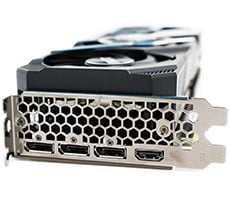
If you're familiar with NVIDIA's Quadro line of workstation graphics cards, the GeForce 7800 GTX 512MB may look somewhat familiar. The new 512MB GTX is equipped with a two-slot cooler, similar to the one used on the Quadro FX 4500. The cooler has a large copper heat-plate in the center and is flanked by two large banks of aluminum fins. Connecting the heatsink's fins to the heat-plate are four liquid filled heat-pipes (two per side). In the center of the cooler is large, variable speed fan that blows air over the heatsink's fins, where its then exhausted from the system through vents in its mounting plate. There are a few other things that differentiate the GeForce 7800 GTX 512MB from its 256MB cousin as well. As we noted in the chart above, the 512MB 7800 GTX's GPU is clocked at 550MHz; its 512MB of GDDR3 RAM is clocked at an impressive 1.7GHz (850MHz DDR). The configuration of the GeForce 7800 GTX 512MB's RAM also differs from the 256MB GTX in ways other than clock speed. 256MB GeForce 7800 cards have 128MB of RAM situated on either side of the card, whereas the new 512MB GTX uses higher-capacity chips that are all mounted to the front side of the PCB. The configuration of the 512MB card's VRM is similar to a GeForce 7800 GTX 256MB, however, as they both have a relatively large aluminum heat sink mounted to their MOSFET power arrays. Another piece of NVIDIA powered hardware we'd like to give some attention to, is the motherboard we used for testing throughout this article. We upgraded our test system with an Asus A8N32-SLI motherboard, which is based on the relatively new nForce 4 SLI X16 chipset. The nForce 4 SLI X16 has essentially the same feature set as the original nForce 4 SLI chipset, but with more PCI Express lanes. The nForce 4 SLI X16 chipset offers two full-bandwidth PEG slots, each with 16 PCI Express lanes of their own. The original nForce 4 SLI offers only 8 PCI Express lanes to each PEG slot when configured for dual-graphics cards. The addition of the Asus A8N32-SLI, along with new chipset and graphics drivers gave our NVIDIA based test system a measurable performance boost, as you'll see on the page ahead. |
| Our Test System & 3DMark05 | ||||||||||||||
HOW WE CONFIGURED THE TEST SYSTEM: We used two different test systems for this article. We tested our NVIDIA based cards on an Asus A8N32-SLI, nForce 4 SLIX16 chipset based motherboard, powered by an AMD Athlon 64 FX-55 processor and 1GB of low-latency Corsair XMS RAM. However, the ATI based cards were tested on an ATI reference Radeon Xpress 200 motherboard, but with the same processor and RAM. The first thing we did when configuring these test systems was enter each BIOS and load the "High Performance Defaults." The hard drive was then formatted, and Windows XP Professional with SP2 was installed. When the installation was complete, we installed the latest chipset drivers available, installed all of the other necessary drivers for the rest of our components, and removed Windows Messenger from the system. Auto-Updating and System Restore were also disabled, the hard drive was defragmented, and a 768MB permanent page file was created on the same partition as the Windows installation. Lastly, we set Windows XP's Visual Effects to "best performance," installed all of the benchmarking software, and ran the tests.
There are a few important comparisons to make while perusing the new GeForce 7800 GTX 512MB's benchmark scores on the proceeding pages. First, looking at the new 512MB GeForce card's performance versus its 256MB cousin. And second, focus on the GeForce 7800 GTX 512MB's performance as is compares to a 512MB Radeon X1800 XT. Then at the ultra-high-end compare the two SLI systems to each other. As you can see above, using 3DMark05's default benchmark parameters, the new GeForce 7800 GTX 512MB handily beats the 256MB GeForce 7800 GTX by almost 2000 points. The Radeon X1800 XT fares much better, trailing by only 473 points, but that's still enough of a margin to give NVIDIA's new flagship a clear advantage here. Standing alone, perched way at the top of the chart is the GeForce 7800 GTX 512MB SLI configuration, which bested a pair of 256MB cards by roughly 800 points. |
| Splinter Cell: Chaos Theory | ||||||
Before today, the Radeon X1800 XT compared favorably to NVIDIA's flagship video card. The Radeon X1800 XT outperforms a 256MB GeForce 7800 GTX by a fair amount at both resolutions and test configurations. But now that NVIDIA has unleashed the GeForce 7800 GTX 512MB, the green team has jumped out to a big lead. The GeForce 7800 GTX 512MB clearly outruns the Radeon X1800 XT at both resolutions, regardless of the test settings. And a pair of 512MB GeForce 7800 GTX cards running in SLI mode literally has a field day in this benchmark. Whereas no single card can break the 60 FPS barrier at 1600x1200 when anti-aliasing and anisotropic filtering are enabled, the GeForce 7800 GTX 512MB SLI rig surpassed the 100 frame per second mark. |
| F.E.A.R. v1.02 | ||||||
Before we discuss F.E.A.R. performance, we should note that there is a bug in ATI's Catalyst v5.11 drivers that hinders performance in this new title. And to remedy the problem, Catalyst A.I. was disabled in these tests... F.E.A.R. is another game where ATI's Radeon X1800 XT compared very favorably to a 256MB GeForce 7800 GTX, besting NVIDIA's previous flagship card by a wide margin when anti-aliasing and anisotropic filtering were enabled. And in fact, the Radeon X1800 XT is still able to fend off the new 512MB GeForce 7800 GTX, albeit by smaller margins. Without any additional pixel processing enabled though, the Radeon X1800 XT's performance doesn't look so good, as it gets beaten by 20 FPS and 15 FPS depending on the resolution. F.E.A.R. also happens to be another game where SLI with a pair of 512MB GeForce 7800 GTX cards is able to break the key 60 frame per second barrier at 1600x1200, when anti-aliasing and anisotropic filtering is enabled. Graphically intense games like F.E.A.R. are what SLI was made for. |
| FarCry v1.33 | ||||||
FarCry has historically been somewhat of a strong suite for ATI graphics hardware, as is evident in the graph above. Without using any additional pixel processing, all of the graphics configurations we tested were essentially CPU bound, and the Radeon X1800 XT trails all of the NVIDIA cards by small margins. However, with anti-aliasing and anisotropic filtering enabled, the Radeon X1800 XT looks strong when compared to any other single card configuration. The Radeon X18000 XT was able to outrun the GeForce 7800 GTX 512MB by a couple of frames per second at 1600x1200 when AA and aniso were used, but at the lower resolution the GeForce came out ahead by a similar margin. If we factor in the performance of the SLI configurations though, NVIDIA's platform is untouchable. A pair of 512Mb GeForce 7800 GTX cards is over 15% faster than a pair of 256MB cards, and remains CPU bound even when FarCry's resolution is ratcheted way up and anti-aliasing and anisotropic filtering are used. |
| Half Life 2 | ||||||
Our custom Half Life 2 benchmark proved to be no match for any of the high-end graphics cards we tested here. In fact, with this benchmark, our test systems were basically CPU bound in every configuration. What is interesting to note, however, is the effect a 512MB frame buffer has on performance in this game. As we noted in our review of the 512MB Radeon X800 XL back in June, Half Life 2 performance goes up significantly when it has access to more frame buffer memory, especially as the resolution is increased. Here, the 512MB GeForce 7800 GTX (and 512MB GeForce 7800 GTX SLI rig) and Radeon X1800 XT all posted very high framerates, besting the 256MB GeForce 7800 GTX at both resolutions, regardless of whether or not anti-aliasing and anisotropic filtering were used. |
| Doom 3 v1.3 | ||||||
As many of you probably know, the Catalyst v5.10a and new v5.11 drivers we used here have significantly boosted the performance of the Radeon X1800 XT in OpenGL based games. The performance increases are so significant, that the Radeon X1800 XT was actually able to surpass a 256MB GeForce 7800 GTX at 1280x1024 when anti-aliasing and anisotropic filtering were enabled. And at 1600x1200, the Radeon hung right alongside the 256MB GeForce 7800 GTX. The new 512MB GeForce 7800 GTX, however, smacks ATI's current flagship card back down a rung on the 3D performance ladder. The 512MB GeForce 7800 GTX actually outpaced the X1800 XT by about 50 FPS at default test settings, at both resolutions. And with anti-aliasing and anisotropic filtering enabled, the new 512MB GeForce 7800 GTX is between 21 - 25 FPS faster than the Radeon X1800 XT depending on resolution. Throw a second 512MB GeForce 7800 GTX into the mix and enable SLI, and NVIDIA's latest flagship gaming platform is again untouchable. Even a pair of 256MB GeForce 7800 GTX cards gets smoked by up to 30+ frames per second. |
| Quake 4 | ||||||
Quake 4 and Doom 3 are based on essentially the same game engine, so as you'd expect, the performance landscape in our custom Quake 4 benchmark looks much like Doom 3's. In this test though, the Radeon X1800 XT has a measurable advantage over a 256MB GeForce 7800 GTX when anti-aliasing and anisotropic filtering are used. Without additional pixel processing though, the Radeon doesn't look as strong and gets beat by significant margins. Factor in the performance of the new 512MB GeForce 7800 GTX, and NVIDIA's flagship distances itself from any other single card configuration. Looking at the performance of the SLI rigs, we see a pair of 512MB GeForce 7800 GTX cards easily outpaces a pair of 256MB GeForce 7800 GTX cards. The 512MB version's much higher core and memory clock speeds, and larger frame buffers allow it to jump way ahead of the pack. In fact, the 512MB SLI rig is over 20 frames per second faster then the dual-256MB card SLI rig at 1600x1200 when AA and aniso are enabled. |
| Overclocking the GF 7800 GTX 512MB | ||||
For our next set of performance metrics, we spent a little time overclocking our matched pair of GeForce 7800 GTX 512MB cards using the clock frequency slider available within NVIDIA's Forceware drivers after enabling the "Coolbits" registry tweak. We'd like to note that overclocking video cards in SLI mode is somewhat more difficult than overclocking a single card. When overclocking a pair of cards in SLI mode, your peak overclock will be limited by whichever card overclocks the lowest. If card A's core can hit 600MHz, and card B's core can hit 590MHz, both cards end up being clocked at 590MHz, even though card B still has some clock speed headroom to spare. Each card is not overclocked individually in SLI mode to alleviate potential synchronization problems.
Due to the fact that the GeForce 7800 GTX 512MB is based on the same GPU, built with the same manufacturing process, we weren't expecting it to have very much juice left in the tank, considering the 512MB card's GPU is clocked 120MHz higher than NVIDIA's original reference spec for the 256MB version. We ended up being somewhat surprised, however. In a single card configuration, we were able to take one of our GeForce 7800 GTX 512MB cards up from its default core and memory clock speeds of 550MHz / 1.7GHz, up to 597MHz / 1.78GHz. For those keeping count, those are core and memory clock speed increases of 47MHz and 80MHz (DDR), respectively. Not too bad. Our results while overclocking a pair of 512MB GeForce 7800 GTX cards in SLI mode were very similar. With two cards running in the system, we hit peak core and memory frequencies of 593MHz and 1.77GHz -- also, respectable increases. While the card were overclocked, we re-ran a couple of benchmarks to see what kind of performance increases we'd find. As you can see, performance in 3DMark05 and Doom 3 increased marginally while overclocked. Perhaps if our test system was equipped with a faster CPU, the performance increases while overclocked would have been higher. |
| Power, Temperature, & Acoustics | ||||||||||||||
We have a few final data points we'd like to cover before bringing this article to a close. Throughout all of our benchmarking, we monitored how much power our NVIDIA based test system was consuming using a power meter. We also monitored GPU core temperatures, and set up a sound level meter about six inches away from the graphics cards as well. Our goal was to give you all an idea as to how much power each configuration used and to explain how loud the configurations were under load. Please keep in mind that we were testing total system power consumption here, not just the power being drawn by the video cards alone.
Because the new GeForce 7800 GTX 512MB card is essentially the same as its 256MB counterpart but with much higher clock speeds, increased memory capacity, and a beefier cooler, we expected it would draw considerably more power than a 256MB GTX. It turned out that while idling at the Windows desktop, a single 512MB GeForce 7800 GTX consumed 12 more watts than a 256MB card. But in a dual-card SLI configuration, the difference dropped to only 7 watts. Running the cards with a heavy 3D load revealed much larger differences. With two 512MB GeForce 7800 GTX cards at the heart of our test system, it consumed over 410 watts of power; 43 more watts than a pair of lower-clocked, 256MB cards. And in a single card configuration running at full load, the 512MB GeForce 7800 GTX burned though an additional 34 watts of power.
We also spent some time monitoring GPU core temperatures while our test system was idling, and while it was running with a heavy 3D workload. In a single GPU configuration, the new GeForce 7800 GTX 512MB's core hovered around 49oC while idling, but with a load placed on the GPU, core temperatures shot up to about 75oC. In an SLI configuration, with two cards installed into our test system, GPU core temperatures remained largely unchanged, although they did go up by a couple of degrees depending on which GPU we monitored. Acoustics - |
| Our Summary & Conclusion | ||||||||
Performance Summary: Let's get the easy part out of the way first. In terms of gaming performance, a dual-card GeForce 7800 GTX 512MB SLI configuration currently has no equal. In most of the standard benchmarks where no anti-aliasing or anisotropic filtering was used, the GeForce 7800 GTX 512MB SLI configuration was clearly the fastest setup we tested. And in the tests where it didn't have a clear advantage over the competition, it was because the benchmark was CPU limited. Throw anti-aliasing and aniso into the mix, and the GeForce 7800 GTX SLI rig easily pulls ahead of every other configuration in about 85% of the tests, and the remaining 15% are CPU limited. The performance picture changes slightly if we focus on the performance of a single GeForce 7800 GTX 512MB versus its ATI built rival, the Radeon X1800 XT. In the single card tests, the GeForce 7800 GTX 512MB outperformed the X1800 XT in 10 of 13 tests, occasionally by very large margins. With anti-aliasing and anisotropic filtering enabled, a single GeForce 7800 GTX 512 took the top spot in 6 of 12 tests, essentially tied in 3 tests, and lost to the Radeon X1800 XT in only 3. It's clear, based on these numbers, the new GeForce 7800 GTX 512MB is an best of class performer.
Looking at the features and performance of the new 512MB GeForce 7800 GTX from a hardcore gamer's standpoint, you can't help but be impressed by this product. Thanks to some tweaks to its manufacturing process, some faster, higher-capacity RAM, and a powerful cooler, NVIDIA was able to take the already very fast GeForce 7800 GTX and make it considerably more powerful. In both single-card and dual-card SLI configurations the GeForce 7800 GTX 512MB was measurably faster than not only its 256MB cousin, but ATI's flagship Radeon X1800 XT as well. And as we showed in our recent coverage of ATI's Radeon X1K family launch, NVIDIA and ATI based products currently have similar in-game image quality, and offer similar performance when playing back video depending on the scenario. NVIDIA also has an advantage in terms of availability. Because this is yet another "hard launch", the GeForce 7800 GTX 512MB will be available immediately from multiple outlets. The price for this monolith? -- A hefty $649 (MSRP as told to us by NVIDIA). But considering ATI's Radeon X1800 XT is currently selling for $599, which is incidentally $50 higher than ATI's original MSRP, NVIDIA can easily justify the price. If history is any indicator though, expect multiple partners to bring 512MB GeForce 7800 GTX cards to market and prices to drop rather quickly. Heading into the holiday buying season, NVIDIA is in a very strong position. They've got very strong products in every segment of the market - The GeForce 7800 GTX 512MB at the ultra-high-end, the GeForce 7800 GT in the performance-mainstream segment, the new 6800 GS in the mainstream segment, and the GeForce 6600 256MB DDR2 in the budget segment. Let's hope for competition's sake that ATI can work some magic soon, or it's going to be a rough Golden Quarter for the red team. ** Update 11/14/2005 (12:30PM) - It looks like the GeForce 7800 GTX 512MB is already available at a few on-line retailers, but unfortunately prices are much higher than MSRP at the moment. Prices range from $50 to $100 higher than MSRP at NewEgg, Monarch, ZipZoomFly, and Tiger Direct.
|