|
|
| i955X Express Chipset Architecture For The Pentium EE 840 | ||||||
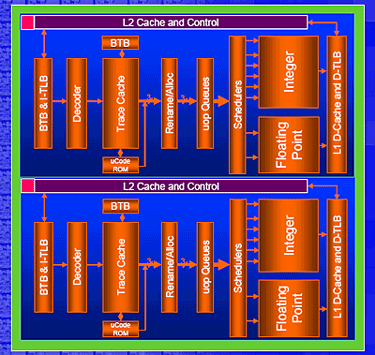
Infused with up to 22 PCI Express lanes on-board and the ability to configured for dual PCIe Graphics, with an optional bridge chip, the i955X Express and its companion ICH7 chipset is the next logical progression on Intel's chipset roadmap in support of their new dual core processors. Here's a quick take on the i955X which our reference hardware is based upon in our upcoming performance benchmark tests.
The i955X is very much reminiscent of Intel's i925X or i915 chipsets, with a few notable exceptions. First Dual Channel DDR-667 DDR2 DRAM is officially supported. Although this has been available through many third party motherboard BIOS options with the current Intel chipset offering, this new official memory interface speed, coupled with a 1066MHz FSB, should offer a further performance boost and a bit more headroom even beyond with overclocking. Interestingly enough, Intel is also showing capability to expand off the chipset's single X16 native PCI Express graphics slot, and with the help of another X16 bridge chip (which is not really a bridge but rather a PCI Express "fan-out" of sorts) the platform supports a dual X16 configuration for two PCI Express graphics cards. There is no doubt, in addition to the nForce 4 SLI Intel Edition which you'll see here on HotHardware very soon, this expansion capability will also support NVIDIA's SLI Dual Graphics technology for the enthusiast and gaming community. This is thanks in part to Intel and NVIDIA's recent cross-licensing agreement. In fact, the system our staff tester received, was configured with dual PCIe graphics slots, with the second slot supporting a X4 PCI Express graphics configuration. Theoretically, any X16 PCIe graphics card should be able to auto-negotiate down to a X4 config. Unfortunately, none of our current in-house PCIe graphics cards would function in SLI mode, most likely due to driver issues. Finally, Intel's new ICH7 Southbridge that is coupled with the i955X now supports the SATA2 standard with up to 300MB/sec of bandwidth over its interface to a SATA II compliant hard drive. In addition, the ICH7 has another two PCI Express links on it for further PCI Express peripheral expansion, now offering a total of 6 x1 links versus the ICH6's 4 x1 setup.
|
| SANDRA Testing | ||||
First up, we've got a quick snap-shot for you of overall system bandwidth and raw CPU power, with SiSoftware's SANDRA benchmark suite.
Since SANDRA's CPU test modules fully support and exploit the multi-threaded capabilities of both HyperThreading and Dual Core CPUs, the new Pentium EE 840 posts amazing results in this test. Two physical cores clearly are much faster than the two logical cores (with HyperThreading) that are available on the P4 570J. The Athlon 64 4000+ brings up the rear with no multi-threading capabilities at all.
More of the same on the multimedia and SSE side of things, almost 2X the performance.
Here we see a different story that is more representative of the variation in platform configurations we tested. The 955X/Pentium EE 840 system is running DDR2-667 at CAS5 and the rest of the other P4s are running DDR2-533 at CAS3, with the Athlon 64 running DDR-400 CAS2. In the case of the Athlon's dominance in this test, the A64's integrated memory controller offers up superior low latency metrics, while P4 500 series chips also only have one logical CPU competing for system memory bandwidth. |
| PCMark 04 and Cinebench | ||||||||
Basic functions like text search, and file compression are tested in Futuremark's PCMark 04 CPU test. Here are the results.
Again, multi-threading aware, this test shows the Pentium Extreme Edition 840 Dual Core CPU on top in CPU performance but just behind the P4 570J in the overall test, due mainly to it's lower system memory bandwidth results. In future testing and our follow-up article we plan to enable the P4 EE 840 with CAS3 DDR2-667 capable memory and see where that takes us.
Cinema 4D is another multi-threaded capable application that the Cinebench 2003 benchmark is based on.
The numbers speak for themselves. Two physical cores with a total of 4 logical processing threads active, allows the new Pentium Extreme Edition 840 a sizable advantage in this application, to the tune of over 50% versus our fastest test score. |
| Windows Media Encoder 9 and Lame MP3 Encoding Tests | ||||
Converting an MPEG to Windows Streaming Media format with Media Encoder 9, shows our the new Pentium EE 840 has about a 15% advantage over the 3.8GHz P4 570. WME9 is another multi-threaded, SSE enabled test that allows the current Pentium 4 architecture to shine.
Lame MP3 is not a multi-thread capable application and as such these tests are representative of pure single core CPU performance and system memory bandwidth. We only had time to run the 570J in comparison to our 840 scores. However surprisingly, even though the Pentium EE 840's cores are a full 600MHz slower than the 570J's single 3.8GHz core, it only trails by a few seconds. Regardless, the Athlon 64 4000+ rules the roost here with a full 15 second advantage over the fastest Pentium 4 score we recorded. |
| 3D Mark 05 benchmarks | ||||
Synthetic DirectX 9 Game testing is next with Futuremark 3DMark 05.
3DMark 05's CPU test module is multi-threaded and as such, the Pentium EE 840 once again takes the lead, this time by about 9% over the 3.8GHz P4 570J. The default game test however, is not multi-threaded. Here are the results for that...
With a 3.2GHz clock speed on each of its core CPUs, the Pentium Extreme Edition 840 chip scores a lot like a 3.2GHz P4 540J over all. We'll see if this translates over in real-world game testing next, with our Doom 3 benchmarks. |
| Doom 3 Benchmarks | ||||
Doom 3 is a single-threaded game that thrives on system memory bandwidth and a powerful graphics card. Let's see how thing stack up in this scenario.
As expected, the Pentium Extreme Edition 840 performs a lot like a 3.2GHz P4 540J, since it's cores have the same clock speed. There is perhaps a slight advantage shown for the new Pentium EE 840 here, as other system resource calls are probably handled more fluidly with the new Dual Core Pentium EE 840 but the benefits are negligible. |
| Wrap-up - To be continued... |
First Pass Performance Analysis - Looking back at our quick battery of tests, the new Pentium Extreme Edition 840 and the i955FX test system we had access to, performs very well in multi-threaded applications like Cinema 4D and Windows Media Encoder 9. In single threaded applications and the few gaming datapoints we took, Intel's new flagship chip performs a lot like it's 3.2GHz Pentium 4 540J counterpart. It will take time for the developer community to take advantage of these new Dual Core architectures but certainly, with both Intel and AMD driving the initiative, it is a path the industry will follow for years to come. We plan to come back to you all shortly with more in-depth testing and coverage of the new Pentium Extreme Edition 840 and the i955X chipset platform in the days ahead. For now, we hope this was a healthy and informative tease. Please stick around for the full scoop as we spend more lab time with Intel's new Desktop Dual Core processors.
|