|
|
| Introduction and Specifications | ||||||||||||||||||||||||||||||||||||||
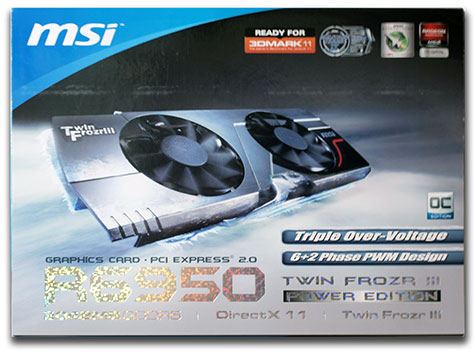
Looking at its features and specifications reveals one of the MSI R6950 Twin Frozr III’s differentiating attributes—it’s overclocked from the factory. The Radeon HD 6950 GPU powering the card is bumped up from the reference design’s 800MHz to 850MHz and the memory clock has been increased from the reference design’s 1,250MHz to (5Gbps effective) to 1,300MHz (5.2Gbps effective). The increases in GPU core and memory clocks will obviously give the card a performance edge over straight-up reference designs, but in addition to tickling the frequencies, MSI has tweaked a number of other aspects of the Radeon HD 6950 as well. |
| Test Setup & Unigine Heaven v2.1 | ||||||||||||
How We Configured Our Test Systems: We tested the graphics cards in this article on a Gigabyte GA-EX58-UD5 motherboard powered by a Core i7 980X six-core processor and 6GB of OCZ DDR3-1333 RAM. The first thing we did when configuring the test system was enter the system BIOS and set all values to their "optimized" or "high performance" default settings. Then we manually configured the memory timings (DDR3-1333, CAS 7) and disabled any integrated peripherals that wouldn't be put to use. The hard drive was then formatted and Windows 7 Ultimate x64 was installed. When the installation was complete we fully updated the OS and installed the latest DirectX redist, along with the necessary drivers, games, and benchmark applications.
The MSI R6950 Twin Frozr III was clearly the fastest of the Radeon HD 6950-based cards in the Heaven benchmark, thanks to its higher GPU and memory clocks. And it even managed to pull ahead of the GeForce GTX 560Ti in what is undoubtedly a strong benchmark for current-gen NVIDIA-based graphics cards. |
| Futuremark 3DMark11 | ||||||
The MSI R6950 Twin Frozr III performed well in 3DMark11, once again outpacing all of the other Radeon HD 6950-based cards by a fair margin, but just missing the mark set by GeForce GTX 570. |
| FarCry 2 Performance | ||||||
As expected, the MSI R6950 Twin Frozr III was the fastest Radeon HD 6950 in the FarCry 2 benchmark. The card was able to catch the GeForce GTX 560 Ti at the higher resolution, but not the overclocked edition of the 560 Ti. |
| Just Cause 2 Performance | ||||||
Once the resolution was cranked up, the MSI R6950 Twin Frozr III was able to match the speed of the overclocked GeForce GTX 560 Ti, and it of course outpaced the other 6950s, but the Radeon HD 6970 and GeForce GTX 570 were still a notch ahead. |
| Metro 2033 Performance | ||||||
The MSI R6950 Twin Frozr III's higher-than-reference clocks don't help it very much in this game, but it doesn't matter, it's still the fastest of the Radeon HD 6950s and it manages to outpace the GeForce GTX 570 as well. |
| Lost Planet 2 Performance | ||||||
The NVIDIA powered cards simply dominate in the Lost Planet 2 benchmark. The performance trend we've seen to this point differentiating the Radeons, however, still rings true--the MSI R6950 Twin Frozr III come out on top and just misses the mark set by the more expensive Radeon HD 6970. |
| F1 2010 Performance | ||||||
The MSI R6950 Twin Frozr III performed well in the F1 2010 benchmark. Here, the MSI R6950 Twin Frozr III surpasses the GeForce GTX 570 at the higher resolution and only trails the Radeon HD 6970 by less than 4 frames per second. |
| Alien vs. Predator Performance | ||||||
Our results with the Alien vs. Predator benchmark were interesting. Here, the MSI R6950 Twin Frozr III's higher GPU and memory clocks allow it to pull ahead of the GeForce GTX 570, whereas the reference Radeon HD 6950 could not. |
| Total System Power Consumption | ||||
Before bringing this article to a close, we'd like to cover a few final data points--namely power consumption and noise. Throughout all of our benchmarking and testing, we monitored how much power our test system was consuming using a power meter. Our goal was to give you all an idea as to how much power each configuration used while idling and while under a heavy workload. Please keep in mind that we were testing total system power consumption at the outlet here, not just the power being drawn by the graphics cards alone.
Our power consumption tests revealed some interesting data. Despite having higher clocks and dual fans, the MSI R6950 Twin Frozr III actually consumed less power than a reference Radeon HD 6950 under both idle and load conditions. This leads us to beleive the GPU binning done by MSI, in conjunction with the use of more efficient power delivery circuitry on the card, make the MSI R6950 Twin Frozr III a bit more "green" than straight-up reference cards. |
| Overclocking the R6950 Twin Frozr III | ||||
We also spent some time overlcocking the MSI R6950 Twin Frozr III using MSI’s own Afterburner tuning utility. If you haven’t tried afterburner, we definitely recommend giving it a shot—MSI supports many of today’s most popular GPUs with Afterburner, and they don’t have to be MSI branded cards either. It turned out we were able to crank Afterburner’s GPU and memory clocks up to their maximum values of 900MHz for the GPU and 1325MHz for the memory and still maintain stability. These are only modest gains over the R6950 Twin Frozr III’s stock clocks, but they’re much higher than a reference Radeon HD 6950.
While we had the card overclocked, we re-ran a couple of high-resolution benchmarks to see what kind of performance increases were to be had. The increases weren’t huge, but the 50MHz bump in GPU clock and 25MHz bump in memory clock definitely pushed framerates a bit higher than stock, as would be expected. |
| Our Summary and Conclusion | ||||
Performance Summary: The MSI R6950 Twin Frozr III performed very well throughout our entire battery of benchmarks. The R6950 Twin Frozr III’s higher GPU and memory clocks gave a marked advantage over AMD’s reference design Radeon HD 6950. The R6950 Twin Frozr III was also faster than its predecessor, the R6950 Twin Frozr II, as well. The R6950 Twin Frozr III’s higher clocks also allowed it to catch or even surpass the GeForce GTX 570 in a couple of tests, where the stock reference card could not.
|