|
|
| Introduction and Specifications | ||||
Back in April, we first gave you a glimpse of the extreme Asus ARES dual-Radeon HD 5870 GPU powered graphics card, complete with some preliminary benchmarks. At the time, the specifications weren't quite finalized and there was little word about availability in the U.S., but the card's impressive configuration immediately piqued our interest. The ARES was, after all, a "true dual-Radeon HD 5870" CrossFire setup on a single PCB. The Radeon HD 5970 was / is the fastest single graphics card on the market, and the Asus ARES would clearly offer more performance due to its increased number of stream processor cores and potentially higher clocks.
Above are the final specifications for the Asus ARES. As you can see, not only does the card employ dual, fully functional Radeon HD 5870 GPUs with the full complement of 1600 stream processors running at 850MHz, but each of the GPUs is paired to 2GB of GDDR5 memory, clocked at 1200MHz (4800MHz effective), for a grand total of 4GB. This card is obviously geared to the ultra enthusiast, with a high-res monitor (think 30" LCD) or a multi-monitor Eyefinity setup.
To further enhance the extreme image of the ARES, Asus ships the card is an absolutely gigantic box, that's more than triple the size of their typical graphics card packaging. And inside the box is a locking, metal briefcase that protects the actual card and all of its included accessories. Wait until you see this thing... |
| Asus ARES: Up Close and Personal |
As we've mentioned, inside the gigantic Asus ARES retail box resides a locking, metal briefcase that holds the card itself and all of the accessories included with it. While the size is a bit much, the overall presentation is definitely that of an ultra-high-end, enthusiast product. Cracking open the brief case reveals a number of items; the ARES card (obviously), a pair of dual 6-pin to 8-pin PCI Express power adapters, a DVI to HDMI adapter, a CrossFire bridge connector, a case badge, driver discs, and users manuals. In addition, Asus also throws in a Republic of Gamers branded gaming mouse, with adjustable DPI settings and customizable buttons.
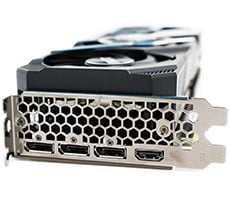
Getting down to the nitty-gritty, the Asus ARES is a unique sort of beast. The card is massive and quite heavy. The PCB measures 11.5" by 5" and the large cooling solution will cover three expansion slots. A finned aluminum heatsink adorns the backside of the PCB, to cool half of the RAM. Another aluminum heatsink covers much of the front of the card, to cool the power regulation circuitry and remaining RAM, and two large all-copper heatsinks with think, 8mm heatpipes take care of the two Cypress XT (Radeon HD 5870) GPUs. In the middle is a large 100mm cooling fan. And covering the whole assembly is a black and red aluminum shroud. As you can see, the Asus ARES is a biggun'. And it requires three power connectors--two 8-pin, and one 6-pin. The shebang weighs in at around 5lbs, so securely screwing the card in place is paramount--the plastic, tool free hold downs on some cases aren't going to cut it. |
| Test System and Unigine Heaven | ||||||||||||
How We Configured Our Test Systems: We tested the graphics cards in this article on a Gigabyte GA-EX58-UD5 motherboard powered by a Core i7 965 quad-core processor and 6GB of OCZ DDR3-1333 RAM. The first thing we did when configuring the test system was enter the system BIOS and set all values to their "optimized" or "high performance" default settings. Then we manually configured the memory timings and disabled any integrated peripherals that wouldn't be put to use. The hard drive was then formatted, and Windows 7 Ultimate x64 was installed. When the installation was complete we fully updated the OS and installed the latest hotfixes, along with the necessary drivers and applications.
The Asus ARES takes the top spot in the Unigine Heaven benchmark. Its combination of dual Radeon HD 5870 GPUs, high-clocks, and 4GB of total RAM push it ahead of every other card here. |
| Futuremark 3DMark Vantage | ||||||
The Asus ARES simply dominated the 3DMark Vantage tests. The card finished well ahead of the Radeon HD 5970, which was previously the fastest graphics card we had tested. |
| Enemy Territory: Quake Wars | ||||||
We know, we're beginning to sound like a broken record. But, once again, the Asus ARES was the fastest card overall in our custom ET: Quake Wars benchmark. |
| Crysis v1.21 Performance | ||||||
To answer the question weighing heavily on everyone's mind, yes, the Asus ARES can play Crysis. Its dual-GPUs and huge frame buffer push the ARES well ahead of anything else in our custom Crysis benchmark. |
| FarCry 2 Performance | ||||||
Much like the Crysis results on the previous page, the Asus ARES simply dominates in the FarCry 2 benchmark. Nothing can touch it here. |
| Left 4 Dead 2 | ||||||
Left 4 Dead 2 is mostly CPU bound with the settings we used for testing, and as such, the Asus ARES shows only marginal performance improvements. Regardless, it's still the fastest card out there. |
| Tom Clancy's H.A.W.X. | ||||||
Yet another dominant performance from the Asus ARES. The card had no trouble churning through the H.A.W.X. benchmark at either resoltuion, and yes, it was the fastest card overall by a wide margin. |
| Total System Power Consumption | ||||
Before bringing this article to a close, we'd like to cover a few final data points--namely power consumption and noise. Throughout all of our benchmarking and testing, we monitored how much power our test system was consuming using a power meter. Our goal was to give you all an idea as to how much power each configuration used while idling and while under a heavy workload. Please keep in mind that we were testing total system power consumption at the outlet here, not just the power being drawn by the graphics cards alone.
Considering the Asus ARES' excellent performance, its two, fully-loaded Radeon HD 5870 GPUs and massive 4GB total frame buffer, it should come as no surprise that the card requires a lot of power. And our testing showed it was the most power hungry of the ATI-based cards by a decent margin. But it's not that far out of line with other enthusiast offerings, and in fact, the GTX 480 pulled more power under load. |
| Our Summary and Conclusion | ||||
Performance Summary: Summarizing the Asus ARES' performance couldn't be any easier. Quite simply, the Asus ARES is the fastest graphics card we have ever tested. The ARES' combination of dual-Radeon HD 5870 GPUs and 4GB (2GB per GPU) of fast GDDR5 frame buffer memory resulted in excellent performance across the board. In every test, at every resolution, the Asus ARES came out on top.
We have to look at the Asus ARES from two different perspectives. From a technological standpoint alone, the Asus ARES is impressive to say the least. Asus' engineers have assembled the fastest, single graphics card on the planet, that's also quieter than lower-performing solutions, and they should be commended. There's no question the Asus ARES represents the current pinnacle of ultra-high-end, enthusiast graphics card.
But, all of that custom engineering, performance, and technology comes at a price. The Asus ARES commands a hefty $1200 MSRP. To put that into perspective, a pair of 2GB Radeon HD 5870 Eyefinity 6 Edition cards will cost about $1000 ($499 ea.), so the few users who can opt for an ARES will pay an approximate 20% premium for the card. To be fair, Asus does include a quality gaming mouse and cool metal briefcase, but the bottom line is consumers will have to pay a premium to play on an ARES.
|