|
|
| Introduction & Specifications | ||||||
Thus far there have been a mere three different models of Intel's new Core i7 processor that have been released to any channel, OEM or retail - the Core i7-920, Core i7-940 and the flagship Core i7-965 Extreme Edition. With clock speeds starting at 2.66GHz and scaling to 3.2GHz, Intel's new Core i7 proverbially lights up anything from AMD's high end line-up right now, even comparing the chip's slowest speed bin, never mind at like clock speeds. That said, the semiconductor business is pretty much a ruthless and relentless game of one-upsmanship; or in Intel's case currently, perhaps its two or three-up. As such, you can be sure Intel is looking for another kill shot, whenever they can. Today Intel is finally releasing new Core i7 models and speed bins to the market, as well as announcing a new flagship chip, the Core i7-975 Extreme Edition. Though it will definitely command a hefty price tag, at a stock clock speed of 3.33GHz and Intel Turbo Boost speeds at 3.45GHz (all cores) and 3.6GHz (single core), you can bet this new Core i7 is one hot-rod of a quad-core CPU. In the pages ahead, we'll wind it out around the test track and show you what the fastest desktop processor on the planet can do when it's tuned up for a touch more horsepower at the factory and made ready for production.
The new Core i7 chips being announced today are Intel's new top-dog, the Core i7-975 Extreme Edition, as well as the new upper mid-range Core i7-950, which in fact will supplant the Core i7-940. These new chips share identical Intel Nehalem-based microarchitectures, with the Core i7-975 offering a faster 6.4GT/sec QPI (Quick Path Interconnect) serial link to Intel's X58 Express Northbridge chipset, as well as a faster 3.33GHz core clock speed with a stock 25X multiplier and a 133MHz reference clock. The Core i7 950 has a 23X stock multiplier that is locked for higher multiples but can be dialed down, while the Core i7-975 is unlocked for higher multiples as well, since it is an "Extreme Edition" product. If you'd like a refresher course on Intel's Core i7 processor technology, we'd suggest taking a look at our Core i7 launch article, as well as our recent Core i7 overclocking article and how-to video. These articles and our video spotlight will provide a solid reference, should you feel the need for a deep dive understanding of the technology, Intel's new platform, and how to maximize its performance. |
| Vital Signs and Overclocking | ||||||||
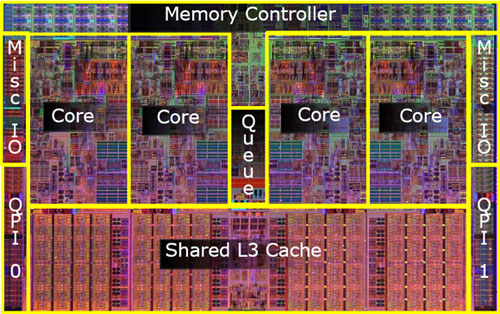
Here you can also see that the QPI link (Quick Path Interconnect) for the Core i7 975 Extreme Edition is 3200MHz which offers 32GB/s of serial, bi-directional bandwidth, or a total of 6.4GT/s (GigaTransfers per second), as Intel likes to quantify it. In short, that's a bucket-load of bandwidth for any processor architecture. Also there are 4 cores shown here, capable of processing 8 threads via Intel Hyperthreading technology. Finally, those cores are backed up by 32Kx4 instruction and 32Kx4 data L1 cache (32K per core), 256K of L2 cache per physical core (1MB total) and 8MB of shared L3 cache. Beyond that, one very distinct notable is the fact that this revision of the chip is based on the Core i7's D0 stepping, which has been widely reported as having significantly more flexibility and potential in terms of overclocking. Specifically, with respect to memory speeds, this stepping of the processor can offer some pretty magical combinations of both core clock speed and DDR-3 memory speeds. As such, we set out to see what the Core i7 975 could do with a standard retail PIB cooler snapped on top to keep it stable. First, let's look at thermals...
Here we've got the Core i7 975 setup with a Turbo Boost clock speed of 3.6GHz and a 27X multiplier. We've also have Cinebench R10 loaded up in the background pushing a 100% load on the processor. We ran Cinebench in a loop, just to warm the core up a bit and then took this reading at full load. In our open air test bench bench setup, the Core i7 975 Extreme Edition barely breaks a sweat at 47ºC. Of course, within the confines of a PC chassis, core temps will likely scale a bit higher, but regardless, Intel's new core stepping offers plenty of thermal margin and very reasonable operating thermals.
We're sure you are wondering if this new top-shelf Core i7 overclocks any better than its predecessor, so we put it through a quick round of overclocking. All overclocking was performed with the Intel stock cooler and a very modest 100mv voltage bump to allow the core to scale to 1.25V should it need the extra juice.
We were able to take the Core i7 975 Extreme Edition from its stock frequency of 3.33GHz at its stock reference clock of 133MHz, up to a maximum stable overclock of 4.1GHz with a reference clock of 164MHz. As you'll note in the above screen shots, we left the multiplier at its stock 25X setting but also did allow the memory controller to scale up to 1968MHz over its DDR3 interface. This was accomplished using some rather special OCZ Blade DDR3-2133 (PC17000) memory from our friends at OCZ that we'll give you a sneak peek of next. We topped out at these processor and memory clock speeds with full stability and were able to run several iterations of Cinebench R10, as well as a full course of our entire benchmark suite. As such, we'll include the benchmark numbers for the Core i7 975 at 4.1GHz for all of our benchmark results in the pages ahead. Again this was all performed with a stock, retail Intel heatsink. Impressive, to say the least. |
| PCMark Vantage Performance | ||||
Next up, we ran the new Core i7 975 through Futuremark’s latest system performance metric built especially for Windows Vista, PCMark Vantage. PCMark Vantage simulates a host of different usage scenarios for various types of mainstream user workloads, including High Definition TV and movie playback and manipulation, gaming, image editing and manipulation, music compression, communications, and office productivity tasks. Most of the tests are multi-threaded as well, so the tests can exploit the additional resources offered by a multi-core CPU.
|
| LAME MT and Kribibench Performance | ||||||||
In our custom LAME MT MP3 encoding test, we convert a large WAV file to the MP3 format, which is a popular scenario that many end users work with on a day-to-day basis to provide portability and storage of their digital audio content. LAME is an open-source mid to high bit-rate and VBR (variable bit rate) MP3 audio encoder that is used widely in a multitude of third party audio conversion and editing applications and software suites.
In this test, we created our own 223MB WAV file (a hallucinogenically-induced Grateful Dead jam) and converted it to the MP3 format using the multi-thread capable LAME MT application in single and multi-thread modes. Processing times are recorded below, listed in seconds. Shorter times equate to better performance.
The new Core i7 975 processor offered the quickest encoding time according to our custom LAME MT benchmarks. The Core i7 Extreme 975 was 3 seconds faster than the Core i7 965 in the multi-threaded test (about 12%). It's also interesting to note that the Core i7 920 at 2.66GHz is as fast as a Core 2 Extreme QX9770 in this test. Unfortunately, AMD's fastest Phenom II is only able to hang with Intel's 3GHz Core 2 chip and is surpassed by the entire Core i7 family of CPUs. Our time for the Core i7 975 overclocked to 4.1GHz offers a glimpse of things to come as well.
For this next batch of tests, we ran Kribibench v1.1, a 3D rendering benchmark produced by the folks at Adept Development. Kribibench is an SSE aware software renderer where a 3D model is rendered and animated by the host CPU and the average frame rate is reported. We used two of the included models with this benchmark: a "Sponge Explode" model consisting of over 19.2 million polygons and the test suite's "Ultra" model which is comprised of over 16 billion polys.
Intel's new Core i7 processors--regardless of their clock speed--were also the fastest of the bunch in the Kribibench rendering test and the Core i7 975 Extreme punched out about a 10% performance gain over its Core i7 965 counterpart. And of course 4.1GHz the numbers pretty much speak for themselves. |
| Cinebench R10 and POV-Ray Rendering Performance | ||||||||
Cinebench R10 is an OpenGL 3D rendering performance test based on Cinema 4D from Maxon. Cinema 4D is a 3D rendering and animation tool suite used by 3D animation houses and producers like Sony Animation and many others. It's very demanding of system processor resources and is an excellent gauge of pure computational throughput.
This is a multi-threaded, multi-processor aware benchmark that renders a single 3D scene and tracks the length of the entire process. The rate at which each test system was able to render the entire scene is represented in the graph below.
It's not hard to see that the Intel Core i7 is in a class of its own, when it comes to raw computing throughput. On a multi-core level the trend we've seen in our previous benchmark runs continues here with Cinebench. Intel's fastest Core i7 975 processor is some 57% faster than AMD's fastest Phenom II. Comparing single-threaded performance, Intel's new flagship is about 39% faster. However, you have to remember, Intel's Core i7 Extreme Editions are currently also 4 times the price of a Phenom II 955. A more balanced comparison from a pricing perspective would be the Core i7 920, though even then, you still have to factor in total platform costs, including Intel's more expensive triple-channel DDR3 implementation and the higher price of X58 chipset-based motherboards.
POV-Ray , or the Persistence of Vision Ray-Tracer, is a top-notch open source tool for creating realistically lit 3D graphics artwork. We tested with POV-Ray's standard 'all-CPU' benchmarking tool on all of our test machines, and recorded the scores reported for each. Results are measured in pixels-per-second throughput; higher scores equate to better performance.
Looking at POV-Ray ray-tracing performance, we see very much the same sort of spread amongst the Core i7 lineup, only this time the Core i7 975 chalks a smaller 5% gain over the Core i7 965. |
| 3DMark06 and Vantage CPU Tests | ||||||||
3DMark06's built-in CPU test is a multi-threaded DirectX gaming metric that's useful for comparing relative performance between similarly equipped systems. This test consists of two different 3D scenes that are processed with a software renderer that is dependent on the host CPU's performance. Calculations that are normally reserved for your 3D accelerator are instead sent to the CPU for processing and rendering. The frame-rate generated in each test is used to determine the final score.
The new Core i7 processors lead all other test systems in this test. The Core i7 920 was once again able to pull out in front of the Core 2 Extreme QX9770 and the Core i7 965 and 975 are out in front by a sizable margin. The Core i7 975 offers an 8% advantage over Intel's next fastest chip.
3DMark Vantage's CPU Test 2 is a multi-threaded test designed for comparing relative game physics processing performance between systems. This test consists of a single scene that features an air race of sorts, with a complex configuration of gates. There are aircraft in the test that trail smoke and collide with various cloth and soft-body obstacles, each other, and the ground. The smoke spreads, and reacts to the planes as they pass through it as well and all of this is calculated on the host CPU.
![]()
More of the same can be seen in Futurmark's latest 3DMark Vantage processor test, though the Core i7 965 and 940 are more tightly coupled and Core i7 975 Extreme Edition leads the 965 by about 4%.
|
| Low Res Gaming: Crysis and ET: Quake Wars | ||||
For our next set of tests, we moved on to some in-game benchmarking with Crysis and Enemy Territory: Quake Wars When testing processors with these game engines, we drop the resolution to 800x600, and reduce all of the in-game graphical options to their minimum values to isolate CPU and memory performance as much as possible. However, the in-game effects, which control the level of detail for the game's physics engines and particle systems, are left at their maximum values, since these actually do place some load on the CPU rather than GPU.
Our low-resolution Crysis and ET: Quake Wars benchmarks scale proportionately once again as expected, though the spread is a bit different, depending on which game engine you look at. In Crysis, a notoriously piggish game engine that requires both a beefy CPU and a high-end GPU to run well, the gain observed for the Core i7 975 over the Core i7 965 is less prominent at about 4%. On the other hand, Id's game engines in general are coded more efficiently and run more efficiently on a wider range of machines, with higher levels of processor cache and memory bandwidth historically offering better numbers in this type of test. Here the Core i7 975 leads the next fastest CPU by about 14%. |
| Total System Power Consumption | ||||
Throughout all of our benchmarking and testing, we monitored how much power our Core i7 975 Extreme Edition test system consumed using a power meter. Our goal was to track how much power each configuration used while idling and while under a heavy host processor workload. Please keep in mind that we were testing total system power consumption at the outlet here, not just the power being drawn by the processors alone. Regardless, if you look at the differentials between similarly configured test platforms, you can easily isolate the power consumption profile of each of the processors we tested.
So, while peak power consumption may be somewhat higher, the Core i7 platform is just as, if not more power efficient, in terms of performance-per-watt results, versus the Core 2 platform. With that in mind, Intel's new 3.33GHz speed bump only consumes 5 watts more, fully loaded versus the Core i7 965. At 4.1GHz overclocked with the Core i7 975, we're subjected to an increased power draw of up to 43 more watts under full load. However, with a 23% clock speed boost, 15% more power consumption doesn't sound all that unreasonable. |
| Performance Analysis and Conclusion | ||||
Performance Summary: To be perfectly frank, discussing the performance profile of the new Core i7 975 Extreme Edition is a tad on the mundane side. In short, we're looking at a 4% clock speed boost that, by and large, offers a 4 - 5% performance increase versus the previous Intel high-end Extreme Edition Core i7 965. In fact, the results were so linear and predictable, that we're rather impressed at the efficiency of IPC (Instructions Per Clock) production as clock speeds scaled with Intel's new leading-edge desktop processor architecture. We witnessed virtually a 1:1 scaling of clock speed versus most benchmark results. It was all a bit uneventful perhaps. Then again, it was also refreshing to see a processor architecture scale so cleanly at various clock speeds. In terms of overclocking, the new Core i7 975 processor stepping offered more headroom in top-end clock speed versus previous iterations of the architecture. Whereas historically we've seen the Core i7 965 hit speeds of 4GHz with relative ease, the new Core i7 975 was able to settle down cleanly at 4.1GHz and handle our entire battery of benchmark tests with only a small voltage bump and a stock retail Intel heatsink keeping it cool; so cool in fact, it never broke 50ºC on our test bench under full load. Right then; with all of our benchmark data points lined up, our thermal profiles and power consumption testing in check, what are the key take-aways with Intel's new Core i7 975 Extreme Edition processor? To put it succinctly, Intel's new Core i7 975 is what it is; a 133MHz speed bump for a processor that runs in excess of 3.2GHz. Does the Core i7 975 offer earth-shattering performance over its Core i7 965 predecessor? Not at all really, but more of a very good thing is just plain goodness. Nevertheless, when you get right down to it, the new Intel Core i7 975 Extreme Edition is quite simply the fastest X86 desktop processor on the market right now. You can't find a faster CPU from any manufacturer on any desktop platform, or whether you consider yourself a "PC" or a Mac, for that matter. What does that say of Intel's seemingly omnipotent new processor line-up? You just have to hand it to them. Enthusiasts and Average Joes alike can attest - Intel is simply "killing it" right now and the Core i7 975 Extreme Edition, though pricey to be sure, is the fastest desktop chip money can buy. What else needs to be said? As we've echoed many times over the years, the numbers speak for themselves. OEM Access: Intel Talks Core i7 975 Extreme, Computex, Westmere and More Right Here.
|