
|
|
| Introduction & Specifications | ||||||
Whenever AMD or Intel release a new processor and chipset platform, you can bet there’s going to be a good amount of excitement surrounding the release, along with anticipation as we eagerly await the arrival of systems that incorporate the new technologies. Velocity Micro’s new Edge Z55 Intel Core i7 Gaming System is out and we’ve had the chance to run it through our tests to see just how it stacks up. As you’ll see, the new Intel Core i7 CPU and X58 chipset enables the Velocity Micro Edge Z55 Gaming System to hold its own against the elite PCs of just a few months ago.
Our test Velocity Micro Z55 was powered by an Intel Core i7 920 processor (2.66GHz), over clocked to 2.93GHz. The system had an Intel "Smackover" DX58SO motherboard with the new LGA1366 processor socket and X58 Chipset. As mentioned, this system trades in the outdated front-side bus for Intel’s new QuickPath Interconnect technology. Our configuration’s 6GB of Corsair DDR3 memory runs at 1333MHz. For graphics, the system uses two ATI Radeon HD 4850 with 512MB GDDR3 running in CrossFire. NVIDIA cards running in SLI are also available for an additional fee but that also likely means a motherboard change. The system we tested had a 750GB Hitachi 7200rpm hard drive, but if you’re looking for more storage, you can upgrade to up to 3TB of hard disk storage space or choose one of Velocity Micro’s solid state drive offerings. Our system came with two identical Lite-On 20x DVD+/RW- Dual Layer burners with Lightscribe labeling Technology. The system’s sound was powered by the 7.1-channel, integrated audio. Creative SoundBlaster X-Fi-based cards are available for an additional $45 to $75. To cool the CPU, Velocity Micro uses an Intel Certified High Performance Heatsink and air cooling. To cool the video cards, you can upgrade to a VideoCool positive-pressure airflow cooling system for an additional $35. The Warranty - Velocity Micro’s standard warranty includes one year of depot-based parts and labor warranty along with one year of regular business hour support from the company’s US-based tech support. Two-, three-, and four-year warranty options are available for an additional cost. On-site support and 24/7 phone support are also available as upgrades. Velocity Micro’s best warranty runs $369 and includes a four-year parts and labor warranty with on-site service and 24/7 phone support. For a bit of future-proofing, Velocity Micro offers a “Lifetime Upgrade Plan,” which lets you return your system to the factory for basic interior cleaning, general maintenance, driver and BIOS updates, operating system updates, discounted component hardware upgrades, and standard performance tuning and benchmarking, regardless of if the system is under warranty or not. Prices for this service start at $99, plus shipping and handling charges, hardware component upgrades and material used, additional labor required, and return packaging material. Should you choose to upgrade components, the original parts from your system will be returned for you to reuse or resell. |
| Design & Build Quality |
|
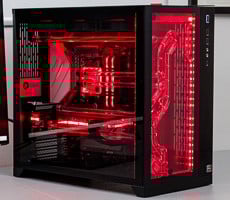
You can select a number of different full-sized desktop cases, with or without removable front doors or side windows, in either black or silver color schemes for the Z55 system. Our test system utilized Velocity Micro’s all-aluminum, signature GX2-W case with a side window to display the system’s craftsmanship. The front of the case is pretty simple, with three 5.25-inch drive bays, two of which are populated with Lite-On 20x DVD+/RW- Dual Layer Burners. There’s also one floppy bay, which houses the 8-in-1 media reader. Below the bays, you’ll find a grill with two fans. There’s another fan on the back of the case. All of the fans, including the fan on the CPU heatsink and the fan on the chipset heatsink, have blue lights. If this isn’t enough light to suit your tastes, you can upgrade to a single or double blue cold cathode chassis light kit ($20 for one light, $40 for two).
The case is sturdy and well built. The system isn’t terribly light, but it is portable enough to tote to and from LAN parties perhaps. For the really mobile-minded, however, we’d suggest investing in the optional $30 wheel kit.
The GX2-W case doesn’t offer any doors to hide the system’s drive bays or power button from little hands, but other case options for this system do offer this additional protection. |
| Interior Design & Layout |
Through the case’s side window, you can see that the interior of the Z55 is roomy and neat. This not only looks clean, but it also helps promote airflow. As one might expect, the heatsink/fan assembly and dual Radeon cards take up the majority of the space near the motherboard. Velocity Micro took great care to route the cables as efficiently as possible to maximize component access. Click image for high res view The case’s side panel easily slides off by removing of two thumb screws. The graphics cards' cables are routed near the edge of the motherboard, which may make it slightly difficult to access the only open 5.25-inch drive bay. Other than that, the cables are largely out of the way. Click images for high res view The two ATI Radeon HD 4850 cards completely block the motherboard’s two PCI Express x1 slots. The single PCI slot is open, but if you were to put a card in it, you would significantly reduce the airflow to the top graphics card. There are six SATA connections on the motherboard. Two are used for the Lite-On drives, and one for 750GB
Click image for high res view
|
| Peripherals & Accessories |
On its Web site and in its press materials, Velocity Micro makes a strong point that each of its systems is built by hand and receives individual attention. Our early-model system didn’t come with Velocity Micro’s traditional owner’s portfolio that contains the system’s manual, driver disks, and accessory pack, likely because we received the system before it was available for purchase. Velocity Micro lists the owner’s portfolio as a standard inclusion when configuring the system on the company’s Web site. We did receive some of the contents of an owner’s portfolio, however, such as the driver and application disc, DX58SO Quick Reference guide, four zip strips, five Velcro ties, five extra screws, Tom Clancy’s Ghost Recon disc, various propaganda, a FarCry2 postcard, an Intel door hanger, AC power cable, and SATA cable. The applications included on the driver and application disc were Acronis True Image 11 Home, CyberLink Live Premium, Diskeeper Home Edition, DivX Pro for Windows,
The Edge Z55 Core i7 Gaming System also comes with a Velocity Micro-branded version of the Creative Multimedia Keyboard Lite and a Velocity Micro-branded version of the Creative Mouse Lite Pro. The USB keyboard has a shiny, black finish with silver hotkeys. The keyboard’s shiny finish picked up a few fingerprints, but they were easily wiped away. The predefined hotkeys include: Back, Forward, Stop, Refresh, Home, Favorites, Calculator, Media Player, Play/Pause, Stop, Previous Track, Next Track, Volume Down, Mute, and Volume Up. The keyboard also has two blue lights that illuminate the area in front of the keyboard. The keys themselves are not backlit and have a pretty light touch, but are a bit noisy.
The USB optical mouse is also black in color. It has a blue backlit scrolling wheel. It also has a removable cover and a Scroll button. No additional cover plates came with our mouse.
|
| Test Setup & SiSoft SANDRA | ||||||||||
![]() We tested the Edge Z55 Intel Core i7 Gaming system exactly as it came configured from Velocity Micro.
We began our testing with SiSoftware's SANDRA XII, the System ANalyzer, Diagnostic and Reporting Assistant. We ran three of the built-in subsystem tests that partially comprise the SANDRA XII suite: Processor Arithmetic, Processor Multi-Media, and Memory Bandwidth.
SiSoft SANDRA's various benchmark modules reported scores for the Edge Z55 Core i7 Gaming System that are in-line with what we would have expected. The Processor Arithmetic test measures almost pure raw CPU power, and the Z55’s Core i7 quad-core outshines the competition. The other systems in the bunch are all quad-cores as well, with the exception of the Athlon X2 6400 64+, which is a dual-core processor. The Processor Multi-Media test is influenced by processor clock speed, but it is also affected by the amount of CPU cache. With the Core i7, Intel’s engineers concluded that a shared L2 cache as used before wasn’t suited to their new quad-core architecture. As a result, the engineers started from scratch and gave each of the cores a Level 2 cache of its own. There’s also 8MB of Level 3 cache for managing communications between cores. |
| Futuremark PCMark Vantage | ||||
![]() For our next round of benchmarks, we ran the complete Futuremark PCMark Vantage test suite. This component of our testing provides a solid assessment of a system's overall performance.
For whatever reason, the Edge Z55 Intel Core i7 Gaming System could not complete the Memories component of this test without failing the process. Each time we tried to run the test, it would hang on this component, regardless of if the system was over clocked or not. The system ran fine without this component of the test, however. Relative to the comparison systems, the Edge Z55 scored very well, blowing past even the overclocked Dell XPS 730 H2C in many of the tests. |
| Cinebench & 3DMark06 CPU | ||||||||
![]() Cinebench R10 is an OpenGL 3D rendering performance test based on Maxon's Cinema 4D, a 3D rendering and animation tool suite used by 3D animation houses and producers like Sony Animation and others. This benchmark is very demanding of system processor resources and is an excellent gauge of pure computational throughput.
This is a multi-threaded, multi-processor aware benchmark that renders a single 3D scene and tracks the length of the entire process. Each test system’s final scores to render the scene are represented below. Raw processing speed and the number of processor cores are the driving force of this processor-intensive test. The Core i7 920 did very well, outperforming all of our other reference systems. These results should be indicative of the type of performance you can expect from CPU-intensive applications, especially those with multi-threading support for four or more cores.
The CPU test component of 3DMark06 is a multi-threaded DirectX gaming metric that can be used to compare relative performance between similarly equipped systems. This test processes two different 3D scenes with a software renderer that depends on the host CPU's performance. Calculations that would normally be reserved for a 3D accelerator are sent to the CPU for processing and rendering. The frame-rate generated in each test determines the final score. Here again, 3DMark06's CPU test is most-heavily influenced by raw processor speed and the number of processor cores. As a result, the Edge Z55's quad-core 2.93GHz Core i7 920 outperforms many of the quad-core based systems, save for the Dell XPS 730, which is overlocked and has an 800MHz+ clock speed advantage. |
| LAME MT & Futuremark 3DMark Vantage | ||||||||
![]() In our custom LAME MT MP3 encoding test, we convert a large WAV file to the MP3 format. This simulates a common scenario that many of us users work with on a regular basis to provide portability and storage of digital audio content. LAME is an open-source, mid- to high- bit-rate and VBR (variable bit rate) MP3 audio encoder that is widely used around the world in a multitude of third party applications.
In this test, we created our own 223MB WAV file and converted it to the MP3 format using the multi-thread capable LAME MT application in single and multi-threaded modes. Processing times are recorded below, listed in seconds. Shorter times equate to better performance.
This LAME MT test is a measure of almost pure processor speed, and is not impacted significantly by L2 cache size or the presence of more than two cores. This test shows the QX9770 processor running at 3.8GHz edging out the Core i7 920 over clocked at 2.93GHz by a few seconds on both the single- and multi-threaded tests. You’ll also notice that the dual-core, E6850 didn’t fare significantly worse than the quad-core i7 920. Many mainstream applications still don’t support multi-threading with more than two cores. As a result, when it comes to encoding audio or video, the results shown here are pretty indicative of the performance you could expect from similar applications.
3DMark Vantage is the latest version of Futuremark's synthetic 3D gaming benchmark. This benchmark is constrained to Windows Vista-based systems because it uses some advanced visual technologies that come by means of DirectX 10, which isn't available on previous versions of Windows. With this latest version of the benchmark, Futuremark added two new graphics tests, two new CPU tests, and several new feature tests, along with support for the latest PC hardware. We used the Performance preset for our test. |
| 3DMark06 Standard Test | ||||
![]() On the next few pages, we'll focus on a few gaming specific benchmarks, starting with the rest of 3DMark06's modules.
![]() 3DMark06 is a hard-core, forward-looking 3D rending benchmark that pushes a system and its GPUs to the limits. The test includes Shader Model 2.0, Shader Model 3.0, and HDR tests. To push the system, scenes are rendered with very high geometric detail and shader complexity, and with extensive use of lighting and soft shadows. The maximum shader length 3DMark06 supports is 512 instructions. The 3DMark06 Overall Score is a weighted average based on the SM 2.0 and HDR / SM3.0, and CPU scores. Here again, the Core i7 920 is at the top of the charts, with a score of 19,017 3DMarks. The processor and dual graphics cards contribute to this score, as would be expected, since real-world 3D game play is influenced by these two subsystem components. As one should expect, both dual Radeon cards outperform the single Radeon card in this test. At the default resolution for the test, it is CPU bound, which helps to explain why the Dell system with a faster processor slightly outperformed our Velocity Micro Z55 Core i7 Gaming System. Again, the Edge Z55 came in behind the Dell XPS system, but beat the dual-Radeon Quad-Crossfire system. To give another perspective on how the Velocity Micro Edge Z55 Core i7 system stacks up, we’ll look at a few real-world gaming tests next. |
| Half Life 2: Episode 2 | ||||
![]()
With its updated game engine, gorgeous visuals, and intelligent weapon and level design, Half Life 2 has become just as popular as its predecessor, the original Half-Life. With Episode 2, you’ll get a number of visual enhancements, such as better-looking transparent texture anti-aliasing. We ran this benchmark at 1,920 x 1,200 with 4X anti-aliasing and 16X anisotropic filtering enabled concurrently. We also enabled color correction and HDR rendering. To benchmark the cards in this test, we used a custom recorded timedemo file. The Edge Z55 put up 187.04 fps on our Half-Life 2: Episode 2 test at 1,920 x 1,200 with 4X AA and 16 AF. This is just 0.13fps lower than the top-scoring Dell XPS system with dual Radeon HD 3870 X2 cards. Other systems put up respectable scores as well, but the Edge Z55 with its dual Radeon HD 4850 cards definitely won out in this largely CPU-bound test setup. |
| Crysis | ||||
![]()
The Edge Z55 didn’t score quite as well in our Crysis test as it had on some of the other benchmarks relative to the other test systems. This is a very taxing benchmark GPU-wise, so an average frame rate of 36.47fps is considered playable. At 39.75fps, the Edge Z55 clicks over the minimum-playability mark, so it still fares pretty well, all things considered. |
| Performance Analysis & Conclusion | ||
![]() Performance Summary: All in all, the Edge Z55 Intel Core i7 Gaming System performed respectably in our benchmark tests. The new Core i7 platform definitely shows performance improvements over previous generation processors and chipsets. In most cases, the Edge Z55 Intel Core i7 Gaming System beat our test systems, or came in at a close No. 2 spot.
![]() During our time with the Edge Z55 Intel Core i7 Gaming System, it performed very well and didn’t give us any grief, except for the Memories test fluke in PC Mark Vantage. Given the way Velocity Micro prides itself in testing each machine before the company sends it out the door, we would expect this system to run well, and it did. With so many vendors quick to shove products out the door in hopes of better profits, we appreciate Velocity Micro’s attention to making sure the system worked as advertised and exhibited quality throughout its build. The Edge Z55's chassis was nice and sturdy. It was also roomy inside of the case, with neatly routed cords and cables. Most of the motherboard and bays were easily accessible, except for the blocked PCI Express x1 slots. Also, even though a person could use the single PCI slot, it’s probably not the best idea because of the way in which it would limit the airflow to the top graphics card. ![]()
|
