|
|
| Introduction and Specifications | ||||
In the conclusion of our coverage of the Radeon HD 4850 and 4870 launch, we made this statement, "...dare we say a $300 graphics card represents an excellent value, from a price point perspective? These cards are definitely going to put significant price pressure on NVIDIA's GTX 200 series." At the time, the GeForce GTX 280 and GTX 260 were selling for upwards of $650 and $400 respectively, and ATI's newly released Radeon, which performed somewhat better than the GTX 260, was introduced at "only" $299.
Above, we have a simple chart detailing the main features and specification of the first-gen GeForce GTX 260 and the new GeForce GTX 260 Core 216. As you can see, not much has changed, at least with respect to the reference specifications. NVIDIA's reference specs for the two cards are virtually identical, with the only real differences coming in the form of an increased number of stream processors (up from 192 to 216) and texture filtering units (up from 64 to 72). NVIDIA achieved this feat, not by designing a totally new GPU, but by enabling one more functional block in the GeForce GTX 260 Core 216's existing GT200 GPU. The GT200 has a total of 10 banks of 24 stream processing units, for a maximum of 240 steam processors (as implemented in the GTX 280). In the first-gen GTX 260, 8 of these banks were enabled, for a total of 192 stream processors. But in the new GeForce GTX 260 Core 216, nine banks are enabled for a total of 216 stream processors. And along with the additional bank of stream processors, eight more texture filering units come along with it. We should note that although the new Core 216 card doesn't have the same GPU configuration, NVIDIA has informed us that the new cards can still be linked with first-gen GeForce GTX 260 cards and operate in SLI mode. That is probably one of the main reasons for amending the GTX 260 name with the Core 216 moniker instead of giving the card a totally new name, like GeForce GTX 270, for example. As for the GeForce GTX 260 Core 216's other features and capabilities, they remain essentially unchanged from the original GeForce GTX 260. For a more complete breakdown of the GT200 GPU at the heart of the GTX 200 series cards, we suggest reading our coverage of the launch from back in June. In that article, we go more in-depth on the GPU, talk much more about PhsyX and CUDA, and breakdown the architecture in greater detail. |
| Our Test Systems and 3DMark06 | ||||||||||||
HOW WE CONFIGURED THE TEST SYSTEMS: We tested all of the graphics cards used in this article on either an Asus nForce 790i SLI Ultra based Striker II Extreme motherboard (NVIDIA GPUs) or an X48 based Asus P5E3 Premium (ATI GPUs) powered by a Core 2 Extreme QX6850 quad-core processor and 2GB of low-latency Corsair RAM. The first thing we did when configuring these test systems was enter their respective BIOSes and set all values to their "optimized" or "high performance" default settings. Then we manually configured the memory timings and disabled any integrated peripherals that wouldn't be put to use. The hard drive was then formatted, and Windows Vista Ultimate was installed. When the installation was complete we fully updated the OS, and installed the latest DX10 redist and various hotfixes, along with the necessary drivers and applications.
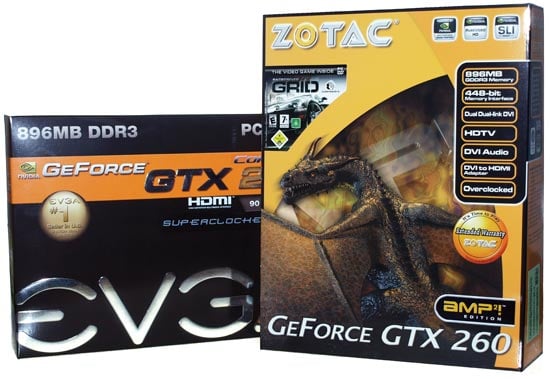
Considering their clock speed differences (the Zotac GeForce GTX 260 AMP^2 Edition is clocked slightly higher than EVGA's offering), the new GeForce GTX 260 Core 216 cards performed just as expected--slightly ahead of the first-gen GTX 260, but just behind the high-end GTX 280. And the increased horsepower gives the Core 216 cards a larger edge over the Radeon HD 4870.
The same hold true in the multi-GPU SLI vs. CrossFire match up, with one notable exception. The GTX 260 Core 216 cards once again fall somewhere in between the first-gen GTX 260 and GTX 280, but superior scaling on the part of the Radeon HD 4870 cards give them the edge in the multi-GPU configuration in this benchmark. |
| 3DMark Vantage | ||||||
The new GeForce GTX 260 Core 216 cards from EVGA and Zotac performed very well in the 3DMark Vantage benchmark. Performance was clearly superior to the first-gen GTX 260 and markedly ahead of the Radeon HD 4870.
Things only got better for the new GeForce GTX 260 Core 216 cards when running them in an SLI configuration. In this test, the GTX 260 Core 216 SLI configuration easily outpaced the first-gen GTX 260 cards running in SLI and a pair of Radeon HD 4870 cards running in a CrossFire configuration. |
| Half Life 2: Episode 2 | ||||||
The Zotac and EVGA GeForce GTX 260 Core 216 cards performed as we expected in our custom Half Life 2: Episode 2 benchmark. In this test, the Core 216 cards once again clearly outpaced the first-gen GTX 260 and pulled well ahead of the Radeon HD 4870. In the multi-GPU tests, the new GTX 260 Core 216 cards put up some very good scores as well. However, the Radeon HD 4870 CrossFire configuration was able to pull ahead at 1920x1200. With the resolution cranked up to 2560x1600 though, the new GeForces came right back and pull well ahead. |
| Unreal Tournament 3 | ||||||
The extra stream processors and goosed clocks of the EVGA and Zotac GeForce GTX 260 Core 216 cards gave them enough added oomph to pull measurably ahead of the Radeon HD 4870 in a single-card configuration, in our custom Unreal Tournament 3 benchmark.
The same held true in the multi-GPU tests. Here, the GeForce GTX 260 Core 216 SLI configuration was only slightly faster than the first-gen GTX 260 cards, and about 3% to 4% faster than the Radeon HD 4870 CrossFire rig. |
| Enemy Territory Quake Wars | ||||||
This benchmark chart, like a couple of the others in this article, clearly illustrate what NVIDIA is trying to do with the new GeForce GTX 260 Core 216. As you can see, the first-gen GeForce GTX 260 just barely lost to the Radeon HD 4870 in ETQW. The new Core 216 cards, however, finished ahead on the 4870. Although the deltas were much different, the same thing plays out in the multi-GPU ETQW tests. Here, once again, the first-gen GTX 260 SLI rig loses to the Radeon HD 4870 CrossFire rig, but the new GeForce GTX 260 Core 216 SLI setup finished well ahead. |
| Crysis v1.2 | ||||||
The new GeForce GTX 260 Core 216 cards performed well in our custom Crysis benchmark. As expected, the higher clocked Zotac card finished just ahead of EVGA's offering. And both cards were well out in front of the Radeon HD 4870.
The GeForce GTX 260 Core 216 SLI configuration showed much better scaling than the Radeons in the multi-GPU tests, and extended their lead in the Crysis benchmark significantly. |
| Power Consumption and Noise | ||||
We'd like to cover a few final data points before bringing this article to a close. Throughout all of our benchmarking and testing, we monitored how much power our test systems were consuming using a power meter. Our goal was to give you an idea as to how much power each configuration used while idling and under a heavy workload. Please keep in mind that we were testing total system power consumption at the outlet here, not just the power being drawn by the motherboards alone.
The new GeForce GTX 260 Core 216 put up some interesting power consumption numbers. Although the difference is small, the Core 216 card actually consumed slightly less power then the first-gen GTX 260 while idling. While under load though, the GeForce GTX 260 Core 216 used a few more watts than its older cousin. In comparison to the Radeon HD 4870, the new GeForce GTX 260 Core 216 cards consumed significantly less power while idling and under load. |
| Our Summary and Conclusion | ||||
Performance Summary: The new GeForce GTX 260 Core 216 performed very well throughout out entire battery of benchmarks. Overall, the GTX 260 Core 216 outperformed the first-gen GeForce GTX 260 in every test--as expected--and outpaced the Radeon HD 4870 in the vast majority of tests as well. The Zotac card we tested was marginally faster than EVGA's offering due to its slightly higher clock speeds, but the differences were small and could be made up for with some mild overclocking. In the multi-GPU tests, the GeForce GTX 260 Core 216 setup performed better than the Radeon HD 4870 CorssFire setup more often than not, but superior scaling in a couple of tests (3DMark06, HL2 1920x1200) gave the Radeons an edge. It seems NVIDIA has done just what they intended to do with the GeForce GTX 260 Core 216. By upping the number of stream processors and texture filtering units in the GPU, they were able to increase the card's performance enough to give it a slight advantage over the Radeon HD 4870. We should reiterate that we tested a couple of factory overclocked cards, however, which give them a performance boost as well, so reference clocked GeForce GTX 260 Core 216 cards will not have as large of an advantage as we have reported here. Regardless, we've given you a look at the performance of the retail product, which is obviously what you should be concerned with more than any reference spec.
|