|
|
| Introduction | |||||||
With the recent run of newer and more affordable graphics cards from ATI, it's almost easy to forget that there's already a sub-$200 frame-rate cruncher called the Radeon HD 4850. Based on the same RV770 chip as the more powerful, yet more expensive HD 4870, the HD 4850 ships with the same 800 stream processors, 40 texture units, and 16 ROPs that have made these cards such hot items. The main area where they differ, other than clock speeds, is in regard to memory. While the HD 4870 ships with high-end GDDR5 memory chips, the HD 4850 finds itself loaded with 512 MB of more mainstream GDDR3.
While the specs above give you a detailed technical overview of what makes the HD 4850 tick, it doesn't cover all of the nuances that you might be looking for. However, since we've already extensively covered the technology behind not only the HD 4850, but the HD 4870 as well, we won't rehash that information here again. If you want to learn more about the technologies employed by ATI, please take a look at the following previous articles, which cover them in detal:
Once up to speed, we'll take a closer look at our two entries in today's HD 4850 Face-off: the HIS Radeon HD 4850 IceQ4 TurboX and Sapphire's Toxic Radeon HD 4850. |
| Sapphire Toxic Radeon HD 4850 512M |
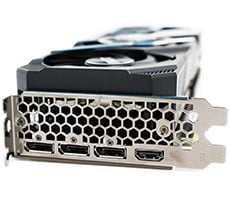
In what we are sure is a completely unintentional coincidence, the Sapphire Toxic HD 4850 ships in a smaller black box adorned by what almost appears to be the Silver Surfer -- a character seen in the last Fantastic Four movie. Inscribed underneath are the words, "Legends Never Die" apparently referring to the level of success that Sapphire has had with the Toxic series, with some specs listed below including 512 MB of GDDR3 memory, factory-overclocked speeds, and cooling provided by Zalman's VF900 HSF. Furthermore, decals placed on the front of the box point out the software in the bundle, including Cyberlink's PowerDVD v7 and DVD Suite v5, Futuremark's latest benchmark: 3DMark Vantage Advanced, and a disc called Ruby Rom which contained demos of John Woo's Stranglehold and Call of Juarez as well as a few wallpapers and screensavers. The rest of the bundle mirrors HIS for the most part, with HDMI and VGA adapters, 6-pin power cable, and a CrossFire bridge cable with an extra S-Video to component video conversion cable thrown in for good measure. Although a majority of Radeon cards used to come with a red PCB, both of today's units ship on green-blue boards instead. While this might have been less noticeable with the HIS version due to the oversized IceQ4 cooler, on Sapphire's Toxic HD 4850 the color scheme is quite prevalent, with matching blue heatsinks placed over the memory and MOSFETs. Rather than large, bulky heatsinks, the ones used here are all isolated from one another and rely on airflow from the fan directly above it for cooling. If there's one company you can point out that produces some of the better performing, yet quieter operating coolers, it would have to be Zalman, and we find that Sapphire has tapped their resources here as well. Zalman's copper-based VF900 rises directly off of the surface of the GPU, using two heatpipes that curl away and form the circular shape that you see above. Heat is dissipated by the air pushed from the central fan over the copper fins surrounding the heatpipes. Unlike other designs, including HIS' IceQ4, this heat is simply radiated out into the chassis rather than expelled out the back, so proper airflow mechanics within the case are a must. Even without a plastic channel to funnel the air, however, the size of the VF900 make this a dual-slot solution as well. Normal operation of the Radeon HD 4850 alone wouldn't warrant the use of a more exotic cooler, but Sapphire's Toxic cards go one better and raise the core speed from the reference speed of 625 MHz to 675 MHz. Memory speeds also get a nice boost from default speeds of 993 MHz to 1100 MHz. Beyond the Zalman cooler and blue heatsinks, the rest of the card consists of a mostly standard layout. Twin CrossFire connectors are placed towards the front end of the board and a single 6-pin power connector lies at the other end. Output consists of dual-DVI connectors with a single S-Video port placed in between. |
| Test System and 3DMark06 Results | ||||||||||||||
|
HOW WE CONFIGURED THE TEST SYSTEMS: We tested all of the graphics cards used in this article on an ASUS Striker II Formula nForce 780i SLI motherboard powered by a Core 2 Duo E6850 dual-core processor and 2GB of low-latency Corsair DDR2 memory. The first thing we did when configuring the test system was to enter their BIOS and set all values to their "optimized" default settings. Then we manually configured the memory timings and disabled any integrated peripherals that wouldn't be put to use. The hard drive was then formatted, and Windows Vista Ultimate and the latest DX10 update was installed. When the installation was complete, we then installed the latest chipset drivers available, and installed all of the other drivers necessary for the rest of our components. Auto-Updating and System Restore were also disabled and the hard drive was defragmented.
The two Radeon HD 4850s showcased in this review start off in a virtual tie with only 21 total 3DMarks separating them. Their collective performance puts them right on par with the GeForce 8800 GTS 512 and overclocked 8800 GT from EVGA, and just ahead of the newer (in name, if not in specs) 9800 GT. There's still a little room, however, between these cards and the more powerful HD 4870 and 9800 GTX+.
When it came time to look at the individual shader model scores, the HD 4850s from HIS and Sapphire didn't fare as well in the SM 2.0 test. Hovering near 5000 points each, the only two cards that were bested here were the ones getting replaced - the HD 3850 and HD 3870 models. The good news is that in the SM 3.0 testing, the complete opposite held true. Both cards zipped right to the top, beating out even the GeForce 9800 GTX+, although ultimately still a good deal behind the HD 4870. |
| 3DMark Vantage | ||||||
The DX10-based 3DMark Vantage is completely dominated by the RV770-powered cards. None of the earlier cards from either camp really even comes close, including the GeForce 9800 GTX+, one of the heavy hitters for NVIDIA before the release of the GTX 260 and 280 cards. Again, we find that within the scope of our review, the two HD 4850s are almost indistinguishable from each other, performance-wise.
|
| Half-Life 2: Episode 2 | ||||||
Sapphire and HIS' Radeon 4850s went toe-to-toe with each other, and with the GeForce 9800 GTX+ as well. And while they couldn't keep up with the faster HD 4870, they did mop up the rest of the compeition from NVIDIA, including the 8800 GTS 512 and an overclocked 8800 GT. |
| Company of Heroes: Opposing Fronts | ||||||
|
Company of Heroes: Opposing Fronts wasn't kind to the Radeons. This DX10-based war title was murder on not only the HD 4850 cards, but on the HD 4870 as well. At 1280x1024, the HD 4850s found themselves anywhere from 10% behind the 9800 GT, to almost 30% compared to the 9800 GTX+. Things fared better at 1600x1200, but both cards still lagged behind the others. |
| Crysis | ||||||
|
Crysis more or less evened the playing field once again, and this time the two HD 4850s find themselves in the middle of the pack. The lead overall went to the HD 4870, just nudging past the 9800 GTX+ at 1280x1024 but dominating at 1600x1200. Both of the HD 4850s trailed immediately after these top two, with minute leads achieved by Sapphire's Toxic model. |
| Enemy Territory: Quake Wars | ||||||
|
Enemy Territory: Quake Wars really tells us two stories here: at lower resolutions the HD 4850s weren't much competition for the majority of similarly priced GeForce cards, with the sole exception being the default clocked 9800 GT from Gigabyte. Compared to the rest of the GeForce cards, we saw a difference of about 10-15 frames per second. However, once we cranked up the resolution to 1600x1200, the dropoff in performance was quite minimal with the HD 4850s, dropping four fps at the most. This moved HIS' and Sapphire's cards right past all other cards except for the HD 4870. |
| Overclocking Results | ||||||||
Overclocking either of the HIS or Sapphire Radeon HD 4850 cards may seem easy; just go into the ATI Catalyst Control Center and click on the Overdrive tab, right? Well, not so fast. Perhaps this might work on default clocked cards, but with caps set at 700 MHz for the GPU and 1200 MHz for the memory, that doesn't leave much room to work with. Instead, we turned to the AMD GPU Overclocking Tool which let us set whatever clock speeds they want. Starting with HIS first, we raised the core and memory speeds about 5 MHz at a time until we found any sort of instability or artifacting. This resulted in a long process of raising speeds, testing, noting the results and then raising speeds once again until finally, at 780MHz on the core and 1195 on the memory we got a black screen and Vista crashed hard. Getting back into Windows, we continued backtracking from there until we finally arrived back at 775 MHz on the GPU, and then went back to the memory overclocking. It appears that we didn't have much further to go, as anything over 1200 MHz caused artifacts to appear when running 3DMark06. Final results for the HIS were 775 MHz GPU and 1200 MHz memory - a 90 MHz bump for the core while gaining 100 MHz on the memory. Next up was Sapphire's Toxic card. With a goal in mind, we quickly raised speeds to just under the results we got with HIS and then moved up more slowly after that. We were only able to go about three rounds of raising speeds before hit our first snag. Once we hit 760 MHz on the core, we would repeatedly get device driver crashes launching any of the benchmark applications. Lowering this speed by a few MHz got us a stable system. The memory, which was already 50 MHz faster than HIS' card to start with also sputtered out early as we were only able to gain an additional 16 MHz there before running into issues. Our results with Sapphire's card were 756 MHz / 1166 MHz, well under what we achieved with the HIS version. Looks like the IceQ4 cooler has earned its merits.
FINAL OVERCLOCKING RESULTS
With our overclocked cards running stable, we decided to give 3DMark Vantage another run-through to see what kind of frame rate increases we might be looking at. Each card saw nearly a 25% increase in GPU speed and 15% on the memory over the default clock speeds of the Radeon HD 4850 (625 / 993). As shown in the 3DMark Vantage GPU tests, that resulted in large increases in the first test's frame rates, with a more modest bump in the second test. Overall, the results of overclocking the cards were quite favorable, giving us performance that was close to but not quite that of the pricier HD 4870. |
| Power Consumption and Thermals | ||||
We'd like to cover a few final data points before bringing this article to a close. Throughout all of our benchmarking and testing, we monitored how much power our test systems were consuming using a power meter. Our goal was to give you an idea as to how much power each configuration used while idling and under a heavy workload. Please keep in mind that we were testing total system power consumption at the outlet here, not just the power being drawn by the motherboards alone.
Out of the cards we used for testing, the Radeon HD 4850s consumed the least power, especially while under load conditions. Interestingly, the differences between the HIS and Sapphire cards is larger than one might expect. The draw at idle conditions had Sapphire's card using 6 more watts than HIS, and 15 more under load. With Sapphire using up more energy, let's see how the cooling fares.
|
| Performance Summary and Conclusion | ||||||||
Performance Summary: In direct comparisons with its main competition, the Radeon HD 4850 finds itself in a nice spot currently - right near the top of the charts overall, and one of the elite cards in the sub-$200 price range. That said, both of the cards featured in this article come pre-overclocked which only helps their performance even more. The 10 MHz advantage in the HIS card's GPU speed and the 50 MHz advantage in memory speed on the Sapphire card, pretty much canceled out any advantages one card may have had over the other, and we found that the HIS and Sapphire cards ended up in a virtual tie throughout our benchmark testing.
HIS Radeon HD 4850 IceQ4 TurboX: With their sixth iteration based on the Radeon HD 4850, we see that HIS isn't content with just pushing out boring reference cards. The IceQ4 cooler that's on this card really hit the mark, offering lower temperatures than we're used to seeing for the HD 4850 without any extra heft. HIS has also pumped up the core speed on this TurboX model card to a speedy 685 MHz, which measurably increased its performance over a reference Radeon HD 4850.
Our Final Verdict: Overall, Sapphire has put out another fine product with the Toxic Radeon HD 4850, but when push comes to shove in the crowded graphic card arena, the HIS Radeon HD 4850 IceQ4 TurboX seems to be the better buy at this time. |