Logo   Banner   TopRight
TopUnder
Transparent
NVIDIA GeForce 9500 GT Mainstream GPU
Transparent
Date: Jul 28, 2008
Section:Graphics/Sound
Author: Marco Chiappetta
Transparent
Introduction and Related Information

NVIDIA Accelerates the Search For a Cure

As much as we love to write about the latest and greatest flagship graphics cards here at HotHardware, the fact of the matter is, cards that fall into the more mainstream market segments are vastly more popular with consumers--at least in terms of the overall sales numbers in the retail channel.  As such, the major players in discreet graphics, currently NVIDIA and ATI, typically drive many more features and into this segment from year to year, while also increasing performance significantly.

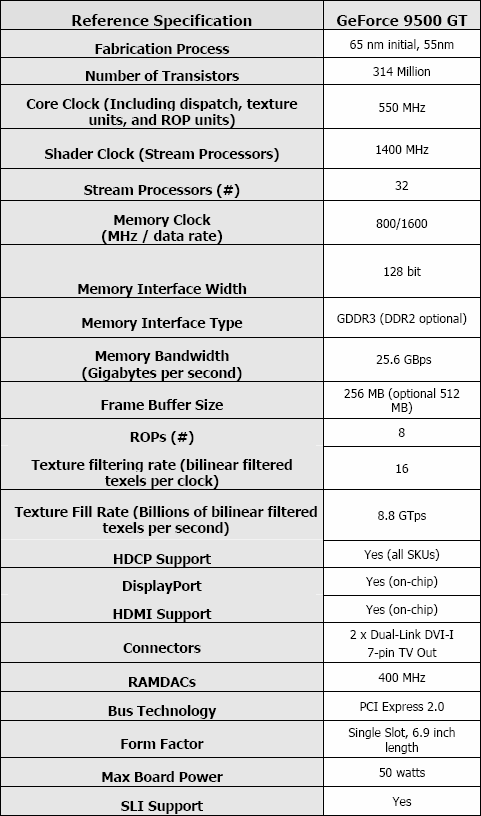
The latest mainstream graphics card to land in our lab comes by way of NVIDIA.  NVIDIA's new GeForce 9500 GT is the company's latest weapon in its arsenal of sub-$100 graphics cards but don't let the relatively low price fool you.  Of course the card won't offer the same level of 3D performance as current high-end, more expensive products.  However, its feature set is comparable to just about anything else on the market.  And its power consumption is nice and low as well.  We'll get into the details in a bit.  For now take a look at the specifications and features...


NVIDIA GeForce 9500 GT
Specifications and Features


In comparison to the recently released GeForce GTX series, the GeForce 9500 GT has only a fraction of the number of stream processors, ROPs, and texture units available, but the GPU's configuration does put it on par with or ahead of the GeForce 8500 / 8600 series of graphics cards, that the 9500 GT will eventually replace (along with the already released GeForce 9600 GT).

As you can see, NVIDIA has disclosed that initial 9500 GT GPUs will be manufactured at 65nm with a 55nm refresh following sometime later.  The GPU is comprised of 314M transistors, with 32 stream processors, and partners will offer a range of cards with frame buffers using either DDR2 or DDR3 memory with sizes likely ranging from 256MB to 512MB.

Transparent
A Close-Up Look At The Card

NVIDIA Accelerates the Search For a Cure

As you can see, the new GeForce 9500 GT is a single-slot solution.  The reference model we received for evaluation and testing was built on a plain-Jane, green PCB, with a cooler featuring a portion of the NVIDIA logo.  We suspect partners like XFX and EVGA, however, may spruce up their designs, as was the case when the GeForce 8600 series launched last year...


Under the card's relatively small cooler, resides a GPU clocked at 600MHz (dispatch, texture units, ROPs) with 32 stream processors clocked at 1.4GHz. As we've mentioned already, cards will likely feature 512MB or 256MB frame buffers (this card has 256MB), clocked at 1000MHz (2000MHz DDR), which will offer up 32GB/s of memory bandwidth over a 128-bit interface. Please note, these clock speeds are higher than the reference specifications listed on the previous page. The GeForce 9500 GT also features 8 ROPs with 16 texture units, and the GPU has a native PCI Express 2.0 interface.

On the output side, much like most other current graphics cards, the GeForce 9500 GT is equipped with a pair of dual-link DVI outputs and a TV/HD component output. Using a dongle, the 9500 GT also supports HDMI output with audio, but the audio must be fed into the card though an S/PDIF input located near its single SLI connector.

Maximum board power is rated at only 50W, which is well below the 75W a PCI Express x16 slot can deliver, so the GeForce 9500 GT does not need supplemental power. And overall board size is a svelte 6.9".

Transparent
GPU - Not Just Got Gaming

As we mentioned in our coverage of the recently released GTX-series, much of NVIDIA's recent marketing has centered around the notion that GPUs aren't just for gaming any longer.  Of course, we've known this to be true for quite some time, but there definitely seems to be more happening in the GPGPU arena as of late.  NVIDIA has also been showing off a number of applications that all benefit from the power of a GPU, and none of them were games.


The application you see pictured above is a beta, pre-release version of Elemental Technologies’ BadaBOOM.  BadaBOOM takes advantage of ETI’s GPU-powered RapiHD Video Platform to offload video encoding duties from the CPU, onto the GPU, to accelerate the process of converting standard-definition video from any format to H.264 for portable media devices, like an iPod, Zune, or iPhone.


A new version of the Folding @ Home client was also recently released which uses NVIDIA GPUs for its calculations. This version of the Folding @  Home client running on a GeForce GTX 280, for example, can processes roughly 500ns / day. That is a massive speed increase compared to existing CPU and previous GPU architectures.  A typical CPU can do about 4ns / day, a PS3 about 100, and Radeon HD 3870 approximately 170.

And of course we can't forget PhysX.  If you remember, NVIDIA acquired AGEIA not too long ago and plans to incorporate PhysX support into all CUDA capable (GeForce 8, 9, and GTX 200 series) graphics cards.  We've done some testing of NVIDIA's beta PhysX-capable driver and even at this relatively early stage everything seemed to work well. Official support for PhysX should be coming in a future driver revision, due out on August 5.

Transparent
Our Test Systems and 3DMark06

NVIDIA Accelerates the Search For a Cure

HOW WE CONFIGURED THE TEST SYSTEMS: We tested all of the graphics cards used in this article on either an Asus nForce 790i SLI Ultra based Striker II Extreme motherboard (NVIDIA GPUs) or an X48 based Asus P5E3 Premium (ATI GPUs) powered by a Core 2 Extreme QX6850 quad-core processor and 2GB of low-latency Corsair RAM. The first thing we did when configuring these test systems was enter their respective BIOSes and set all values to their "optimized" or "high performance" default settings. Then we manually configured the memory timings and disabled any integrated peripherals that wouldn't be put to use. The hard drive was then formatted, and Windows Vista Ultimate was installed. When the installation was complete we fully updated the OS, and installed the latest DX10 redist and various hotfixes, along with the necessary drivers and applications.

HotHardware's Test Systems
Intel and NVIDIA Powered


Hardware Used:
Core 2 Extreme QX6850 (3GHz)

Asus Striker II Extreme
(nForce 790i SLI Ultra chipset)

Asus P5E3 Premium
(X48 Express)

Radeon HD 3650
Radeon HD 3850
GeForce 9500 GT
GeForce 8600 GTS
GeForce 9600

2048MB Corsair DDR3-1333 C7
(2 X 1GB)

Integrated Audio
Integrated Network

Western Digital "Raptor" 74GB
(10,000RPM - SATA)


Relevant Software:

Windows Vista Ultimate SP1
DirectX June 2008 Redist

NVIDIA Forceware v177.72 / v177.39
ATI Catalyst v8.7

Benchmarks Used:
3DMark06 v1.0.2
3DMark Vantage v1.0.1
Unreal Tournament 3 v1.2*
Crysis v1.2*
Half Life 2: Episode 2*
Enemy Territory: Quake Wars*

* - Custom Benchmark

Futuremark 3DMark06
Synthetic DirectX Gaming


3DMark06

3DMark06 is a synthetic benchmark, designed to simulate DX9-class game titles. This version differs from the earlier 3Dmark05 in a number of ways, and includes not only Shader Model 2.0 tests, but Shader Model 3.0 and HDR tests as well. Some of the assets from 3DMark05 have been re-used, but the scenes are now rendered with much more geometric detail and the shader complexity is vastly increased. Max shader length in 3DMark05 was 96 instructions, while 3DMark06 ups that number to 512. 3DMark06 also employs much more lighting and there is extensive use of soft shadows. With 3DMark06, Futuremark has also updated how the final score is tabulated. In this latest version of the benchmark, SM 2.0 and HDR / SM3.0 tests are weighted and the CPU score is factored into the final tally as well.


According to 3DMark06's default benchmark, the new GeForce 9600 GT offers performance well ahead of a Radeon HD 3650, and about on par with a GeForce 8600 GTS.  Take a step up to the GeForce 9600 GT or Radeon HD 3850 though, and performance is significantly increased.


As we tunnel down in to the individual 3DMark06 results, we see how the final score is tabulated.  The performance trend doesn't change with the individual results, with the GeForce 9500 GT out in front of the Radeon HD 3650 but just behind the 8600 GTS.

Transparent
3DMark Vantage

NVIDIA Accelerates the Search For a Cure

Futuremark 3DMark Vantage
Synthetic DirectX Gaming


3DMark Vantage

The latest version of Futuremark's synthetic 3D gaming benchmark, 3DMark Vantage, is specifically bound to Windows Vista-based systems because it uses some advanced visual technologies that are only available with DirectX 10, which y isn't available on previous versions of Windows.  3DMark Vantage isn't simply a port of 3DMark06 to DirectX 10 though.  With this latest version of the benchmark, Futuremark has incorporated two new graphics tests, two new CPU tests, several new feature tests, in addition to support for the latest PC hardware.  We tested the graphics cards here with 3DMark Vantage's Performance preset option, which uses a resolution of 1280x1024, with no anti-aliasing or anisotropic filtering.

The 3DMark Vantage overall scores here are skewed by NVIDIA's PhysX implementation, which affects one of the CPU benchmark, and oddly couldn't be disabled on our test rig.  No matter, however, as the individual GPU test results are next--and they follow the exact same performance trend anyway.


These results essentially mirror what we saw with 3DMark06.  The new GeForce 9500 GT is markedly faster than a Radeon HD 3650 and is almost able to catch the GeForce 8600 GTS.  The more powerful card, which are only slightly more expensive, however, put up much better scores.

Transparent
Half Life 2: Episode 2

NVIDIA Accelerates the Search For a Cure

Half Life 2: Episode 2
DirectX Gaming Performance


Half Life 2:
Episode 2

Thanks to the dedication of hardcore PC gamers and a huge mod-community, the original Half-Life was one of the most successful first person shooters of all time. And courtesy of an updated game engine, gorgeous visuals, and intelligent weapon and level designs, Half Life 2 became just as popular.  Episode 2 - the most recent addition to the franchise - offers a number of visual enhancements including better looking transparent texture anti-aliasing. These tests were run at resolutions of 1,280 x 1,024 and 1,680 x 1,050 with 4X anti-aliasing and 16X anisotropic filtering enabled concurrently.  Color correction and HDR rendering were also enabled in the game engine as well.  We used a custom recorded timedemo to benchmark all cards for these tests.


The new GeForce 9500 GT and GeForce 8600 GTS performed right on top of each other in our custom Half Life 2: Episode 2 benchmark, with only a couple of frames per second separating the two. Once again, the 9500 GT significantly outpaced the Radeon HD 3650 and the higher-end cards couldn't be touched.

Transparent
Unreal Tournament 3

NVIDIA Accelerates the Search For a Cure

Unreal Tournament 3
DirectX Gaming Performance


Unreal Tournament 3

If you're a long-time PC gamer, the Unreal Tournament franchise should need no introduction.  UT's fast paced action and over the top weapons have been popular for as long as Epic has been making the games.  For these tests, we used the latest addition to the franchise, Unreal Tournament 3.  The game doesn't have a built-in benchmarking tool, however, so we enlisted the help of FRAPS here.  These tests were run at resolutions of 1,920 x 1,200 and 2,560 x 1,600 with no anti-aliasing or anisotropic filtering enabled, but with the UT3's in game graphical options set to their maximum values, with color correction enabled.


Talk about sounding like a broken record.  Our custom Unreal Tournament 3 benchmark yielded results very similar to what we saw with HL2:EP2 on the previous page.  The 9500 GT clobbers the Radeon HD 3650, hangs with the GeForce 8600 GTS, and trails the Radeon HD 3850 and GeForce 9600 GT.

Transparent
Enemy Territory: Quake Wars

NVIDIA Accelerates the Search For a Cure

Enemy Territory: Quake Wars
OpenGL Gaming Performance


Enemy Territory:
Quake Wars

Enemy Territory: Quake Wars is Based on a radically enhanced version of id's Doom 3 engine and viewed by many as Battlefield 2 meets the Strogg, and then some.  In fact, we'd venture to say that id took EA's team-based warfare genre up a notch or two.  ET: Quake Wars also marks the introduction of John Carmack's "Megatexture" technology that employs large environment and terrain textures that cover vast areas of maps without the need to repeat and tile many smaller textures.  The beauty of megatexture technology is that each unit only takes up a maximum of 8MB of frame buffer memory.  Add to that HDR-like bloom lighting and leading edge shadowing effects and Enemy Territory: Quake Wars looks great, plays well and works high end graphics cards vigorously.  The game was tested with all of its in-game options set to their maximum values with soft particles enabled in addition to 4X anti-aliasing and 16x anisotropic filtering.


Our custom Enemy Territory: Quake Wars benchmark tells essentially the same story as all of the previous tests. The ne GeForce 9500 GT finished well ahead of the Radeon HD 3650, but just behind the GeForce 8600 GTS.

Transparent
Crysis v1.2

NVIDIA Accelerates the Search For a Cure

Crysis v1.2
DirectX 10 Gaming Performance


Crysis

If you're at all into enthusiast computing, the highly anticipated single player, FPS smash-hit Crysis, should require no introduction. Crytek's game engine produces some stunning visuals that are easily the most impressive real-time 3D renderings we've seen on the PC to date.  The engine employs some of the latest techniques in 3D rendering like Parallax Occlusion Mapping, Subsurface Scattering, Motion Blur and Depth-of-Field effects, as well as some of the most impressive use of Shader technology we've seen yet.  In short, for those of you that want to skip the technical jib-jab, Crysis is a beast of a game.  We ran the full game patched to v1.2 with all of its visual options set to 'High' to put a significant load on the graphics cards being tested  A custom demo recorded on the Island level was used throughout testing.


The GeForce 9500 GT handled Crysis quite well, relatively speaking. Though obviously, you'd have to drop the resolution down another notch at least, along with image quality, to get playable frame rates.  In this test, the GeForce 9500 GT was able to pull just ahead of the GeForce 8600 GTS, unlike many of the others.

Transparent
SD and HD Video Performance

NVIDIA Accelerates the Search For a Cure

We also did some quick testing of the GeForce 9500 GT's video processing engine, in terms of both image quality and CPU utilization with some HQV and H.264 playback tests.

Video Playback Performance: SD and HD
HQV and H.264

HQV is comprised of a sampling of SD video clips and test patterns that have been specifically designed to evaluate a variety of interlaced video signal processing tasks, including decoding, de-interlacing, motion correction, noise reduction, film cadence detection, and detail enhancement. As each clip is played, the viewer is required to "score" the image based on a predetermined set of criteria. The numbers listed below are the sum of the scores for each section. We played the HQV DVD using the latest version of Cyberlink's PowerDVD 8 Deluxe, with hardware acceleration for AMD AVIVO HD and NVIDIA PureVideo HD extensions enabled.


Both ATI's and NVIDIA's latest GPUs have no trouble with SD video playback.  All three of the cards put up near perfect scores in the HQV test.  In case you're not familiar with HQV, 130 points is the maximum score attainable.  At 128 points, a PC equipped with either of these graphics cards plays back DVD video at quality levels better than the vast majority of set-top DVD players on the market.

We should note, however, the GeForce 9500 GT did even better than this score suggests. Althoug HQV's scoring guidelines prohibit a perfect score here, it does perform somewhat better than ATI's offering in the Jaggies 1 and Jaggies 2 tests.


Next we conducted a test using an H.264 encoded movie trailer clip for "Beowulf" which is available for download on Apple's QuickTime HD website.  The CPU utilization data gathered during these tests was taken from Windows Vista's built-in Performance Monitor. The graphs show the CPU utilization for a GeForce 9500 GT and a Radeon HD 4870 using PowerDVD HD to playback the QuickTime clip.


GeForce 9500 GT


Radeon HD 4870


With a fast quad-core processor powering our test system and an unencrypted HD video clip being played back, all of the cards we tested had low CPU utilization in this test.  We should note that with hardware acceleration disabled, playing this video clip results in about 12% - 15% average CPU utilization, so there is a marked improvement with both PureVideo HD and UVD 2.  Also note that with encrypted content, like many off the shelf Blu-Ray discs for example, CPU utilization will be measurably higher that what you see here.  However, both platforms should have no trouble playing back high def digital video.

Transparent
Power Consumption and Noise

NVIDIA Accelerates the Search For a Cure

We'd like to cover a few final data points before bringing this article to a close. Throughout all of our benchmarking and testing, we monitored how much power our test systems were consuming using a power meter. Our goal was to give you an idea as to how much power each configuration used while idling and under a heavy workload. Please keep in mind that we were testing total system power consumption at the outlet here, not just the power being drawn by the motherboards alone.

Total System Power Consumption
Tested at the Outlet


Although the current iteration of the GeForce 9500 GT is manufactured using a 65nm process, as opposed to the 55nm process of the Radeon's, it still exhibits very good power characteristics.  In fact, the GeForce 9500 GT was the lowest power consumer of the bunch while idling and under load.

As you would expect with power consumption this low, heat output is also quite low, and the card's cooler is nice and quiet. We wouldn't call the GeForce 9500 GT silent due to its active cooler, but it is definitely a quiet product, well suited to the HTPC crowd.  We'd also suspect passively cooled models will be available at some point in the future as well, if history is any indicator.

Transparent
Our Summary and Conclusion

NVIDIA Accelerates the Search For a Cure

Performance Summary: Thanks to extremely consistent performance across our battery of benchmarks, it is very easy to summarize the new GeForce 9500 GT's capabilities.  The GeForce 9500 GT is measurably faster than the Radeon HD 3650 NVIDIA is targeting with this release, and it performs about on-par with the GeForce 8600 GTS, which debuted at a much higher price point.  The GeForce 9500 GT, however, is no match for the somewhat more expensive GeForce 9600 GT or Radeon HD 3850.


NVIDIA has informed us that the GeForce 9500 GT should be priced below $100, with obvious variances based on clock speeds and frame buffer size.  And cards should be available immediately.  In the current 3D graphics landscape, $100 can get you a solid product, with new product offerings from both camps.  In fact, there are a couple of Radeon HD 3850's available for well below $100 after mail in rebates at the moment, which currently makes them very attractive options as well.  Based on 3D performance alone, we suspect the GeForce 9500 GT's price will probably settle in below the Radeon HD 3850--think in the $80 range give or take a few bucks--but the 9500 GT does have some characteristics that may make it more desirable for some users.  HTPC  users, for example, may be enticed by the GeForce 9500 GT's diminutive size, quiet cooler, and low power consumption.

In the end though, perhaps now more than ever, consumers need to be vigilant of graphics card pricing.  In the last few weeks alone, the landscape has changed considerably, so something that is a great buy today, may not be quite as competitive tomorrow.  As for the GeForce 9500 GT specifically, if street prices settle at or below the $80 range, it should be a rather compelling product for mainstream consumers.

Update: GeForce 9500 GT cards have hit NewEgg already.  An EVGA 512MB DDR2 model is available for $69 and a significantly overclocked Gigabyte 512MB DDR3 model is available for $89.


  • Decent Performer
  • Low Power Consumption
  • Low Noise
  • Single-Slot
  • SLI Capable
  • Great SD/HD Video Playback
  • Not quite as fast as an 8600 GTS
  • Radeon HD 3850 available at a similar price point


Content Property of HotHardware.com