Logo   Banner   TopRight
TopUnder
Transparent
AMD Phenom X4 9350e and 9950 BE Debut
Transparent
Date: Jul 01, 2008
Section:Processors
Author: Marco Chiappetta
Transparent
Introduction and Specifications


AMD is launching a three-pronged attack on the desktop CPU space today, with the introduction of three new quad-core Phenom X4 processors.  One of the processors, the new Phenom X4 9950 Black Edition, is AMD's latest flagship desktop CPU.  The other two, however, are somewhat surprisingly "green", low-power quad-cores dubbed the Phenom X4 9350e and Phenom X4 9150e.

With its Black Edition branding, it should be obvious to the power user among you that the Phenom X4 9950 BE is targeted squarely at enthusiasts and overclockers.  But the audience for the Phenom X4 9350e and Phenom X4 9150e processors is a little harder to quantify.   We'll explain what we mean by this a little later.  For now, let's take a look at these new processors' features and specifications to see what each brings to the party...
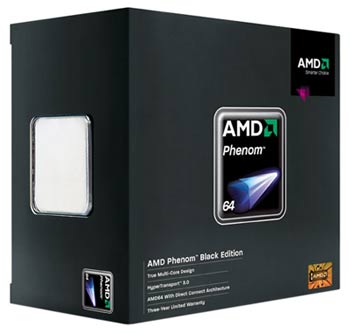
 
AMD Phenom Black Edition Retail Box

AMD Phenom X4 Processors 
Specifications and Features

Model / Processor Frequency: AMD Phenom Processor Model X4 9950, 9350e, 9150e / 2.6GHz, 2.0GHz, 1.8GHz
L1 Cache Sizes: 64K of L1 instruction and 64K of L1 data cache per core (512KB total L1 per processor)
L2 Cache Sizes: 512KB of L2 data cache per core (2MB total L2 per processor)
L3 Cache Size: 2MB (shared)
Memory Controller Type: Integrated 128-bit wide memory controller, capable of being configured for dual 64-bit channels for simultaneous read/writes
Memory Controller Frequency: Up to 1.6GHz - 2.0GHz with Dual Dynamic Power Management
Types of Memory: Support for unregistered DIMMs up to PC2 8500 (DDR2-1066MHz)
HyperTransport 3.0: One 16-bit/16-bit link @ 3200MHz to 3600MHz full duplex
Total Processor Bandwidth: Up to 33.1 GB/s bandwidth (9950), 31,5GB/s (9350e), 29.9GB/s (9150e)
Packaging: Socket AM2+ 940-pin organic micro pin grid array (micro-PGA) (backward compatible with Socket AM2)
Fab location: AMD's Fab 36 wafer fabrication facilities in Dresden, Germany
Process Technology: 65nm (.065-micron) DSL Silicon on Insulator (SOI)
Approximate Transistor count: approx. 450 million (65nm)
Approximate Die Size: 285 mm2 (65nm)
Nominal Voltage: 1.05-1.3 Volts (9950), 1.0-1.125v (9150e, 9350e)
Max Ambient Case Temp: 61 degress (9950) 70 degrees (9350e, 9150e) Celsius
Max TDP: 140 Watts (9950), 65 Watts (9350e, 9150e)
ACP: *to be announced after launch
Future Memory Controller Note: Future 45nm processors versions are planned to include support for DDR3 memory


AMD Phenom X4 9950 Black Edition and 9350e Side-By-Side

Strictly from a technical standpoint, the new flagship Phenom X4 9950 and more power-friendly Phenom X4 9350e and Phenom X4 9150e processors are essentially identical.  They are all based on the same core and have very similar feature sets.  They only differ in their rated clock speeds and associated power ratings.
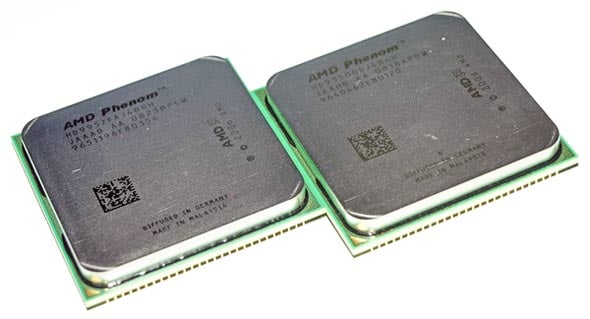
The Phenom X5 9950 Black Edition, due to its relatively high clock speed (for a Phenom) has a max TDP of 140 watts - the highest of any AMD Phenom CPU.  To reach its 2.6GHz clock speed, the chip requires 1.05 - 1.3 Volts.  The 2.0GHz and 1.8GHz Phenom X4 9350e and Phenom X4 9150e processors, however, are on the opposite end of the spectrum.  These two processors are selectively binned and require a maximum of only 1.125v, which results in a much lower 65 watt TDP.  We should also point out that at 65W, the Phenom X4 9350e and Phenom X4 9150e processors are technically the most power friendly desktop quad core processors available.

Transparent
Vital Signs and Overclocking


As you saw on the previous page, the new Phenom X4 9950 Black Edition and Phenom X4 9350e physically look just like all current Phenom processors. They utilizes the same packaging and 940-pin Socket AM2+ configuration.


Details from CPU-Z with the Phenom X4 9350e

 
Details from CPU-Z with the Phenom X4 9950


We recieved Phenom X4 9950 Black Edition and X4 9350e processors for testing, hence the two sets of CPU-Z screen shots above.  As you can see, CPU-Z correctly identifies and outlines the Phenom X4 9950's X4 9350e's inner workings, save for the missing "e" in the 9350e's name.  The processors are based on the Agena core with socket AM2+ packaging.  They are clocked at 2.6GHz (13 x 200MHz) and 2.0GHz (10 x 200MHz) respectively.  Both chips are reported as stepping ‘DR-B3’ and they both support all of the instructions sets listed in the aptly names "instructions" section of CPU-Z.  The processors' 2MB L2 cache configuration (512KB per core) is 16-way set associative, but their 2MB of shared L3-cache is 32-way set associative.  With the exception of their clock speeds and power ratings mentioned on the previous page, technically, nothing else has changed with these new chips since the introduction of the first B3-Phenoms.

Overclocking The Phenom X4 9950
Pedal To The Metal

We know many of you are wondering just how much clock speed headroom these new Phenoms have left under their hoods, so we spent some time overclocking our chips using a Gigabyte 790FX-chipset based motherboard.  Because the Phenom X4 9950 is a "Black Edition" processor, its multiplier is unlocked and can be increased for east overclocking.  The X4 9350e, however could only be overclocked by altering the HT frequency, which requires much more work.


Phenom X4 9950 Overclocked to 3.1GHz


By altering its multiplier and increasing the CPU voltage to 1.45v, we were able to take our Phenom X4 9950 to an respectable 3.1GHz using nothing but a stock AMD PIB cooler.  Higher frequencies were possible, but we couldn't keep the system 100% stable, so we backed things down to 3.1GHz.  While running at that speed, we re-ran some tests and also monitored core temperatures and found that the chip never broke the 60ºC mark, and hovered around 58ºC under load  - at least according to AMD's Overdrive software.  That is one heck of an overclock and relatively cool temperatures for a Phenom in our opinion.  If the majority of chips have the same amount of headroom as ours, we suspect the 9950 Black Edition will be appealing to AMD CPU enthusiasts looking for the best the company has to offer.

As for the X4 9350e, we couldn't stabilize our system with any HT reference clock above 277MHz, which resulted in a respectable overclock to 2.77GHz.  To acheive that speed, however, we had to drop the HT link and memory controller multipliers, as you can see in the CPU-Z screenshot to the left.

Transparent
Our Test Systems and SANDRA


How We Configured Our Test Systems: When configuring our test systems for this article, we first entered their respective system BIOSes and set each board to its "Optimized" or "High performance Defaults". We then saved the settings, re-entered the BIOS and set memory timings for either DDR2-1066 (AMD) with 5,5,5,15 timings or DDR3-1333 with 7,7,7,20 timings (Intel). The hard drives were then formatted, and Windows Vista Ultimate was installed. When the Windows installation was complete, we updated the OS, and installed the drivers necessary for our components. Auto-Updating and Windows Defender were then disabled and we installed all of our benchmarking software, defragged the hard drives, and ran all of the tests.

 HotHardware's Test Systems
 Intel and AMD - Head To Head 

System 1:
Core 2 Extreme QX9650
(3.0GHz - Quad-Core)
Core 2 Quad Q6600
(2.40GHz - Quad-Core)
Core 2 Duo E6850
(3.0GHz - Dual-Core)

Asus P5E3 Premium
(X48 Chipset)

2x1GB Corsair DDR3-1800
CL 7-7-7-20 - DDR3-1333

GeForce 8800 GTX
On-Board Ethernet
On-board Audio

WD740 "Raptor" HD
10,000 RPM SATA

Windows Vista Ultimate
NVIDIA Forceware v163.75
DirectX Redist (November 2007)

System 2: 
AMD Phenom X4 9950
(2.6GHz)
AMD Phenom X4 9350e
(2.0GHz)
AMD Phenom X3 8750
(2.4GHz)
AMD Phenom X4 9850
(2.5GHz)
AMD Phenom 9600
(2.3GHz)
AMD Athlon 64 X2 4600+
(2.4GHz) 

Gigabyte GA-MA790FX-DQ6
(AMD 790FX Chipset)

2x1GB Corsair PC2-8500
CL 5-5-5-15 - DDR2-1066

GeForce 8800 GTX
On-Board Ethernet
On-board Audio

WD740 "Raptor" HD
10,000 RPM SATA

Windows Vista Ultimate
NVIDIA Forceware v163.75
DirectX Redist (November 2007)


 Preliminary Testing with SiSoft SANDRA XII SP2a
 Synthetic Benchmarks


We began our testing with SiSoftware's SANDRA XII, the System ANalyzer, Diagnostic and Reporting Assistant. We ran three of the built-in subsystem tests that partially comprise the SANDRA XII suite with AMD's new Phenom X4 9950 and X4 9350e processors (CPU Arithmetic, Multimedia, and Memory Bandwidth).  All of the scores reported below were taken with the processors running at their default clock speeds of 2.6GHz and 2.0GHz, with 2GB of DDR2-1066 RAM running in unganged mode.


Processor Arithmetic
Phenom X4 9350e


Multimedia
Phenom X4 9350e


Memory Bandwidth
Phenom X4 9350e


Processor Arithmetic
Phenom X4 9950


Multimedia
Phenom X4 9950


Memory Bandwidth
Phenom X4 9950


SiSoft SANDRA's various benchmark modules reported scores right in-line with logical expectations.  The higher-clocked Phenom X4 9950 was faster than any other AMD quad-core CPU and the lower-clocked X4 9350e finished behind the other AMD-based quad-cores, and they both trailed Intel's quad-core offerings by significant amounts in the processor arithmetic and multimedia tests. In the memory bandwidth tests though, the new Phenoms shot to the head of the pack with peak bandwidth of greater than 10GB/s for both.

Transparent
PCMark Vantage

We ran a handful of processors and platforms, including the new Phenom X3 8750, through Futuremark’s latest system performance metric built especially for Windows Vista, PCMark Vantage. PCMark Vantage runs through a host of different usage scenarios to simulate different types of workloads including High Definition TV and movie playback and manipulation, gaming, image editing and manipulation, music compression, communications, and productivity.  Most of the tests are multi-threaded as well, so the tests can exploit the additional resources offered by a quad-core CPU.

Futuremark PCMark Vantage
Simulated Application Performance


The new Phenom X4 9950 and 9350e performed just as expected in the PCMark Vantage suite of benchmark tests.  The 9950's higher clock speed make it the fasted AMD CPU released to date, but the 9350e has trouble hanging with any of the competing offerings tested here.

Transparent
LAME MT and Kribibench v1.1

In our custom LAME MT MP3 encoding test, we convert a large WAV file to the MP3 format, which is a popular scenario that many end users work with on a day-to-day basis to provide portability and storage of their digital audio content.  LAME is an open-source mid to high bit-rate and VBR (variable bit rate) MP3 audio encoder that is used widely around the world in a multitude of third party applications.

LAME MT
Audio Encoding

In this test, we created our own 223MB WAV file (a hallucinogenically-induced Grateful Dead jam) and converted it to the MP3 format using the multi-thread capable LAME MT application in single and multi-thread modes. Processing times are recorded below, listed in seconds. Once again, shorter times equate to better performance.


Our custom LAME MT benchmark heavily favored the Intel processors, whether running in single- or multi-threaded mode. The Phenom X4 Black Edition put up the best numbers of any AMD processor, as expected, and the much lower-clocked 9350e trailed by a decent margin.


Kribibench v1.1
CPU-Bound 3D Rendering

For this next batch of tests, we ran Kribibench v1.1, a 3D rendering benchmark produced by the folks at Adept Development.  Kribibench is an SSE aware software renderer where a 3D model is rendered and animated by the host CPU and the average frame rate is reported.  We used two of the included models with this benchmark: a "Sponge Explode" model consisting of over 19.2 million polygons and the test suite's "Ultra" model that is comprised of over 16 billion polys.


The Phenom X4 9950 Black Edition performed well in the Kribibench tests, besting the Core 2 Quad Q6600.  The Phenom X4 9950e finished somewhere in between the triple-core 8750 and higher-clocked Phenom 9600.

Transparent
Cinebench R10 and 3DMark06

Cinebench R10 is an OpenGL 3D rendering performance test based on Cinema 4D. Cinema 4D from Maxon is a 3D rendering and animation tool suite used by 3D animation houses and producers like Sony Animation and many others.  It's very demanding of system processor resources and is an excellent gauge of pure computational throughput.

Cinebench R10
3D Rendering

This is a multi-threaded, multi-processor aware benchmark that renders a single 3D scene and tracks the length of the entire process. The time it took each test system to render the entire scene is represented in the graph below, listed in seconds.


Once again, the new Phenom X4 9950 Black Edition was the fastest of the AMD-built processors, but it couldn't compete with the Core 2 Quad Q6600 or the Core 2 Extreme QX9650 though.  The Phenom X4 9350e also trailed all of the competing offerings in the single-threaded test and finished right in between the tri-core X3 8750 and quad-core 9600 in the mult-threaded test.

Futuremark 3DMark06
Synthetic DirectX Gaming


3DMark06's built-in CPU test is a multi-threaded DirectX gaming metric that's useful for comparing relative performance between similarly equipped systems.  This test consists of two different 3D scenes that are processed with a software renderer that is dependent on the host CPU's performance.  Calculations that are normally reserved for your 3D accelerator are instead sent to the CPU for processing and rendering.  The frame-rate generated in each test is used to determine the final score.


According to 3DMark06's built-in CPU benchmark module, the Phenom X4 9950 is a tad more powerful than a Core 2 Quad Q6600 - the QX9650 can't be touched though.  And once again, the Phenom X4 9350e came in between the tri-core X3 8750 and quad-core 9600.

Transparent
Gaming: Crysis and F.E.A.R.


For our next set of tests, we moved on to some in-game benchmarking with Crysis and F.E.A.R. When testing processors with Crysis or F.E.A.R., we drop the resolution to 800x600, and reduce all of the in-game graphical options to their minimum values to isolate CPU and memory performance as much as possible.  However, the in-game effects, which control the level of detail for the games' physics engines and particle systems, are left at their maximum values, since these actually do place some load on the CPU rather than GPU.

Low-Resolution Gaming: Crysis and F.E.A.R.
Taking the GPU out of the Equation


Our gaming benchmarks mirror much of what we have seen up to this point.  The Phenom X4 9950 Black Edition proved to be AMD's most potent CPU to date in both the F.E.A.R. and Crysis benchmarks.  The lower-clocked Phenom X4 9350e, however, trailed its higher clocked competition.

Transparent
Total System Power Consumption


Before we bring this article to a close, we'd like to cover a few final data points. Throughout all of our benchmarking and testing, we monitored how much power our test systems were consuming using a power meter. Our goal was to give you an idea as to how much power each configuration consumed while idling and under a heavy workload. Please keep in mind that we were testing total system power consumption at the outlet here, not just the power being drawn by the motherboards alone.

Total System Power Consumption
Tested at the Outlet


The Phenom X4 9950 Black Edition and X4 9350e couldn't be more different from a power-consumption perspective.  As expected, the higher-clocked X4 9950 with its 140 watt TDP consumed the more power under load than any of the other processors we tested.  The 65W Phenom X4 9350e, however, was much more power friendly and consumed only slightly more power than a dual-core Athlon 64 X2 4600+.  Also note, that with a different motherboard, the AMD power consumption scores would likely be even lower, as the early revision Gigabyte 790FX motherboard we used for testing consumes more power than some other 790FX-based products.

Update: Because the new Phenom X4 9350e is an energy efficient CPU targeted at more mainstream users, and won't necessarily be paired up with a high-end motherboard and graphics card like we used for the testing above, we decided to take it for a spin in a micro-ATX AMD-780G based Gigabyte GA-MA78GM-S2H motherboard as well.  With a more power friendly board like this, using the IGP, power consumption was considerably lower.  In fact, the Phenom X4 9350e idled at around 69 watts and peaked under load at 132 watts.  That's a huge difference in comparison to the 790FX / 8800 GTX combo above.

Transparent
Our Summary and Conclusion


Performance Summary: Summarizing the performance of the Phenom X4 9950 Black Edition processor is a relatively easy matter.  The Phenom X4 9950 is the fastest desktop CPU to be released by AMD to date.  Due to its 2.6GHz core clock speed, the X4 9950 is roughly 4% faster than the X4 9850 across the board.  In comparison to Intel's offerings, the Phenom X4 9950 is about on par with the Core 2 Quad Q6600, trading victories depending on the test.  The new Phenom X4 9350e is a little harder to categorize.  As expected, due to its relatively low clock speed, the X4 9350e finished behind AMD's other quad-core offerings.  It was, however, faster than the higher-clock tri-core Phenom X3 8750 in most multi-threaded benchmarks.  In single-threaded applications though, the X4 9350e's 2.0GHz core clock resulted in comparatively lower performance.


The new Phenom X4 processors being released by AMD today will appeal to two totally different types of consumer.  The Phenom X4 9950 Black Edition is an obvious candidate for AMD enthusiasts looking for the best CPU AMD has to offer.  It's 140 W TDP means it is only suited to higher-end motherboards that can supply the necessary power, but anyone looking for a Black Edition should be pairing it with an appropriate enthusiast-class or professional series motherboard anyway.

The Phenom X4 9350e's appeal isn't quite as broad.  Because AMD has a number of higher-clocked dual- and tri- core processors at a similar price point, the X4 9350e is best suited to more specific types of user.  If you're a heavy multi-tasker on a budget (or regularly use multi-threaded applications), the Phenom X4 9350e's four cores will ultimately pay dividends.  The CPU is particularly well suited to HTPC applications as well, due to its quad-core architecture and relatively low 65W TDP.  This chip is a great match for an AMD 780G-based motherboard, and can easily be the basis of a sub-$500, eco-friendly, quad-core system when paired with the right components. On the other hand,  as we saw in our power numbers, a 790FX-based platform doesn't match up well versus current Intel offerings (especially the GB board we used), in terms of performance per watt.  And Intel obviously still holds onto the overall performance crown and has a number of competing offerings that are just as compelling.

In regard to pricing, the Phenom X4 9950 comes in at $235 - the same price point as the X4 9850 Black Edition.  We're told the Phenom X4 9850 BE will remain at $235 as well, but only for one week.  On July 7th the 9850's price drops to $205.  Also note that AMD is planning to make future 9850's non-black edition parts, which means they're multipliers can't be increased.  This won't happen until sometime later in the year though.  Phenom X4 9350e and 9150e processors will be offered for sale at $195 and $175, respectively.  That makes them two of the most affordable quad-core processor out there.

In the end, the release of these new Phenom processors further expands AMD's quad-core processor line-up with new high-end and new energy-efficient processors.  With only about $60 separating AMD's highest and lowest-clocked quad-cores, however, and a smattering of tri- and dual-core chips thrown into the mix as well, choosing the right CPU for yourself can be quite a trick.  AMD enthusiasts and overclockers, look to the Phenom X4 9950.  But SFF aficionados or multi-taskers on a tight budget, may want to check out the Phenom X4 9350e or 9150e.


  • Good Performance
  • Competitive Pricing
  • New High-End, and Energy Efficient Quad-Cores
  • Intel Still Faster Overall
  • 140W TDP for the X4 9950 BE


Content Property of HotHardware.com