Logo   Banner   TopRight
TopUnder
Transparent
NVIDIA GeForce 9600 GT Round-up: PNY, MSI, ASUS
Transparent
Date: Jun 10, 2008
Section:Graphics/Sound
Author: Shane Unrein
Transparent
Introduction and Specifications

NVIDIA's GeForce 9 Series was first introduced in February of this year by way of the 9600 GT launch. Admittedly, we thought it was interesting to see a new GeForce series launch, not with the flagship card, but rather with a new midrange offering. It makes perfect sense, though, considering that more people can afford midrange cards than can afford high-end, flagship cards. Since this launch, NVIDIA has added to the GeForce 9 Series by introducing the dual-GPU GeForce 9800 GX2 and the GeForce 9800 GTX. So far, the GeForce 9 Series seems to be another successful line from the NVIDIA camp.


In this article, we are going to expand our coverage of the GeForce 9600 GT by doing another round-up of three retail cards: the PNY Verto 9600 GT, the MSI N9600GT OC, and the ASUS EN9600GT SILENT. As you might expect, all three of these cards sport 512MB of GDDR3 and a 256-bit memory interface. What you may not expect is how different these three cards actually are. Two feature custom coolers, one of which is passive, making it silent. Because of these custom coolers, these two cards are dual-slot solutions while the third uses the single-slot reference cooler. Only one of them ships with a factory overclock while the other two utilize NVIDIA's reference clocks. We are eager to see how these three cards compare when it comes to performance, noise and heat. Let's jump right in and take a look at the specifications of all three side-by-side.


PNY Verto 9600 GT
more info


  • NVIDIA G94 Graphics Processing Unit
  • 650 MHz GPU Clock Speed
  • 64 Stream Processors
  • 1,625 MHz Shader Clock Speed
  • 512 MB GDDR-3 Memory
  • 256-bit Memory Interface
  • 1,800 MHz Memory Clock Speed
  • 57.6 GB/s Memory Bandwidth
  • Shader Model 4.0 (DirectX 10) Support
  • PCI Express 2.0 Interface
  • 6-pin PCI Express Power Connector
  • Supports 2-Way SLI Configurations
  • Single-Slot Cooling System (Reference)
  • HDCP Ready
  • 2 x Dual-Link DVI, 1 x HDTV/S-Video Outputs
  • Warranty: 1 year (plus an additional 2 years upon completion of a registration form on PNY's website)
MSI N9600GT OC
more info


  • NVIDIA G94 Graphics Processing Unit
  • 700 MHz GPU Clock Speed
  • 64 Stream Processors
  • 1,680 MHz Shader Clock Speed
  • 512 MB GDDR-3 Memory
  • 256-bit Memory Interface
  • 1,900 MHz Memory Clock Speed
  • 60.8 GB/s Memory Bandwidth
  • Shader Model 4.0 (DirectX 10) Support
  • PCI Express 2.0 Interface
  • 6-pin PCI Express Power Connector
  • Supports 2-Way SLI Configurations
  • Dual-Slot Cooling System (Custom)
  • HDCP Ready
  • 2 x Dual-Link DVI, 1 x HDTV/S-Video Outputs
  • Warranty: 3 year limited warranty (2 years Parts & Labor, and the third Year Parts ONLY)
ASUS EN9600GT SILENT
more info


  • NVIDIA G94 Graphics Processing Unit
  • 650 MHz GPU Clock Speed
  • 64 Stream Processors
  • 1,625 MHz Shader Clock Speed
  • 512 MB GDDR-3 Memory
  • 256-bit Memory Interface
  • 1,800 MHz Memory Clock Speed
  • 57.6 GB/s Memory Bandwidth
  • Shader Model 4.0 (DirectX 10) Support
  • PCI Express 2.0 Interface
  • 6-pin PCI Express Power Connector
  • Supports 2-Way SLI Configurations
  • Dual-Slot Cooling System (Custom, Passive)
  • HDCP Ready
  • 2 x Dual-Link DVI, 1 x HDTV/S-Video Outputs
  • Warranty: 3 year limited warranty

As you can see, the MSI N9600GT OC sports a slight overclock of 700 MHz for the core clock, 1,900 MHz for the memory clock, and 1,680 MHz for the shader clock, while the PNY Verto 9600 GT and ASUS EN9600GT SILENT ship with no overclock (which puts them at the reference speeds of 650 MHz, 1,800 MHz, and 1,625 MHz, respectively). All three cards support the PCI Express 2.0 interface, 2-way SLI and DirectX 10. Each card sports two dual-link DVI outputs, one HDTV/S-video output, and a 6-pin PCI Express power connector.
 

Transparent
Closer Look at the Cards

The first card we are going to show you here is the PNY Verto 9600 GT. As you can see in the images below, this card doesn't differ significantly from NVIDIA's reference design.


PNY Verto 9600 GT


Included with the PNY Verto 9600 GT, you will find an installation CD, a multi-language quick installation manual, two DVI-to-VGA adapters, an S-video cable, an HDTV (component video) break-out cable, and a "Y" adapter power cable. Just like this spartan bundle, the card itself is rather simple, as you can see in the pictures above. Just like the other two cards in this round-up, the Verto 9600 GT sports two DVI connectors and an HDTV/S-video connector.

The single-slot cooler features a small yet relatively quiet fan that works with the heatsink to do a respectable job keeping the GPU cool. At idle, the temperature reported for the GPU was 43°C. During the 3DMark06 benchmark, the temperature rose to 62°C. Our overclocking results with the Verto 9600 GT were similar to our previous 9600 GT attempts. We were able to reach 750 MHz for the core and 2,200 MHz for the memory, which is not too shabby.


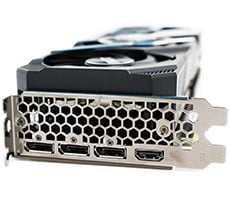
Next up, we have the MSI N9600GT OC, which doesn't look much like the NVIDIA reference design at all. The cooler is red and features a bigger fan. Additionally, this is a two-slot solution rather than single-slot.


MSI N9600GT OC


With its big red cooler, it's impossible not to notice the MSI N9600GT OC. If you read the specifications on the previous page, you already know that this card is the only overclocked card in the bunch for this round-up. MSI obviously wanted to make sure its overclocked 9600 GT stays cool. As you can see from the pictures, the cooler uses two heatpipes and a relatively large clear/frosted fan.

Like the PNY offering, the MSI bundle is simple, but it's not the same. The N9600GT OC bundle includes an installation CD, a general MSI video card quick user's guide, a N9600GT series quick user's guide, a DVI-to-VGA adapter, a DVI-to-HDMI adapter, an S-video cable, an HDTV (component video) break-out cable, a "Y" adapter power cable, and an audio cable for use with HDMI (connects from a header on the card to an S/PDIF header on your motherboard or sound card). One more aspect of the bundle worth mentioning is that MSI also includes a bunch of handy utilities on the installation CD.

If you assumed that the MSI N9600GT OC's cooler does a better job cooling the GPU than the PNY's reference cooler, then you assumed correctly. At idle, the N9600GT OC's GPU temperature was 39°C. During 3DMark06, the temperature hit 53°C, which was 9°C cooler than the PNY's reference design. Thanks to its more efficient cooler, the N9600GT OC overclocked a bit better as well. While we achieved the same memory overclock (2,200 MHz), we were able to push the core clock 50 MHz higher, resulting in an 800 MHz core. What's more, the cooler is at least as quiet as the PNY's reference cooler at idle and during load. Nevertheless, we have to point out that the N9600GT OC is very loud during boot and POST, but the fan quiets down once the login prompt appears and the driver are initialized.


Finally, the last card in this round-up is the ASUS EN9600GT SILENT, which also departs quite a bit from the NVIDIA reference design. As the name suggests, this card is completely silent thanks to its fanless, passive design. The quiet approach is always appealing, but the downside here is that the design results in a two-slot wide card.


ASUS EN9600GT SILENT


Every time new NVIDIA or ATI cards come out, we look forward to seeing if companies will create silent versions of those cards, and we are happy to see ASUS do just that with the EN9600GT SILENT. Like the PNY Verto 9600 GT, the ASUS EN9600GT SILENT utilizes NVIDIA reference speeds for the core, memory and shader clocks. This really isn't too surprising since it is a passively cooled card. As you can see in the pictures, the cooler sports three heatpipes and a large slab of metal.

The EN9600GT SILENT package includes a quick setup guide, a VGA driver/utility CD, a multi-language manual CD, an "HDMI Adapter / SPDIF Cable Connection Instruction" booklet, a DVI-to-VGA adapter, a DVI-to-HDMI adapter, an HDTV (component video) break-out cable, a "Y" adapter power cable, and an audio cable for use with HDMI (connects from a header on the card to an S/PDIF header on your motherboard or sound card).

Some silent coolers can actually do as good of a job as or better than fan-based coolers, but that didn't prove to be the case here. Both the PNY card with its reference cooler and the MSI card with its custom cooler do a better (albeit noisier of course) job at keeping the GPU cool. At idle, the ASUS EN9600GT SILENT runs at about 60°C, and during 3DMark06, the GPU temperature reached 75°C. The silent cooler also didn't allow us to overclock the EN9600GT SILENT as high as the other two cards. The high stable overclock we reached was 725 MHz for the core and 2,000 MHz for the memory.
 

All 3 Cards Side-by-Side


We noticed something interesting once we laid all three cards next to each other: the ASUS EN9600GT SILENT is actually shorter than the other two cards by approximately half an inch. This means that ASUS uses a custom PCB with the EN9600GT SILENT as well.
 

Transparent
Test System and 3DMark Vantage

HotHardware's Test System
Intel Core 2 Duo Powered


Hardware Used:
Intel Core 2 Duo E6400 (2.13GHz)

Abit Fatal1ty FP-IN9 SLI
(nForce 650i SLI chipset)

PNY Verto GeForce 9600 GT
MSI N9600GT OC
ASUS EN9600GT SILENT
GeForce 8800 GT 512MB
Radeon HD 3850 256MB

2048MB Corsair DDR2-800 C4
(2 X 1GB)

Integrated Audio
Integrated Network

Maxtor DiamondMax Plus 9
(7,200RPM - SATA)


Relevant Software:

Windows Vista Ultimate (32-bit)

NVIDIA Forceware v174.74
ATI Catalyst v8.4
NVIDIA nForce v8.43

Benchmarks Used:
3DMark Vantage
3DMark06
Crysis v1.21
Enemy Territory: Quake Wars v1.4
Company of Heroes
Half-Life 2: Episode 2


Futuremark 3DMark Vantage
Synthetic DirectX Gaming

We'll start things off by taking a look at performance in Futuremark's latest 3D rendering benchmark application - 3DMark Vantage. For more information on 3DMark Vantage, check out our launch article.


For the most part, the 3DMark Vantage results are right in line with our expectations. Since the MSI N9600GT OC is overclocked it outperforms reference clocked PNY Verto 9600 GT and ASUS EN9600GT SILENT by a small margin, and all three cards are bested by the 512MB GeForce 8800 GT (with the odd exception of GPU Test 2). Furthermore, all three 9600 GTs post better numbers than the 256MB Radeon HD 3850.

Transparent
Futuremark 3DMark06

Futuremark 3DMark06
Synthetic DirectX Gaming

3DMark06
Before Vantage, there was Futuremark 3DMark06, which has been quite popular for some time now. This version of the benchmark includes not only Shader Model 2.0 tests but also Shader Model 3.0 and HDR tests as well. Some of the assets from 3DMark05 have been re-used, but the scenes are now rendered with much more geometric detail, and the shader complexity is vastly increased as well. Max shader length in 3DMark05 was 96 instructions, while 3DMark06 ups the number of instructions to 512. 3DMark06 also employs much more lighting, and there is extensive use of soft shadows. With 3DMark06, Futuremark has also updated how the final score is tabulated. In this latest version of the benchmark, SM 2.0 and HDR / SM3.0 tests are weighted, and the CPU score is factored into the final tally as well.

These results are very similar to the 3DMark Vantage results. The main difference is that the margins separating the cards aren't quite as big. The ASUS EN9600GT SILENT suprised us a bit, though, considering it managed to outperform the PNY Verto 9600 GT despite the fact that both cards sport the same clock speeds.

Transparent
Company of Heroes

Company of Heroes
DirectX 9 and 10 Gaming Performance

Company of Heroes
Relic Entertainment's World War II era real-time strategy game Company of Heroes was originally released as a DirectX 9 title for Windows, but recent upates to the game have incorporated support for new DirectX 10 features that improve image quality and enhance the game's finer graphical details. The game features a built-in performance test, which which we used to attain the results below. Our Company of Heroes tests were run at resolutions of 1280x1024 and 1600x1200 with 4x anti-aliasing and all of the game's image-quality related options set to high.

Once again, there really aren't any shocking results here. Thanks to its factory overclock, the MSI N9600GT OC edges out the other two 9600 GTs, but none of the cards can keep up with the GeForce 8800 GT 512MB, especially as the rendering load becomes more demanding.
 

Across the board, the performance drops significantly in Company of Heroes when DirectX 10 is used. Still, trend-wise, the results are similar to the DirectX 9 results.

Transparent
Enemy Territory: Quake Wars

Enemy Territory: Quake Wars
OpenGL Gaming Performance

Enemy Territory: Quake Wars
Enemy Territory: Quake Wars is based on id's radically enhanced Doom 3 engine and viewed by many as Battlefield 2 meets the Strogg, and then some. In fact, we'd venture to say that id took EA's team-based warfare genre up a notch or two. ET: Quake Wars also marks the introduction of John Carmack's "Megatexture" technology that employs extremely large environment and terrain textures that cover vast areas of maps without the need to repeat and tile many small textures. The beauty of megatexture technology is that each unit only takes up a maximum of 8MB of frame buffer memory. Add to that HDR-like bloom lighting and leading edge shadowing effects and Enemy Territory: Quake Wars looks great, plays well and works high-end graphics cards vigorously. The game was tested with all of its in-game options set to their maximum values with soft particles enabled in addition to 8x anti-aliasing and 16x anisotropic filtering.

The GeForce 8800 GT 512MB didn't want to cooperate with our ETQW benchmark for an unknown reason. We ran this test several extra times to confirm our results, and they were the same every time. Our theory is that the problem is driver related, but we didn't dive too deep into it since our main focus is how the three 9600 GTs perform against each other. As you can see, the MSI card takes a very slight lead, and the 256MB Radeon HD 3850 doesn't even threaten the 9600 GTs.

Transparent
Half-Life 2: Episode 2

Half-Life 2: Episode 2
DirectX Gaming Performance

Half-Life 2: Episode 2
Thanks to the dedication of hardcore PC gamers and a huge mod community, the original Half-Life became one of the most successful first person shooters of all time. And thanks to an updated game engine, gorgeous visual, and intelligent weapon and level design, Half-Life 2 became just as popular. Episode 2 offers a number of visual enhancements, including better looking transparent texture anti-aliasing. These tests were run at resolutions of 1280x1024 and 1600x1200 with 4x anti-aliasing and 8x anisotropic filtering enabled concurrently. Color correction and HDR rendering were also enabled in the game engine as well. We used a custom recorded timedemo file to benchmark all cards in this test.

Continuing to meet our expectations, the MSI N9600GT OC again outperforms the PNY Verto 9600 GT and ASUS EN9600GT SILENT by a small margin. All three cards are right on the heals of the 512MB GeForce 8800 GT.

Transparent
Crysis

Crysis
DirectX 9 and 10 Gaming Performance

Crysis
If you're at all into enthusiast computing, the highly anticipated single player, FPS smash-hit Crysis should require no introduction. Crytek's game engine visuals are easily the most impressive real-time 3D renderings we've seen on the computer screen to date. The engine employs some of the latest techniques in 3D rendering, like Parallax Occlusion Mapping, Subsurface Scattering, Motion Blur and Depth-of-Field effects, as well as some of the most impressive use of Shader technology we've seen yet. In short, for those of you that want to skip the technical jib-jab, Crysis is HOT. We ran the full game patched to v1.21 with all of the game's visual options set to 'High' to put a significant load on the graphics cards being tested.

We aren't sure what happened here with the GeForce 8800 GT 512MB at 1024x768. Nevertheless, if you are considering acquiring a GeForce 9600 GT in the near future, these results have to make you smile. Logic would suggest that the GeForce 8800 GT 512MB would outpace all of the 9600 GTs, but all three of the 9600 GTs hold their own or even barely beat the 8800 GT 512MB.

The DirectX 10 results were a little more in line with our expectations, but all three of the 9600 GTs still kept up with the 8800 GT 512MB.

Transparent
Performance Summary and Conclusion

Performance Summary: When we compare just the three GeForce 9600 GTs in this round-up, the performance summary is relatively clear. The two 9600 GTs with reference clocks (the ASUS EN9600GT SILENT and the PNY Verto 9600 GT) are just a bit slower than the overclocked MSI N9600GT OC in most of the testing that we performed. It didn't take much logic to expect these results, though. What impressed us was how well the GeForce 9600 GTs fared against the GeForce 8800 GT 512MB.


All three of these GeForce 9600 GTs are good choices for different reasons. If you want a no frills, single-slot 9600 GT that is probably one of the least expensive 512MB 9600 GTs currently available, then we'd have no problem recommending the PNY Verto 9600 GT to you. It's a good buy at about $139

PNY Verto 9600 GT 512MB
 
•  One of the least expensive 9600 GTs available
•  Single-slot cooler
•  Great bang for the buck
•  Reference cooler
•  Reference clocks


If you'd rather have a flashy, factory-overclocked 9600 GT and don't mind giving up two expansion slots, then we wouldn't hesitate to suggest that you check out the MSI N9600GT OC. You'll have to pony up
about $15 more (or about $155) for this card, though. For the extra coin, you get a custom cooler that works better than the reference design, a DVI-to-HDMI adapter, an audio cable to use with HDMI, and a plethora of custom MSI utilities.
  
MSI N9600GT OC 512MB
 
•  Factory overclocked
•  Good performance
•  Good custom cooler
•  DVI-to-HDMI adapter included
•  Best overclocking potential of the bunch
•  More expensive than other 9600 GTs
•  Two-slot cooler


On the other hand, if you'd prefer to buy a silent gaming solution that doesn't sacrifice performance and don't mind a two-slot solution, then the ASUS EN9600GT SILENT would have to be at the top of short list of candidates. In addition to the custom passive cooler and the custom PCB that goes with it, you get an DVI-to-HDMI adapter, an audio cable to use with HDMI, and a handful of custom ASUS utilities. This card would be perfect in a quiet HTPC that is also used for gaming or in any gaming PC designed with noise reduction in mind. Although we had difficulty finding this card in stock anywhere other than NewEgg, it was listed at $155 with a $20 rebate, which brings its price down to a very attractive $135.
 

ASUS EN9600GT SILENT 512MB
 
•  Absolutely silent
•  DVI-to-HDMI adapter included
•  Good performance
•  Have to lift up the heatsink to fully connect power
•  Reference clocks
•  Two-slot cooler
•  Limited availability


Content Property of HotHardware.com