|
|
| Introduction, Specs and Features | |||||||
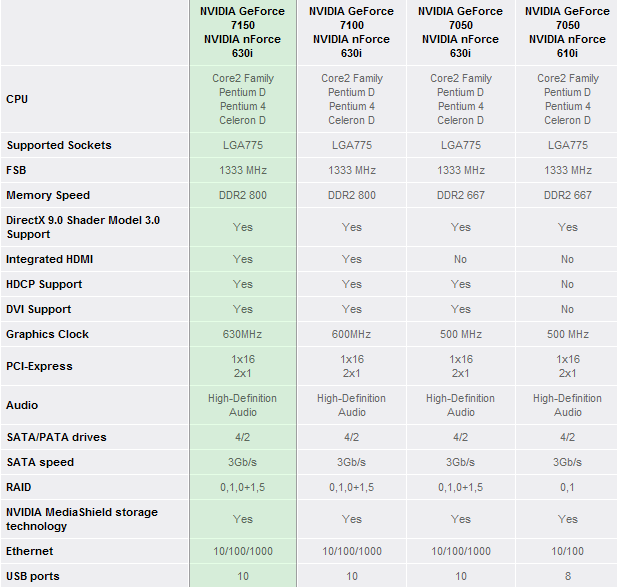
As enthusiasts, we aren't too fond of the idea of running a PC with integrated video. Like many of you, we prefer a discreet video card for the performance benefits, even if it has to be an entry-level solution. Despite that fact, though, most of the monitors in homes and offices across the world are connected to IGPs, and not to dedicated video cards. We love the latest flagship graphics cards as much as the next enthusiast, but we aren't completely impractical. We realize that integrated video is more than sufficient for the majority of users who spend 99% of their time surfing the web, e-mailing, blogging, shopping or playing 2D games like Solitaire. Today, we are going to take a look at a motherboard for the Intel platform from XFX that offers an integrated video solution. The naming of this board skipped the creative department at XFX and went straight to the dry model number assigning team; the end result is the MG-630I-7159. The board is a micro-ATX solution based on the NVIDIA nForce 630i MCP and GeForce 7150 mGPU. This board sports Intel's LGA775 socket and support for the Core 2, Pentium D, Pentium 4 and Celeron D CPU families. It features 1333 MHz front-side bus (FSB) support and will accept up to 4GB of 800 MHz DDR2 memory, which runs in single-channel mode (unfortunately). On the video side of things, XFX's implementation of the GeForce 7150 GPU boasts a 650 MHz core clock, support for up to 256MB of memory, DirectX 9 Shader Model 3.0 support and three outputs (HDMI, DVI and VGA).
XFX doesn't use much more packaging than is necessary to box up and protect the MG-630I-7159 and its accompanying accessories. Like many of you, some of us keep our boxes, so we prefer a minimalist approach to packaging to save space in our closets and cabinets. On the back of the box, you can see a list of features and specifications.
|
| Closer Look - MG-630I-7159 | ||||
At first glance, the MG-630I-7159 seemed like a really good option for home theater PCs (HTPCs) because of its size and onboard video connection options. When we took a closer look, we couldn't help but feel like our first impressions were spot on. Since this is a micro-ATX board, though, you can't expect to put three or four TV tuners in an HTPC with this board due to the limited expansion slots. As you can see in the picture below, the board has a green PCB, features all black connectors, and sports a black heatsink on the MCP.
|
| BIOS and Overclocking | ||||||||
The MG-630I-7159 utilizes a Phoenix AwardBIOS that doesn't offer many surprises. XFX throws in some options for overclocking and tweaking, however, hardcore overclockers may be left wanting more. There is plenty here to work with for a majority of users interested in getting a little more out of their system though.
Before we reveal our results, we'd like to point out that we never had to reset our BIOS during our trial and error overclocking session despite a large number of failed attempts. We found this to be pleasantly surprising. Keep in mind that this board features 1333MHz FSB (333 quad-pumped) support and our test processor is only rated for a 1066MHz FSB (266 quad-pumped). Without changing any of the default settings, we were able to crank the FSB up from 1066MHz to 1400MHz (350 quad-pumped). After that, we had to lower the CPU multiplier to 7 and boost the voltages a tad to reach 1440MHz. Nothing else we tried at that point allowed us to go any further. As always, overclocking is something you do at your own risk, and your mileage will vary. |
| HH Test System and PCMark Vantage Results | ||||||||||
Due to the fact that we wanted to test the overall system and gaming performance of the MG-630I-7159 with its onboard GeForce 7150 graphics and with a dedicated video card (the 8800 GT listed in the test system specs above), you will see three sets of numbers in all of our graphs: one set is the XFX MG-630I-7159 using its onboard graphics, one set is the XFX MG-630I-7159 with the 8800 GT installed, and the final set is our comparison board, the Abit nForce 650i SLI board with the 8800 GT.
We ran our test motherboards through PCMark Vantage, Futuremark’s latest system performance metric built especially for Windows Vista. PCMark Vantage runs through a host of different usage scenarios to simulate different types of workloads, including High Definition TV and movie playback and manipulation, gaming, image editing and manipulation, music compression, communications, and productivity. Most of the tests are multi-threaded as well, so the tests can exploit the additional resources offered by multi-core CPUs.
As you can see above, the MG-630I-7159's performance is very similar to the Abit 650i when both boards utilize the 8800 GT. As expected, though, the Gaming and Memories scores are negatively impacted by the use of the MG-630I-7159's onboard graphics. |
| SiSoftware SANDRA XII Results | ||||
We continued our testing with SiSoftware's SANDRA XII, the System ANalyzer, Diagnostic and Reporting Assistant. We ran three of the built-in subsystem tests that partially comprise the SANDRA XII suite on the test motherboards (CPU Arithmetic, CPU Multimedia, and Memory). All of the scores reported below were taken with the processor running at its default clock speed of 2.13GHz with DDR2-800MHz RAM, operating in Linked mode.
Because these first two benchmark modules are CPU-related performance tests, we weren't surprised at all by these results. All three setups post scores that are nearly identical.
Once again, the memory score is affected by the use of the onboard graphics. Additionally, even with the 8800 GT installed the MG-630I-7159 can't keep up with the Abit 650i because the MG-630I-7159 uses a single channel for memory whereas the 650i supports dual channel operation. With that said, we are a little surprised the performance gap isn't a bit wider. |
| Cinebench and 3DMark06 CPU Results | ||||||||
Cinebench R10 is an OpenGL 3D rendering performance test based on Cinema 4D. Cinema 4D from Maxon is a 3D rendering and animation tool suite used by 3D animation houses and producers like Sony Animation and many others. It's very demanding of system processor resources and is an excellent gauge of pure computational throughput.
This is a multi-threaded, multi-processor aware benchmark that renders a single 3D scene and tracks the length of the entire process. The time it required each test system to render the entire scene is represented in the graph below, listed in seconds.
All three configurations' results are neck and neck in Cinebench, which isn't surprising considering this is a CPU-oriented test. What this shows you is that the GPU doesn't affect the outcome here.
3DMark06's built-in CPU test is a multi-threaded DirectX gaming metric that's useful for comparing relative performance between similarly equipped systems. This test consists of two different 3D scenes that are processed with a software renderer that is dependent on the host CPU's performance. Calculations that are normally reserved for your 3D accelerator are instead sent to the CPU for processing and rendering. The frame-rate generated in each test is used to determine the final score.
Again, we see more of the same. Although we expect CPU specific tests to perform similarly, it is good to see the entry-level 630i keeping up with the slightly more advanced 650i board. |
| Kribibench Results | ||||
For this next batch of tests, we ran Kribibench v1.1, a 3D rendering benchmark produced by the folks at Adept Development. Kribibench is an SSE aware software renderer where a 3D model is rendered and animated by the host CPU and the average frame rate is reported. We used two of the included models with this benchmark: a "Sponge Explode" model consisting of over 19.2 million polygons and the test suite's "Ultra" model that is comprised of over 16 billion polys.
These results here surprised us a bit. We expected them to basically line up again with very little variance. That is pretty much what happened with the Ultra model. However, the Sponge Explode model was a different story. When using the onboard graphics, the MG-630I-7159 finished slightly ahead other two configurations. |
| 3DMark06 GPU and Crysis Results | ||||||||
Surprisingly, the MG-630I-7159 edges out the Abit 650i board when both are using the 8800 GT. We assumed these results would be much closer, but the MG-630I-7159 won by a respectful margin. Not surprisingly, the onboard GeForce 7150 didn't perform very well at all. As you can see (and probably expected), it is quite sad compared to the excellent 8800 GT, but it is obviously not meant to compete with the likes of the GeForce 8800 series.
Even with the resolution and quality settings turned down to low, Crysis is still a very demanding game. The MG-630I-7159 once again outperformed the Abit 650i when the 8800 GT was installed. On the other hand, the onboard graphics barely made a blip at 12.25 FPS. |
| Company of Heroes Results | ||||
These charts and the charts on the previous page demonstrate why we made our statements in the introduction. Onboard graphics are not designed for cutting edge gaming. Yes, you can do some casual gaming and older titles may run fine at lower resolutions, but modern games are just too much. You are far better off even with a $50 entry-level card than onboard graphics if you want to try to play some basic 3D games, should your budget allow it, even though that still may not result in a great experience. Anyway, forgive us for the brief digression. This time around, the two configurations with the 8800 GT performed nearly the same, while the onboard graphics once again trailed significantly. |
| Performance Summary and Conclusion | ||||
Performance Summary: XFX's nForce 630i GeForce 7150 motherboard, the MG-630I-7159, performed in line with our expectations for the most part. In most benchmarks, it performed as well as the nForce 650i chipset (when the GeForce 8800 GT was installed). The main exception to this showed up in memory performance, which is due to the MG-630I-7159's single-channel memory architecture. We found the onboard graphics performance to be acceptable overall, but the GeForce 7150's power is not meant for intense gaming, as the benchmarks showed.
Although we wish the memory and onboard graphics performance were better, we were pleased with the features and overall experience that the MG-630I-7159 provided. XFX went beyond the absolute basics that we typically find on an entry-level board by adding the onboard power and reset switches, the diagnostic LED error reporter, and eSATA. Additionally, the BIOS offers a decent set of overclocking and tweaking options. We were also pleasantly surprised to see three video output options, which included HDMI. For an entry-level motherboard, we feel the MG-630I-7159 offers a strong feature set, and it is worth its current $90 street price. The bundle isn't very exciting, but that is to be expected of an entry-level product liks this. Plus, the basic bundle helps keep the price down. If you want good gaming performance, all you have to do is add a mid-range discreet graphics card, and all of the sudden, this entry-level board becomes a decent gaming platform.
|