



GeForce 8800 GT Round-Up: Asus, EVGA, MSI


At the end of October '07, NVIDIA's GeForce 8800 GT 512MB hit the scene and garnered near universal praise due to its strong performance and value proposition. With its revamped 65nm GPU and single-slot board design, the GeForce 8800 GT was poised to storm the $200 - $249 graphics card space. However, due to availability issues, street prices remained on the high side at launch. This was especially the case for factory-overclocked models from well respected manufacturers that are currently selling for upwards of $300.
Availability is still tight for the GeForce 8800 GT, but we thought it was time to round a few cards up for a HotHardware-style benchmark fest. We’ve got factory-overclocked GeForce 8800 GT cards from Asus, EVGA, and MSI in house, the EN8800GT TOP, the e-GeForce 8800 GT KO, and the NX8800GT, respectively. At their most basic level, all three of these cards are quite similar, but each company does put their own spin on the GeForce 8800 GT in an effort to differentiate their product from the competition. Which one does the best job remains to be seen...
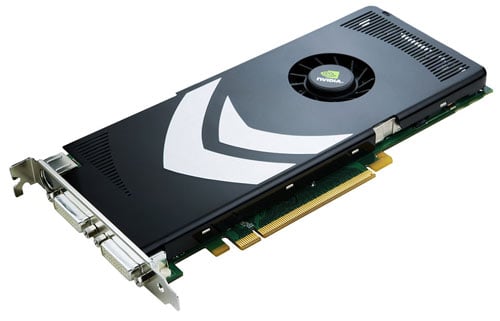

NVIDIA GeForce 8800 GT
Features & Specifications
Fabrication: 65nm
Number of Transistors: 754 Million
Stream Processors: 112
Memory Interface: 256-bit
Frame Buffer Size: 512 MB
ROPs: 16
HDCP Support: Yes
HDMI Support: Yes
Connectors:
2xDual-Link DVI-I
7-Pin TV Out
RAMDACS: 400MHz
Bus Technology: PCI Express 2.0
Max Board Power: 110 Watts
NVIDIA unified architecture:
Fully unified shader core dynamically allocates processing power to geometry, vertex, physics, or pixel shading operations, delivering up to 2x the gaming performance of prior generation GPUs.
Full Microsoft DirectX 10 Support:
World's first DirectX 10 GPU with full Shader Model 4.0 support delivers unparalleled levels of graphics realism and film-quality effects.
NVIDIA SLI Technology:
Delivers up to 2x the performance of a single graphics card configuration for unequaled gaming experiences by allowing two cards to run in parallel. The must-have feature for performance PCI Express graphics, SLI dramatically scales performance on today's hottest games.
NVIDIA Lumenex Engine:
Delivers stunning image quality and floating point accuracy at ultra-fast frame rates.
16x Anti-aliasing: Lightning fast, high-quality anti-aliasing at up to 16x sample rates obliterates jagged edges.
128-bit floating point High Dynamic-Range (HDR):
Twice the precision of prior generations for incredibly realistic lighting effects - now with support for anti-aliasing.
NVIDIA Quantum Effects Technology:
Advanced shader processors architected for physics computation enable a new level of physics effects to be simulated and rendered on the GPU - all while freeing the CPU to run the game engine and AI.
NVIDIA nView Multi-Display Technology:
Advanced technology provides the ultimate in viewing flexibility and control for multiple monitors.
Dual 400MHz RAMDACs:
Blazing-fast RAMDACs support dual QXGA displays with ultra-high, ergonomic refresh rates - up to 2048x1536@85Hz.
Dual Dual-link DVI Support:
Able to drive the industry's largest and highest resolution flat-panel displays up to 2560x1600.NVIDIA PureVideo HD Technology:
The combination of high-definition video decode acceleration and post-processing that delivers unprecedented picture clarity, smooth video, accurate color, and precise image scaling for movies and video.
Discrete, Programmable Video Processor:
NVIDIA PureVideo HD is a discrete programmable processing core in NVIDIA GPUs that provides superb picture quality and ultra-smooth movies with low CPU utilization and power.
Hardware Decode Acceleration:
Provides ultra-smooth playback of H.264, VC-1, WMV and MPEG-2 HD and SD movies.
HDCP Capable:
Designed to meet the output protection management (HDCP) and security specifications of the Blu-ray Disc and HD DVD formats, allowing the playback of encrypted movie content on PCs when connected to HDCP-compliant displays.
Spatial-Temporal De-Interlacing:
Sharpens HD and standard definition interlaced content on progressive displays, delivering a crisp, clear picture that rivals high-end home-theater systems.
High-Quality Scaling:
Enlarges lower resolution movies and videos to HDTV resolutions, up to 1080i, while maintaining a clear, clean image. Also provides downscaling of videos, including high-definition, while preserving image detail.
Inverse Telecine (3:2 & 2:2 Pulldown Correction):
Recovers original film images from films-converted-to-video (DVDs, 1080i HD content), providing more accurate movie playback and superior picture quality.
Bad Edit Correction:
When videos are edited after they have been converted from 24 to 25 or 30 frames, the edits can disrupt the normal 3:2 or 2:2 pulldown cadences. PureVideo HD uses advanced processing techniques to detect poor edits, recover the original content, and display perfect picture detail frame after frame for smooth, natural looking video.
Video Color Correction:
NVIDIA's Color Correction Controls, such as Brightness, Contrast and Gamma Correction let you compensate for the different color characteristics of various RGB monitors and TVs ensuring movies are not too dark, overly bright, or washed out regardless of the video format or display type.
Integrated SD and HD TV Output:
Provides world-class TV-out functionality via Composite, S-Video, Component, or DVI connections. Supports resolutions up to 1080p depending on connection type and TV capability.
Noise Reduction:
Improves movie image quality by removing unwanted artifacts.
Edge Enhancement:
Sharpens movie images by providing higher contrast around lines and objects.

We detailed the GeForce 8800 GT’s architecture and features in-depth in our launch coverage from last October, so we won’t go in depth again here. As you can see from the list of features and specifications above, the 8800 GT is somewhat of a hybrid between the 8600 and 90nm G80-based 8800 series. The G92 at the heart of the GeForce 8800 GT has an updated video engine like the GeForce 8600, but with a shader and ROP configuration reminiscent of a GeForce 8800.
If you’d like more information regarding the GeForce 8800 GT and its innermost workings, we suggest reading our launch article which is available right here. Otherwise, read on for Asus, EVGA, and MSI’s take on NVIDIA GeForce 8800 GT.







;)