Back in November 2007, AMD launched the 55nm ATI RV670 GPU. With this launch, we were introduced to two new ATI video cards, the Radeon HD 3870 and 3850. If you read our launch article, then you already know that the RV670 is a derivative of the R600, which powers the Radeon HD 2900 XT. Our initial experience with AMD's new cards was pretty positive. The Radeon HD 3870 and 3850 offer good performance at nice MSRPs with impressive power characteristics.
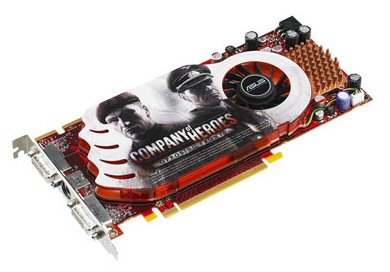
After launch articles, though, everyone anxiously waits for the retail board reviews. This article will be our first look at a full retail board based on the new RV670 GPU. The card we have up on the review block today is the ASUS EAH3850 TOP (full model number: EAH3850/G/HTDI/256M). As you've probably already realized, this is a Radeon HD 3850 card, as such it sports 256MB of GDDR3 memory and DirectX 10.1 support.
To see how this retail version of a Radeon HD 3850 performs, we're going to pit it against a variety of cards, including a Radeon X1950 Pro, GeForce 8600 GT and a 256MB 8800 GT. It should be interesting to see where ASUS' EAH3850 falls in this pack in our benchmarks. Before we get to those, though, let's take a look at the specifications and features of the EAH3850.

|
|
| ASUS EAH3850 256MB |
| Features & Specifications | |
FEATURES
|
|
Exclusive Hottest DX10 Game bundle: Company of Heroes - Opposing Fronts
ASUS Splendid:
Watching movies on PC is as good as on Top-of-the-line consumer television
ASUS Gamer OSD:
Real-time overclocking, benchmarking and video capturing in any PC game! |
ASUS Video Security Online:
Keep an eye on your home at all times no matter where you are
ASUS Smart Doctor:
Your intelligent hardware protection and overclocking tool. |
SPECIFICATIONS
|
|
Memory: 256 MB DDR3
Video Output Function:
- TV-out + HDTV Support
- Two Dual-link DVI Connectors
- CrossFireX Bridge Connectors
|
Clocks:
- GPU: 730 MHz
- Memory: 950 MHz (1.9 GHz effective)
|
666 million transistors on 55nm fabrication process
256bit 8-channel GDDR3/4 memory interface
Ring Bus Memory Controller
- Fully distributed design with 512-bit internal ring bus for memory reads and writes
- Optimized for high performance HDR (High Dynamic Range) rendering at high display resolutions
Unified Superscalar Shader Architecture
- 320 stream processing units
- Dynamic load balancing and resource allocation for vertex, geometry, and pixel shaders
- Common instruction set and texture unit access supported for all types of shaders
- Dedicated branch execution units and texture address processors
- 128-bit floating point precision for all operations
- Command processor for reduced CPU overhead
- Shader instruction and constant caches
- Up to 80 texture fetches per clock cycle
- Up to 128 textures per pixel
- Fully associative multi-level texture cache design
- DXTC and 3Dc+ texture compression
- High resolution texture support (up to 8192 x 8192)
- Fully associative texture Z/stencil cache designs
- Double-sided hierarchical Z/stencil buffer
- Early Z test, Re-Z, Z Range optimization, and Fast Z Clear
- Lossless Z & stencil compression (up to 128:1)
- Lossless color compression (up to 8:1)
- 8 render targets (MRTs) with anti-aliasing support
- Physics processing support
Full support for Microsoft DirectX 10 / 10.1
- Shader Model 4.0
- Geometry Shaders
- Stream Output
- Integer and Bitwise Operations
- Alpha to Coverage
- Constant Buffers
- State Objects
- Texture Arrays
Dynamic Geometry Acceleration
- High performance vertex cache
- Programmable tessellation unit
- Accelerated geometry shader path for geometry amplification
- Memory read/write cache for improved stream output performance
Anti-aliasing features
- Multi-sample anti-aliasing (up to 8 samples per pixel)
- Up to 24x Custom Filter Anti-Aliasing (CFAA) for improved quality
- Adaptive super-sampling and multi-sampling
- Temporal anti-aliasing
- Gamma correct
- Super AA (CrossFire configurations only)
- All anti-aliasing features compatible with HDR rendering
CrossFire Multi-GPU Technology
- Scale up rendering performance and image quality with 2 or more GPUs
- Integrated compositing engine
- High performance dual channel interconnect
|
Texture filtering features
- 2x/4x/8x/16x high quality adaptive anisotropic filtering modes (up to 128 taps per pixel)
- 128-bit floating point HDR texture filtering
- Bicubic filtering
- sRGB filtering (gamma/degamma)
- Percentage Closer Filtering (PCF)
- Depth & stencil texture (DST) format support
- Shared exponent HDR (RGBE 9:9:9:5) texture format support
ATI Avivo HD Video and Display Platform
- Two independent display controllers
- Drive two displays simultaneously with independent resolutions, refresh rates, color controls and video overlays for each display
- Full 30-bit display processing
- Programmable piecewise linear gamma correction, color correction, and color space conversion
- Spatial/temporal dithering provides 30-bit color quality on 24-bit and 18-bit displays
- High quality pre- and post-scaling engines, with underscan support for all display outputs
- Content-adaptive de-flicker filtering for interlaced displays
- Fast, glitch-free mode switching
- Hardware cursor
- Two integrated dual-link DVI display outputs
- Each supports 18-, 24-, and 30-bit digital displays at all resolutions up to 1920x1200 (single-link DVI) or 2560x1600 (dual-link DVI)
- Each includes a dual-link HDCP encoder with on-chip key storage for high resolution playback of protected content
- Two integrated 400 MHz 30-bit RAMDACs
- Each supports analog displays connected by VGA at all resolutions up to 2048x1536
- HDMI output support
- Supports all display resolutions up to 1920x1080
- Integrated HD audio controller with multi-channel (5.1) AC3 support, enabling a plug-and-play cable-less audio solution
- Integrated Xilleon HDTV encoder
- Provides high quality analog TV output (component / S-video / composite)
- Supports SDTV and HDTV resolutions
- Underscan and overscan compensation
- HD decode for H.264/AVC, VC-1, DivX and MPEG-2 video formats
- Flawless DVD, HD DVD, and Blu-Ray playback
- Motion compensation and IDCT (Inverse Discrete Cosine Transformation)
- HD video processing
- Advanced vector adaptive per-pixel de-interlacing
- De-blocking and noise reduction filtering
- Edge enhancement
- Inverse telecine (2:2 and 3:2 pull-down correction)
- Bad edit correction
- High fidelity gamma correction, color correction, color space conversion, and scaling
- MPEG-2, MPEG-4, DivX, WMV9, VC-1, and H.264/AVC encoding and transcoding
- Seamless integration of pixel shaders with video in real time
- VGA mode support on all display outputs
PCI Express 2.0 x16 bus interface
OpenGL 2.0 support
|
As you can see on the box above, ASUS decided to include the highly-acclaimed RTS game Company of Heroes: Opposing Fronts. The entire front of the box is designed around this fact, and the front of the box is actually a flap that lifts up to reveal even more CoH info. There's even a handle on the top of the box, so that it's a little easier to carry around and show off to your friends.
When we opened the box, we were happy to see that ASUS packs the box's contents with their safe arrival in mind. Styrofoam surrounds the card, so it will most likely arrive in working condition. The box holds more than just the card, though, of course. ASUS also throws in a driver CD, a software/utility CD, the CoH: Opposing Fronts game (although our copy seems to be missing from the review kit we were sent), an ASUS-branded CD case, a setup guide, a TV-out (component video) cable, a composite to S-video adapter, a power cable, a CrossFire connector bridge, a DVI-to-VGA adapter, and a DVI-to-HDMI adapter. Overall, it's a pretty good bundle.





;)
;)
;)
;)
;)