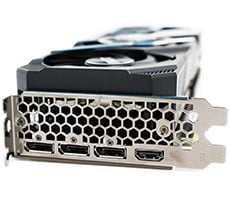
ASUS MARS II Review: GTX 580 SLI On One PCB

Before bringing this article to a close, we'd like to cover a few final data points--namely power consumption, noise, and overclocking. Throughout all of our benchmarking and testing, we monitored how much power our test system was consuming using a power meter. Our goal was to give you an idea as to how much power each configuration used while idling and while under a heavy workload. Please keep in mind that we were testing total system power consumption at the outlet here, not just the power being drawn by the graphics cards alone.
|
|
|


Looking back at the numbers, it should come as no surprise that the Asus MARS II consumed the most power off all of the cards we tested, while idling and while under load. At idle our Asus MARS II-equipped test system consumed 43 more watts that its closest cousin, the GeForce GTX 590. And while under load the test system pulled a whopping 673 watts from the outlet. If you're worried about your carbon footprint, the MARS II is most definitely not for you. This card is extremely power hungry.
 |
|

The Asus GPU Tweak Utility
The Asus MARS II includes a copy of the company's excellent GPU Tweak Utility, so we fired it up to do a bit of monitoring and overclocking as well. Asus has informed us that most cards will do 800MHz GPU clocks easily, the majority will do 820MHz, and a smaller number are hitting around 870MHz. We were easily able to hit 828MHz on the GPUs with a 90+MHz increase to the memory clock as well, but think there was more left in the tank. Unfortunately, we only had a limited time to test the card before cranking out this article, so we couldn't tweak much further. We should note, that while overclocked, the MARS II managed to put up 59.9 FPS in the AvP benchmark at 2560x1600, which was an 7 FPS increase over stock.
Using GPU Tweak, we also monitors temperatures on the MARS II during out benchmarking session. At idle, the card's GPUs typically hovered in the 40'C range and under load they hit 85'C consistently. Thankfully, the MARS II's massive cooler and fans do a good job of dissipating heat becuse the card cooled down rather quickly and even while under load it never got terribly loud. It wasn't quiet by any means under load, but it was definitely quieter than a Radeon HD 6990, to give you a frame a reference.