|
|
| Layout | ||||
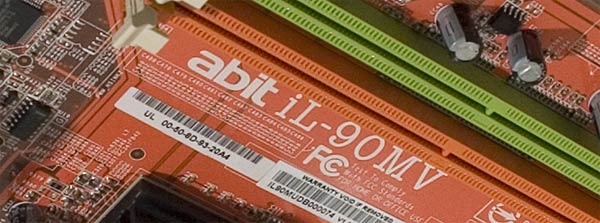
Layout The Abit IL-90MV certainly has an interesting look. Utilizing a bright orange PCB color and a Micro-ATX form factor, this board stands out in a crowd of generic motherboards. Not only is the board unique in its shape and color, but the placement of the major components onboard also differs quite bit from what one expects from a modern day motherboard. Specifically, the positioning of the CPU socket and memory sockets are "swapped", although we have seen similar layouts for other Socket-479m based motherboards.
The motherboard supports Intel Socket-479m Core Duo and Core 2 Duo (mobile) processors. The board cannot support older Pentium-M processors, nor can it support the desktop variant of the Core 2 Duo processor which runs on a different CPU socket (775). The platform runs on Intel mobile processors for a reason, in that they produce far less heat and consume less power compared to desktop equivalents. Intel Socket-479m dual-core processors typically consume 25-31 watts (TDP), compared to 65 watts and higher for the Socket-775 variants. While mobile processors are a bit more expensive per clock compared to the desktop variants, the low power attributes make them perfect for a home theater system. Sitting to the left of the CPU socket is the motherboard's Northbridge, which in this case is the Intel 945G. The 945G is one generation old, as Intel has launched their new integrated graphics chipsets as of about a month ago. Nevertheless, the 945G is still up to handling the needs of a home theater PC. The 945G chipset supports front side bus speeds up to 667 MHz (the fastest FSB offered by the Core Duo / Core 2 Duo mobile) and supports up to 2 GB of DDR2-667 memory in a dual-channel design. The chipset runs cool enough to use simple aluminum alloy heatsinks, which make it a good choice for a low-noise system. To the north of the chipset are two DDR2 DIMM sockets, each capable of supporting 1GB of DDR2 memory. Since the board does support dual-channel operation, peak theoretical memory bandwidth with DDR2-667 memory would be 10.6 GB/s, although the 945G memory controller will never hit is theoretical peak; real-world memory bandwidth will likely be in the 3-4 GB/s range.
Socket-479m CPU socket, 945G Northbridge, and DDR2 DIMM memory sockets. The Socket-479m CPU socket has four holes surrounding it for heatsink mounting purposes. Since Intel's mobile processors are not bundled with retail cooling units, it's up to the motherboard manufacturer to bundle a cooler. Abit bundles a newly created cooler with this board, known as the Abit OTES Stream. The OTES Stream is a anodized black aluminum alloy CPU cooler which mounts on this motherboard, and is rated to handle the fastest Intel dual-core Socket-479m processors. The cooler features a diagonally mounted cooling fan which not only keeps the CPU cool, but also blows air on the 945G Northbridge as well. The cooler did a great job of keeping our CPU running within its thermal limitations and at extremely low noise levels. However, we should note that this cooler is not designed for aggressive cooling. With the cooler on our Core 2 Duo Mobile T7600 (2.33 GHz) processor, our CPU idled at over 100'F and the cooling fan spun at around 600 RPM for nearly zero noise. However, during intensive stress testing with EIST (Speedstep) disabled, we noticed our CPU temperature shoot up to 180'F in an open-air environment, which led our cooling fan to spin up to its maximum of 3,600 RPM. Even with this speed, the OTES Stream cooler was surprisingly quiet. However, one should keep temperature in mind when using this motherboard in a cramped case environment, and always remember to keep EIST enabled.
|
| Layout and HD Playback | ||||||
Board Layout Continued While the Intel 945G chipset does support PCI Express graphics, Abit decided not to put a full PCI Express x16 expansion slot onboard. This may be a limitation in the eyes of some, as this means you can only upgrade the graphics with a PCI Express x1 card (they are out there, if you look) or an older 32-bit PCI graphics card. However, neither option is good if you're looking for performance. This board certainly isn't designed for the high-end power user or gamer. For home theater users, the onboard Intel GMA950 graphics are plenty good enough to handle the latest high-end digital media. As you can see, the board is equipped with one PCI Express x1 port and two 32-bit PCI slots. Since the motherboard has onboard graphics, sound, and Ethernet, it's fully possible to run this motherboard without any expansion cards installed at all. However, home theater users will likely throw in a TV tuner card into one of the open slots.
The Southbridge onboard is the Intel ICH7M, which is the mobile variant of the ICH7 I/O controller hub. ICH7M has a fairly modern feature set, but is lacking in several ways compared to Intel's latest ICH8. The ICH7 supports only two Serial ATA ports, and only at 150 MB/s speeds. Keep in mind, this is a mobile chipset at heart, and this kind of storage connectivity is plenty fine for notebook environments. For a HTPC, this storage limitation may be limiting, although with two SATA ports, you can in theory connect up to 1.5 TB of disk space using 2 x 750 GB Seagate HDD's, and you could always add more with a dedicated SATA PCI controller card. The two onboard RAID ports support RAID 0 and RAID-1 array connectivity, and the board also supports two Ultra ATA/133 devices. Just north of the Ultra ATA port we can see the power connector, which is a 24-pin ATX connector. This connector is required along with a 4-pin +12V ATX connector for the processor. However, since this board is extremely low power, you can get by with fairly low wattage power supplies and still be fine (we're talking 200W+). In most cases, this motherboard will be using under 100W of power when fully loaded. As for onboard peripherals, this board is loaded with just about everything one could want for a home theater PC environment. A quick look at the I/O panel shows PS/2 mouse keyboard, HD-15 monitor output, HDMI 1.2 / DVI output, S/PDIF digital audio in/out, 8-channel analog outputs, Firewire 400, USB 2.0 ports, and Gigabit Ethernet. This board is completely free from Serial and Parallel ports, as Abit does not even include the headers for them. Onboard audio is powered by a Realtek ALC882M high-definition audio CODEC, which allows for 8-channel output. Onboard Gigabit Ethernet is powered by an Intel 82573L controller chip. Firewire is controlled by a standard 32-bit PCI chip from Texas Instruments. In addition to the 4 x USB 2.0 and 1 x Firewire port on the I/O panel, Abit also includes pin-outs for another Firewire port and 4 x USB 2.0 ports on the motherboard, for a total of 8 x USB 2.0 ports and 2 x Firewire 400 ports.
Abit IL-90MV I/O Panel The big feature for HTPC users is a (gold plated) HDMI output port, as this is the only the second motherboard we've seen to date with this feature. AOpen released a motherboard for mobile Intel processors about a year ago with HDMI output, but it was limited to the Japanese market only. As HDMI now has more mainstream acceptance worldwide, seeing this connector on a motherboard does make sense for HTPC users. HDMI is used on many high-end flat panel displays, as it links together digital video and 7.1 channel digital audio into a single connector. The HDMI port on this motherboard is powered by the Intel GMA950 graphics processor, but has a Silicon Image TDMS PanelLink chip onboard for HDMI output. Abit also bundles an HDMI to DVI adapter cable for those who want to connect directly to DVI displays. There is a BIOS option which allows the user to control which type of output they want to use.
The big question we had when initially looking at this motherboard was - "Is the Intel GMA950 processor powerful enough to push true HD (1080p) content at full resolution without slowdowns?". Somewhat surprisingly, that answer is a big yes. The Intel GMA950 more or less offloads most (if not all) of the processing onto the main system CPU, so if you have a fast enough processor in the system, you can easily push 1080p content from this motherboard. We loaded our test system with 2.0GHz and 2.33GHz Core 2 Duo (mobile) processors and played back WMV HD 1080p test files on this motherboard. Playback was perfectly smooth and looked beautiful. A quick look at our CPU performance levels throughout the file playback shows that the system only used about 20-30% of the system's CPU resources to push 1080p content, which means one could theoretically go for a lower-powered processor and still be able to run 1080p movie files without slowdowns.
|
| BIOS | ||||
BIOS The IL-90 MV comes with a Phoenix AwardBIOS which is much more simplistic than we've seen with other Abit platforms. As Abit is not targeting this motherboard at their typical enthusiast-minder consumer, the BIOS of this motherboard is quite simple. Tweaking options are kept to a minimum and there are no overclocking features of any kind. As you can see, the BIOS did correctly see our brand new Core 2 Duo T7600 (2.33 GHz) processor, but it required a BIOS flashing to do so. With the motherboard's stock BIOS, the board would boot properly with the Core 2 Duo mobile processor, but would bizarrely show the system as having "3 CPUs". With the latest BIOS, everything is A-OK, as seen below.
Core 2 Duo Mobile on the IL-90MV This isn't to say that there isn't any BIOS flexibly at all. One has control over basic DDR2 memory timings, and can also monitor temperatures and voltage levels through the BIOS as well. You also can control some basic settings in regards to onboard video (how much system memory is utilized, which output ports to use), but in comparison to other Abit boards we've tested with in the past, the IL-90MV is quite basic. For HTPC usage though, the options which Abit has presented are just fine. Of course, we would have liked to see some basic overclocking options to see how far we could overclock our Core 2 Duo mobile processor, but it's not in the cards right now. Perhaps in a future BIOS release.
|
| Testbed Information and Sandra | ||||||||
![]() Higher Scores = Better Performance
![]() Higher Scores = Better Performance When equipped with a Core 2 Duo mobile processor, the Abit IL-90MV puts up solid numbers against a comparably equipped Athlon64 X2 platform. Clock for clock, the Core 2 Duo bests the Athlon64 X2, but the Core 2 Duo suffers in terms of memory bandwidth due to the aging 945G chipset of the Abit motherboard. |
| 3DMark and PCMark | ||||
![]() Higher Scores = Better Performance
![]() Higher Scores = Better Performance In a desktop environment, the IL-90MV puts up solid numbers against our Athlon64 X2 platform in PCMark. These platforms absolutely stink for 3D graphics though, as the onboard video of each of these motherboards shows dismal 3DMark scores. |
| Windows Media Encoder and LAME | ||||
![]() Lower Scores = Better Performance ![]() Lower Scores = Better Performance The Core 2 Duo performs well for media encoding environments, which bodes well for the board in a home theater environment. Recording and encoding live digital content? No problem. |
| Cinebench and Sciencemark | ||||
![]() Lower Scores = Better Performance
![]() Higher Scores = Better Performance Our various other synthetic benchmarks show the platform in a good light, although the Core 2 Duo struggles on a clock for clock basis against AMD's dual-core Athlon64 processor in Sciencemark. |
| HDTach | ||||
![]() Higher Scores = Better Performance
![]() Lower Scores = Better Performance The aging ICH7M still puts up solid disk benchmarks with our Maxtor Diamondmax SATA test drive. We see the same level of performance as the newer GeForce 6150 / nForce 430 chipset, but at significantly lower CPU utilization levels. |
| Conclusion | ||||
Our Conclusion
The IL-90MV comes as close as we've seen yet to being the perfect home theater PC motherboard. Beyond the basic core system components (CPU, memory, hard disk), there really aren't any major features which one needs to add to this motherboard in order to have an HD-ready home theater PC system. Many folks will add a TV tuner card (or two), and this board is ready with both PCIe x1 slots and 32-bit PCI slots. It would be nice to add a graphics card to expand the video output abilities of this board, but if leaving out this feature helps keep the price low while still satisfying the majority of the market, it's a limitation we're willing to accept. In comparison to other Core Duo / Core 2 Duo mobile platforms, the IL-90MV is surprisingly low priced at around $150. Most Socket-479m motherboards to date retail for around $200+, and those with custom layouts and non-standard outputs go for more, se we were expecting the price tag on the IL-90MV to be considerably higher. We would love to see a second generation board for this form factor, perhaps using Intel's latest chipsets with X3000 series integrated graphics, Serial ATA-II, and DDR2-800 support. We would also like to see a bit more control over fan speeds and clock speeds, and a PCI Express x16 expansion slots. While the 945G chipset is certainly aging, it still can do the job just fine for home theater PC usage. This board impressed us greatly. We're giving the Abit IL-90MV a 9 on the Heat Meter and hope this won't be the last HTPC-oriented board from Abit
|