Logo   Banner   TopRight
TopUnder
Transparent
Asus V9950 Ultra GeForce FX 5900 Ultra
Transparent
Date: Sep 09, 2003
Section:Graphics/Sound
Author: HH Editor
Transparent
Asus V9950 Ultra GeForce FX 5900 Ultra - Page 1

The Asus V9950 Ultra - GeForce FX 5900 Ultra
The First Single-Slot Ultra to Hit Our Lab...

By - Marco Chiappetta
September 9, 2003

Recently it seems as though NVIDIA has made a few wrong moves, that got them a ton of bad press. First, there was the whole 3DMark03 situation. Then came the Unreal Tournament 2003 filtering "bug". These issues along with all of the resulting commentary were significant and had to be discussed, but they distracted many people from the fact that NVIDIA's NV35 GPU was a very noteworthy product.  With the NV35, now named the GeForce FX 5900 Ultra, NVIDIA eliminated most of the 5800 Ultra's shortcomings. The 5900 Ultra enjoys the benefits of a 256-bit wide memory bus and some tweaks to the manufacturing process allowed them to use a much quieter cooling solution. This, in addition to the fact, that the 5900 Ultra is faster then a 5800 Ultra in virtually all meaningful benchmarks, means serious enthusiasts should consider the GeForce FX 5900 Ultra for any high-end gaming rig.

Today on HotHardware.Com we're going to take a look at Asus' take on the NV35, the V9950 Ultra. This card sports 256MB of high-speed memory and a custom cooler that won't eat up your first PCI slot.  Read on to see what we thought of Asus' current flagship video card...

  
CLICK ANY IMAGE FOR AN ENLARGED VIEW

Specifications & Features of the Asus V9550 Ultra
NVIDIA's Flagship GPU (For Now)
NV35 and GeForce FX 5900 Ultra:
  • .13u Manufacturing Process
  • 256-Bit GPU - 450MHz Clock Speed
  • Flip-Chip BGA Package with copper interconnects
  • Up To 8 Pixels Per Clock Processing (or 4x2 depending on circumstance)
  • 1 TMU Per Pipe (16 Textures per unit)
  • 256-bit Memory Architecture
  • CineFX 2.0 for Cinematic Special Effects
  • "UltraShadow" Hardware Shadow Acceleration
  • 2x floating point pixel shader performance of NV30
  • 256-bit Memory Architecture
  • 256MB of DDR/DDR2
  • 2nd Generation compression & caching
  • 256MB High Speed Frame Buffer
  • AGP 4X/8x
  • DVI + VGA + TV / VIVO
  • Full DirectX 9.0 & OpenGL Support

Features:

  • CineFX 2.0 for Cinematic Special Effects
  • Intellisample HCT - Next Generation Antialiasing, Anisotropic Filtering and Compression
  • Hardware Acceleration for Shadows
  • Full DX9 Compliance
  • 64-Bit Floating-Point Color
  • 128-Bit Floating-Point Color
  • 2 x 400MHz Internal RAMDACs
  • Long Program length for Pixel and Vertex Shading
  • Unified Vertex and Pixel Shading instruction set
  • Unified Driver Architecture
  • nView 2.0 - Multi-Display Technology
  • Digital Vibrance Control 3.0

Memory:

  • 850MHz DDR

  • 256-Bit Bus Width

  • 128MB & 256MB Memory Capacity

  • 3rd. Generation Lightspeed Memory Architecture

  • Effective bandwidth - 27.2GB/s actual @ 850MHz


CLICK TO ENLARGE

THE GEFORCE FX 5900 ULTRA
CORE CLOCK: 450MHz
MEMORY CLOCK: 850MHz
FILLRATE: 3.6 GP/s
MEMORY BANDWIDTH: 27.1 GB/s


The V9950 Ultra shipped with a very complete assortment of bundled accessories and software.  For those looking to run a dual analog monitor setup, Asus includes a DVI-to-DB15 adapter, otherwise the card is equipped with single DB15 and DVI connectors (CRT + LCD).  A standard S-Video cable is also included to compliment this card's TV-Out capabilities.  There is quite a bit of software included with the card as well.  Aside from the obligatory User's Manual and Quick Start Guide, we found a driver / utility CD, which obviously contained drivers, but it also had some useful utilities like Asus' SmartDoctor program.  Basically, SmartDoctor gives users the ability to overclock their card but we're still partial to using CoolBits (call us minimalists!). 

Asus also included a copy of their AsusDVD XP playback software and a "Games Power" CD with demos of some recent games like Splinter Cell, Big Mutha Truckers and Warcraft III.  Lastly, three complete games were also bundled with the V9950 Ultra; the DX9 game Gun Metal, Delta Force: Black Hawk Down and Battle Engine Aquila.  Overall, we feel Asus did a good job with configuring the V9950 Ultra's bundle.  It seems like Asus covered all of the bases.

Next Up - The Card & Some Eye Candy 

Transparent
Asus V9950 Ultra GeForce FX 5900 Ultra - Page 2

The Asus V9950 Ultra - GeForce FX 5900 Ultra
The First Single-Slot Ultra to Hit Our Lab...

By - Marco Chiappetta
September 9, 2003

Although the PCB itself adheres to NVIDIA's GeForce FX 5900 Ultra reference design, Asus took some steps to ensure the V9950 Ultra is easily discernable among its competition.  After a long stretch in '02 of reviewing one GF4 Ti after another, with only a sticker applied to a fan to tell them apart, we were glad to see Asus make some changes that really help differentiate this card from other GFFX 5900 Ultras.


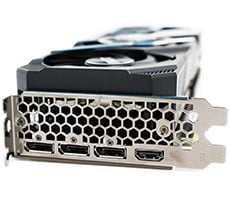
The V9950 Ultra's blue PCB was the first trait to catch our eye.  A colored PCB does nothing for performance, but it does help give the card some style and distinguish it from the plain-vanilla green PCBs being sold be some other manufacturers.  To give the V9950 Ultra even more personality, Asus also uses a gold-plated external plate and gold-plated DVI and DB15 connectors.  Asus claims the plating improves signal quality, but in side-by-side comparisons with an NVIDIA reference card and an Abit 5900 non-Ultra, we didn't see any image quality differences in either 2D or 3D (up to 1600x1200x85Hz).  The V9950 Ultra's distinguishing factor has got to be its custom copper cooling solution.  The NVIDIA designed, dual-slot FX-Flow cooler is gone.  Instead, Asus employs a specially designed, quiet 2-Fan copper heatsink on the V9950 Ultra, that no only does an excellent job cooling the GPU and RAM, but it occupies only a single slot!  We pulled the cooler off the card and found it to be very well mated to the board's components.  The heat plates mounted to the front and back of the card made perfect contact with the NV35 GPU and 256 RAM (16 - 2.2ns Hynix BGA chips), although we would have liked to have seen a bit more thermal paste applied to the GPU.  Like other GeForce FX 5900's, the fans on the V9950 Ultra spin-up or down when switching from 2D to 3D mode.  Even when running at full speed, the fans used on the this card are relatively quiet.  We could not hear the V9950 Ultra over the CPU and case fans used in our test system.

If you have inspected a few GeForce FX 5900s, you may have noticed one omission from the V9950 Ultra's PCB.  If you take a look at the last picture above, at the lower left corner you'll see a bare spot on the board (here's a shot of Leadtek's A350 PCB for comparison).  That location is usually reserved for a video encoder of some sort.  The V9950 Ultra that we're looking at today does not have any Video-In capabilities, which is why an encoder is not present.  Knowing Asus, however, we wouldn't be surprised to see a "Deluxe" version of this card with ViVo functionality introduced sometime in the near future.

Screenshots While Gaming With Gun Metal
Yes, It's a DX9 Game!

     
1024x768 - 4X AA

Before we sat down to benchmark the V9950 Ultra, we spent some time gaming with this beast.  This was actually a good month for gamers.  Some highly anticipated games and demos were all released recently.  We played with the Call of Duty demo, Tron 2.0, Gun Metal and Unreal Tournament 2003.  All of the games ran very well on the V9950 Ultra, even with anti-aliasing and Anisotropic filtering enabled (which is to be expected with current titles running on a $450+ dollar card!).  We snapped off a few screenshots from Gun Metal, one of the games included with the V9950 Ultra, to give you some idea of the kind of in-game images this card is capable of displaying.  All of the shots above were taken at 1024x768 with 4XAA and 8X Anisotropic filtering enabled.

Screenshots with Antialiasing Enabled
Works Great, But With Some Weirdness
 

1024x768
NO AA
 

1024x768
2X AA
 

1024x768
4X AA
 

1024x768
4XS AA
 

1024x768
6XS AA
 

1024x768
8X AA

We also took a few screenshots to specifically show you the benefits of the GeForce FX 5900 Ultra's Antialiasing techniques, using the exact same frame from 3DMark03's "Wings of Fury" demo.  As you can see, as the AA level is increased, the visible jaggies in the image are significantly decreased.  Pay special attention to the small plane in the background at the upper-left of the images.  Open up a few of the images, and switch between them quickly to really see the benefits of anti-aliasing.  We did notice something strange when using any level of AA higher than 4X.  The smoke in this scene is rendered differently at 4XS, 6XS and 8X AA levels.  The sampling pattern used and filtering applied to the image when using these modes is probably what causes this anomaly, so sticklers for image quality should probably stick with 4XAA (or lower).

Let's Start Benchmarking

Transparent
Asus V9950 Ultra GeForce FX 5900 Ultra - Page 3

The Asus V9950 Ultra - GeForce FX 5900 Ultra
The First Single-Slot Ultra to Hit Our Lab...

By - Marco Chiappetta
September 9, 2003

To benchmark with Splinter Cell, we used the Oil Rig demo created by the folks at Beyond 3D.  Like Gun Metal, this test is heavily dependant on Pixel Shader performance.  Shaders are used to render the realistic looking ocean water that surrounds an Oil Rig in the demo.  As we've mentioned in the past, Antialiasing doesn't work with Splinter cell (at least with the current version).  Due to this fact, we do not have any AA scores listed in the graphs below.

Benchmarks With Splinter Cell
What a Cool Game

Its higher core clock speed and increased memory help the V9950 Ultra take a firm 8-10% lead over the standard GeForce FX 5900, at both resolutions in Splinter Cell.  However, the Radeon 9800 Pro took the overall lead here.  At 1024x768, the Radeon pulled ahead by a fraction of a frame per second, but at 1600x1200 it was a full 5.5% faster.  Going from the v44.67 drivers to the newer v45.23s gave the GeForce FX 5900 a nice boost.  There's probably more performance to be had here with future driver optimizations from NVIDIA.

Head-to-Head Performance With Comanche 4
Did anyone see the Comanche Bike on American Chopper?  PHAT!

We used Novalogic's combat helicopter simulator Comanche 4 for our next batch of DirectX benchmarks.  Comanche 4 uses DX8 class pixel and vertex shaders to produce some of the realistic visuals used throughout the game.  Unlike the previous tests, this benchmark is heavily influenced by CPU and system memory performance, especially at lower resolutions.  However, when the resolution is raised and AA and Aniso are enabled, the current crop of video cards tend to slow down quite a bit.

The Radeon 9800 Pro and V9950 Ultra swap the lead in Comanche 4, depending on what resolution or AA level is used.  At 1024x768 without AA the V9950 Ultra managed to squeak by the 9800 Pro, but the Radeon pulled ahead when AA and Aniso were enabled.  Things flip-flop at 1600x1200, where the Radeon was top dog without any anti-aliasing enabled.  With AA and aniso enabled at the higher resolution the V9950 Ultra led by a hefty margin in some tests.

UT2003 & Quake 3 Benchmarks 

Transparent
Asus V9950 Ultra GeForce FX 5900 Ultra - Page 4

The Asus V9950 Ultra - GeForce FX 5900 Ultra
The First Single-Slot Ultra to Hit Our Lab...

By - Marco Chiappetta
September 9, 2003

We continued our DirectX benchmarking with Unreal Tournament 2003.  When testing with UT2K3, we use a special utility that is supposed to ensure all of the cards are being tested with the exact same in-game settings and "High-Quality" graphical options.  Unfortunately, the validity of the GeForce FX's scores have been called into question because the texture filtering level changes to something between trilinear and bilinear when Anisotropic filtering is enabled (click here for more detailed information on this topic).  We're told future driver updates should solve this problem and allow true trilinear filtering, but this hasn't happened yet.  Until it does, take these results with a grain of salt.

Performances Comparisons With UT:2003
Tim is the Man

At 1024x768 the V9950 Ultra couldn't catch the Radeon 9800 Pro until 4X anti-aliasing and 8X aniso were simultaneously enabled.  All of the cards performed similarly in most tests, except for the ones where we enabled 6X AA.  With 6X AA enabled, the Radeon 9800 Pro took a commanding lead.  With the resolution set to 1600x1200, the V9950 Ultra pulled ahead of the competition without AA, with 4X AA and with AA and Aniso enabled together, but the Radeon once again jumped way ahead with 6X AA enabled.

Benchmarks / Comparison With Quake 3 Arena v1.32
With Every Review, Doom 3's Release Gets Closer!

That's enough DirectX testing for one review.  Let's move on to some OpenGL testing with the venerable Quake 3 Arena.  We installed the latest point release (v1.32) and ran some tests using the built-in time demo "four".  Before running these tests, we set Quake 3 to the "High Quality" graphics option with Tri-Linear filtering enabled, and then we maxed out the texture quality and geometric detail.

The NVIDIA powered cards don't support 6X anti-aliasing in OpenGL applications, which is why you'll notice "N/A"s listed in our graphs for this, and the next set of tests.  The V9950 Ultra led the pack in all but one configuration in the Quake 3 Arena tests.  At 1024x768 with AA and Aniso enabled, the Radeon 9800 Pro outpaced the 5900s by about 10%.  In every other test though, the V9950 Ultra was the top performer; sometimes by a margin approaching 20%.

Some Serious Sam, Overclocking & The Conclusion... 

Transparent
Asus V9950 Ultra GeForce FX 5900 Ultra - Page 5

The Asus V9950 Ultra - GeForce FX 5900 Ultra
The First Single-Slot Ultra to Hit Our Lab...

By - Marco Chiappetta
September 9, 2003

For our last set of benchmark scores, we used Croteam's Serious Sam: The Second Encounter.  We configured the game to use OpenGL (this is one of the few games that can use either DirectX or OpenGL) and ran a series of tests using the built-in "Little Trouble" demo.   To ensure the playing field was level, we used Beyond3D's "Extreme Quality" script which maxes out the texture and filtering quality with all of the cards being tested.

Head-to-Head / Performance With Serious Sam: TSE
Lots of Guns, Action and Explosions!

It seems like the higher 50MHz core clock speed and the extra memory give the V9950 Ultra the performance boost it needed to overtake the Radeon 9800 Pro.  The 5900 non-Ultra did well at 1024x768, but it couldn't catch the 9800 Pro at 1600x1200.  The V9950 Ultra, however, posted the highest scores regardless of resolution or AA level.

For those of you keeping count, we ran 34 different tests with these card.  In 19 of the tests, the GeForce FX 5900 Ultra based V9950 Ultra outperformed the competition.  In 15 of the tests, the Radeon 9800 Pro was the victor.  Winning in 56% of the tests doesn't seem so bad, until you realize the 9800 Pro we tested with, is available for about $200 less than the V9950.  Ouch...

Overclocking With The Asus V9950 Ultra
Squeezing Every Last Frame From This Puppy!

We were very interested to see just how high the Asus V9950 Ultra would overclock after taking a look at its impressive, custom copper cooling solution.  We installed CooBits and raised the core and memory clock speeds on the 9950 Ultra until we started to see visual anomalies on-screen during our benchmarks.  When all was said and done, we were able to take the core up from its default 450MHz clock speed to 509MHz.  The memory also overclocked well.  We took the memory up to 966MHz DDR, a full 116MHz increase.  These bumps in core and memory clock speeds resulted in an 11% increase in performance in the Gun Metal benchmark.  Not too shabby!

The Asus V9950 Ultra has a lot going for it. This card ships with a very complete bundle of accessories and software, which includes three full version games. The V9950 Ultra is also equipped with a very effective and attractive copper cooler, that unlike most other 5900 Ultras, doesn't eat up a PCI slot. The card performed very well, besting the competition on the majority of tests and it's priced competitively with other GeForce FX 5900 Ultras at $470 US.  Asus' problem is not what other 5900's offer, however.  The real competition comes from ATi's Radeon 9800 Pro, which makes it very difficult to wholeheartedly recommended any 5900 Ultra for the price premium it commands.  The 9800 Pro is nearly every bit as fast, has arguably better image quality and with the same memory configurations, it is similarly priced.  In addition, going with a 128MB Radeon 9800 Pro gives you 95% or more of a 256MB card's performance, for over $150 less. 

In the end, you'll have to take a look at the benchmarks and the screen shots, and decide which card is right for you.  For those of you with the budget to afford it, the choice will be a difficult one.  Based on its excellent cooling solution,  good bundle and top-notch performance, we're giving the Asus V9950 Ultra a HotHardware Heat Meter rating of 8, since among GeForce FX 5900 Ultras, this card is easily the best we've seen yet.

There are a ton of folks just like you in HotHardware's PC Hardware Forum...
Go There Now!


Transparent
Asus V9950 Ultra GeForce FX 5900 Ultra - Page 6
Unknown Title


Content Property of HotHardware.com