|
|
| Introduction and Specifications | ||||||||||||||||||||||||||||||||||||||||||||||||
| Asus has never been a company to shy away from offering over-the-top, custom products that command a price premium. Here's proof. Perhaps it’s because the company is large enough, and thus, has the resources to cater to virtually all market segments, big or small. Or perhaps the top brass at Asus just likes inducing slack-jawed stares from PC enthusiasts. Whatever the reason, we hope they keep it up because testing this kind of stuff and showing it to you all is freakin’ fun. A case-in-point is the Asus MARS II graphics card, which packs a full GeForce GTX 580, dual-GPU SLI configuration onto a single PCB. A quick glance at this monolith should reveal to even the most casual PC users that the MARS II is no ordinary graphics card. Heck, there isn’t a single thing about the Asus MARS II, from its specs, to its sheer size, and its huge price tag, that can be considered mainstream. The MARS II is as over-the-top and as custom as they get and it’s also going to be a limited edition, with only 999 cards slated for production. Luckily, one of those 999 cards (number 545 to be exact) found its way into the HH labs and we’re able to give you the full scoop on this beast. Specifications and a few pics are below; the full Monty is laid out on the pages ahead.
Before we dive in, dissect the Asus MARS II and evaluate its performance, here’s a look at its packaging and accessory bundle. For the most part, it’s pretty standard fair. Included with the card are a couple of 8-pin PCI Express power adapters, a DVI-to-VGA adapter (for the insane user who uses a $1500 graphics card with an analog display), a driver and utility CD (with Asus' excellent GPU Tweak tool), a RoG case badge, a speed-setup guide, and an extended length SLI bridge. |
| The ASUS MARS II Card |
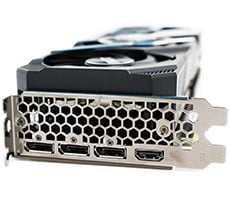
Let’s get down to business. As we’ve mentioned, the Asus MARS II packs a full GeForce GTX 580 SLI, dual-GPU configuration onto a single board. Doing so required some significant engineering on Asus’ part to deal with the power and heat requirements of such a configuration. Asus pulled it off though, by equipping the MARS II with a new “SAP”, or Super Alloy Power VRM capable of 600W of power delivery, binning the GPUs, outfitting the GPUs with DirectCU heatsinks, and capping everything off with a pair of 120mm cooling fans. The exploded view of the Asus MARS II above shows just how complex a product the card really is. The two large heatsinks rest directly atop each GPU. Memory chips flank three sides of each GPU with the SAP VRM smack dab in the middle. A heavy-duty metal backplane adds some much needed rigidity to the card and protects the entire backside. And a large shroud / fan housing covers the front. We should point out that the two fans on the MARS II are capable of pushing 220CFM. For comparison, the fan on a GTX 590 can move 32CFM. Providing smooth, clean power is paramount for any graphics card, but especially for something as complex as the MARS II. To that end, Asus outfitted the card with a 21-phase VRM comprised of “super alloy” chokes, caps, and M.O.S.F.E.T.s, capped off my Asus’ super-hybrid engine. According to Asus, the SAP VRM “utilizes metals that are highly-magnetic, heat-resistant and anti-corrosive to reduce power loss, enhance durability and achieve cooler operation.” Also part of the SAP VRM is a pair of NEC / Tokin Prodalizers mounted directly behind each GPU. These prodalizers offer high capacitance and low ESR for clean power delivery and they’re placed as close to the GPUs are possible to increase efficiency and effectiveness. Unlike the dual-GPU GeForce GTX 590, which is clocked much lower than the GTX 580, by going all out on its power delivery circuitry and cooling apparatus, Asus is able to provide a no-compromise (in terms of performance and features) GeForce GTX 580 SLI setup on a single-PCB, that runs at slightly higher stock frequencies than a pair of reference cards. The GPUs on the Asus MARS II are clocked at 782MHz (1564MHz shaders) and its 3GB of Samsung GDDR5 memory at 1002MHz (4008MHz effective). Reference GeForce GTX 580 cards have the same speed memory with GPUs that run at 772MHz. In case you haven’t noticed up to this point, the Asus MARS II is huge. Really huge. The card measures in at 13” x 6.2” x 2.5”and almost 5.4lbs. It’s three-slots wide and dwarfs the Radeon HD 6990 and GeForce GTX 590. The thing is just plain imposing to look at. |
| Test Setup & Unigine Heaven v2.5 | ||||||||||||
How We Configured Our Test Systems: We tested the graphics cards in this article on a Gigabyte GA-EX58-UD5 motherboard powered by a Core i7 980X six-core processor and 6GB of OCZ DDR3-1333 RAM. The first thing we did when configuring the test system was enter the system BIOS and set all values to their "optimized" or "high performance" default settings. Then we manually configured the memory timings (DDR3-1333, CAS 7) and disabled any integrated peripherals that wouldn't be put to use. The hard drive was then formatted and Windows 7 Ultimate x64 was installed. When the installation was complete we fully updated the OS and installed the latest DirectX redist, along with the necessary drivers, games, and benchmark applications.
Do you see these two graphs? The ones with the longer bars in attached to the Asus MARS II entry? Get used to 'em, because the Unigine Heaven Benchmark isn't the only one that the Asus MARS II dominated. As you can see, Asus' powerhouse outran both the GeForce GTX 590 and Radeon HD 6990 by a wide margin here. |
| Futuremark 3DMark11 | ||||||
Nothing could touch the Asus MARS II in the 3DMark11 benchmark. While running in AUSUM mode, the Radeon HD 6990 came within a few hundred points, but ultimately the MARS II was still more than 10% faster than the OC'd Radeon and about 18 - 22% faster than the stock 6990 and GTX 590. |
| FarCry 2 Performance | ||||||
FarCry 2 was essentially CPU bound at 1920x1200 and all of the high-end, dual-GPU cards finished within a couple of frames per second of one another. At the higher resolution, the MARS II and GeForce GTX 590 distanced themselves from the Radeons and the GTX 590 notched out a victory. |
| Just Cause 2 Performance | ||||||
Talk about a good, old fashioned, butt whoopin'. The Asus MARS II smoked every other card by a wide margin at both resolutions in the Just Cause 2 benchmark. The MARS II's closest competitor--the Radeon HD 6990 AUSUM--still finished about 17FPS behind at the highest resolution we tested. |
| Metro 2033 Performance | ||||||
The Asus MARS II finished about 10% ahead of the Radeon HD 6990 AUSUM in the Metro 2033 benchmark, when tested at 1920x1200. With the resolution cranked up to 2560x1600, however, the overclocked Radeon comes surging back and takes the top spot by the slimmest of margins. |
| Lost Planet 2 Performance | ||||||
The Lost Planet 2 benchmark is all about NVIDIA-powered cards, and the MARS II simply stomps its competition here. The card is over 20% faster than the GeForce GTX 590, which itself clearly outpaces the Radeon HD 6990. |
| F1 2010 Performance | ||||||
F1 2010 favors the Radeon HD 6990 over NVIDIA's flagship GeForce GTX 590, but the Asus MARS II's immense horsepower give it enough concentrated oomph to jump into the lead and outpace even the overclocked Radeon HD 6990. |
| Alien vs. Predator Performance | ||||||
Like F1 2010, the Alien vs. Predator benchmark has the Radeon HD 6990 finishing well ahead of the GeForce GTX 590, but even while running in AUSUM mode, the 6990 can't hold back the Asus MARS II's onslaught. Once again, the Asus MARS II is the fastest card of the bunch. |
| Overclocking and Power Consumption | ||||||||
Before bringing this article to a close, we'd like to cover a few final data points--namely power consumption, noise, and overclocking. Throughout all of our benchmarking and testing, we monitored how much power our test system was consuming using a power meter. Our goal was to give you an idea as to how much power each configuration used while idling and while under a heavy workload. Please keep in mind that we were testing total system power consumption at the outlet here, not just the power being drawn by the graphics cards alone.
Looking back at the numbers, it should come as no surprise that the Asus MARS II consumed the most power off all of the cards we tested, while idling and while under load. At idle our Asus MARS II-equipped test system consumed 43 more watts that its closest cousin, the GeForce GTX 590. And while under load the test system pulled a whopping 673 watts from the outlet. If you're worried about your carbon footprint, the MARS II is most definitely not for you. This card is extremely power hungry.
The Asus MARS II includes a copy of the company's excellent GPU Tweak Utility, so we fired it up to do a bit of monitoring and overclocking as well. Asus has informed us that most cards will do 800MHz GPU clocks easily, the majority will do 820MHz, and a smaller number are hitting around 870MHz. We were easily able to hit 828MHz on the GPUs with a 90+MHz increase to the memory clock as well, but think there was more left in the tank. Unfortunately, we only had a limited time to test the card before cranking out this article, so we couldn't tweak much further. We should note, that while overclocked, the MARS II managed to put up 59.9 FPS in the AvP benchmark at 2560x1600, which was an 7 FPS increase over stock. |