|
|
| Introduction and Specifications | ||||
Solid State Drives are all the rage with PC Enthusiasts these days. Although relatively expensive in comparison to standard hard drives, Solid State Drives have gotten very popular and have earned a reputation as one of the most significant performance upgrades available to enhance general system responsiveness. Capacities are relatively low in comparison to standard hard drives, but access times and transfer rates are in a different league altogether. And it’s a good SSD’s quick access times and speedy transfers that dramatically impact the end user experience, for the better. Solid State Drives are simply different beasts versus traditional hard drives and the performance difference is easily perceptible to the end user.
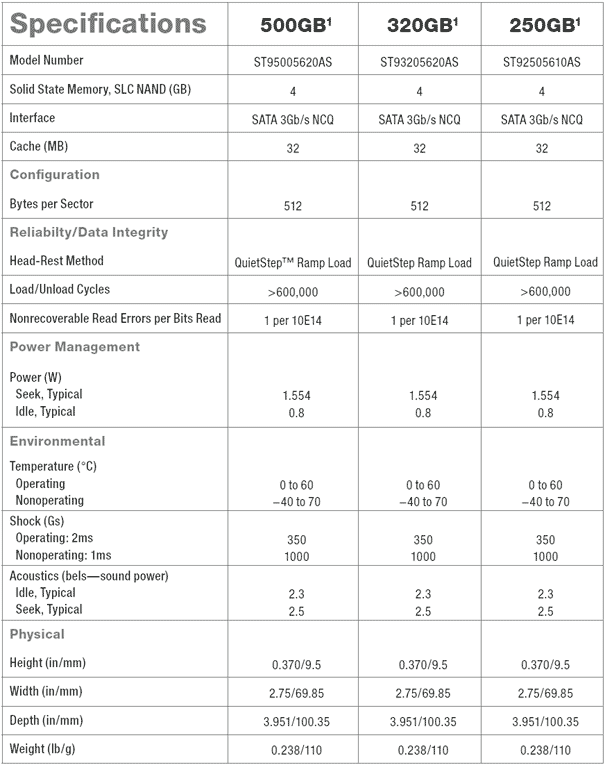
Looking at the Seagate Momentus XT’s features and specifications, it’s only the “Solid State Memory” entry (second from the top) that reveals that this drive is somehow different than a traditional hard drive. Other than that, the Seagate Momentus XT’s specs read like those of a modern, 7200RPM, 2.5” SATA hard drive. And as you’ll see on the next page, it looks like a standard HD too. |
| Seagate Momentus XT Hybrid |
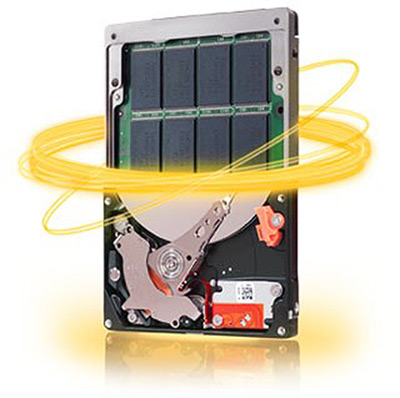
The Seagate Momentus XT will initially be available in three capacities—250GB, 320GB, and 500GB. The drive you see pictured below if the flagship 500GB model.
The Seagate Momentus XT features 4GB of integrated SLC NAND flash, linked to the traditional platter-based storage via an intelligent controller. The drives conform to the 2.5” form factor with 9.5mm Z-Height, and they sport standard SATA 3.0Gb/s interfaces. 32MB of DRAM cache is also incorporated into the drives, and as we’ve already mentioned, they feature 7200RPM spindle speeds. Looking at the pictures above, there’s nothing that hints to the hybrid nature of the Momentus XT. They simply look like standard 2.5” hard drives. But, rest assured, they are different. |
| Test System and IOMeter | ||||||||||||
Our Test Methodologies: Under each test condition, the Solid State Drives tested here were installed as secondary volumes in our testbed, with a standard spinning hard disk for the OS and benchmark installations. The SSDs were left blank without partitions wherever possible, unless a test required them to be partitioned and formatted, as was the case with our ATTO, Vantage, and CrystalDiskMark benchmark tests. And all drives were secure erased prior to the start of any testing. Windows firewall, automatic updates and screen savers were all disabled before testing. In all test runs, we rebooted the system and waited several minutes for drive activity to settle before invoking a test.
In the following tables, we're showing two sets of access patterns with IOMeter; one with an 8K transfer size, 80% reads (20% writes) and 80% random (20% sequential) access and one with IOMeter's default access pattern of 2K transfers, 67% reads and 100% random access. Both tests were conducted with 8 worker threades.
The adaptive memory technology of the Seagate Momentus XT doesn't seem to adapt to the workloads presented by IOMeter, as is evidenced by the similarity in the results between the first and third runs, but the drive does perform well, relative to the other hard drives we tested. With both the default and our workstation access patterns, the Momentus XT finishes well out in front of the other hard drives we tested. The SSD, however, dominates all around. |
| SANDRA Testing | ||||||||||||||||
For our next set of tests, we used SiSoft SANDRA, the the System ANalyzer, Diagnostic and Reporting Assistant. Here, we used the Physical Disk test suite and provided the results from our comparison SSDs. The benchmarks were run without formatting and read and write performance metrics are detailed below. We have also included SANDRA's detailed graph so you are able to see how the drive performs over time along with the average rated result.
The Seagate Momentus XT performs like a standard hard drive in the SiSoft SANDRA Physical Disk benchmark. It finished about 1MB/s ahead of the WD Scorpio Blue in terms of Read bandwidth.
SANDRA's physical disk write performance test has the Seagate Momentus XT finishing well behind the WD Scorbio Blue. We must point out, however, that this benchmark will not fully exploit the benfits of the hybrid solid state storage available on the Momentus XT. Although the spiky write performance inidicates the solid state storage is being accessed. |
||||||||||||||||
| ATTO Disk Benchmark | ||||||||||
ATTO is a more straight-forward type of disk benchmark that measures transfers across a specific volume length. It measures raw transfer rates for both reads and writes and graphs them out in an easily interpreted chart. We chose .5kb through 8192kb transfer sizes over a total max volume length of 256MB. This test was performed on blank, formatted drives with NTFS partitions.
The Seagate Momentus XT performed somewhere in between the WD Scorpio Blue and the Barrcuda 7200.11 in the ATTO Disk Benchmark. The true solid state drive, however, was in a league of its own. But again, we must reiterate, a low-level benchmark like ATTO that simply tests bandwidth with varying block sizes, will not benefit from the adaptive memory technology incorporated into the Momentus XT. |
||||||||||
| CrystalDiskMark Benchmarks | ||||||||||
CrystalDiskMark is another synthetic test we've started looking at that evaluates both sequential as well as random small and large file transfers. It does a nice job of providing a quick look at best and worst case scenarios with SSD performance, best case being large sequential transfers and worse case being small, random 4K transfers.
CrystalDiskMark tells a similar story to ATTO. Here, the Momentus XT finishes in between the Scorpio Blue and Barracuda once again, but well behind the SSD. In a strict comparison between WD's fastest mobile HD though, despite the fact that CrystalDiskMark does not exploit the Momentus XT's adaptive memory technology, the Momentus XT puts up significantly better numbers in every workload. |
||||||||||
| HD Tach Testing | ||||||||||
Simpli Software's HD Tach is described on the company's web site as such: "HD Tach is a low level hardware benchmark for random access read/write storage devices such as hard drives, removable drives, flash devices, and RAID arrays. HD Tach uses custom device drivers and other low level Windows interfaces to bypass as many layers of software as possible and get as close to the physical performance of the device being tested."
HD Tach is another benchmark that doesn't truly benefit from the Momentus XT's adaptive memory technology. But while the drive's transfer speeds are in-line with similar hard drives according to this test, its access time is more on par with the SSD. Of course, the .3ms access time reported for the Momentus XT is representative of the solid state storage partition's performance and not if its spinning platters, but it hints at the benefits of the Momentus XT's adaptive memory technology. |
||||||||||
| PCMark Vantage | ||||
Next we ran the three drives through a battery of tests in PCMark Vantage from Futuremark Corp. We specifically used only the HDD Test module of this benchmark suite to evaluate all of the drives we tested. Feel free to consult Futuremark's white paper on PCMark Vantage for an understanding of what each test component entails and how it calculates its measurements. For specific information on how the HDD Test module arrives at its performance measurements, we'd encourage you to read pages 35 and 36 of the white paper.
We really like PCMark Vantage's HDD Performance for its real-world application measurement approach to testing. From simple Windows Vista start-up performance to data streaming from a disk drive in a game engine and video editing with Windows Movie Maker, we feel confident that these tests best illustrate the real performance profile of our SSDs in an end user/consumer PC usage model.
Here is where things start to get really interesting. The HDD Test suite incorporated into PCMark Vantage represent a pseudo-real world secenario with which the Momentus XT's adaptive memory technology can be exploited. In this graph and the one on the next page, there are two sets of results for the Momentus XT representing the first and third runs of the benchmark on the drive. |
| PCMark Vantage (Cont.) | ||||
Our next series of Vantage tests will stress the write performance. Applications like video editing, streaming and recording are not what we would call a strong suit for the average SSD, due to their high mix of random write transactions. We should also note that it's not so much a weakness of the memory itself, but rather the interface and control algorithms that deal with inherent erase block latency of MLC NAND flash. SSD manufacturers are getting better at this, as is evidenced by our results below...
The trend continued in the remainder of the PCMark Vantage tests. On the first run of the benchmark, the Seagate Momentus XT performed surprisingly well. By the third run though, performace had increased dramatically and approached the level of the true SSD. |
| Our Summary and Conclusion | ||||
Performance Summary: The Seagate Momentus XT produced some interesting performance results. In the purely synthetic tests designed to look at raw throughput, the Momentus XT generally performed like a high-end, 7200 RPM hard drive--transfer rates typically fell between the WD Scorpio Blue and Seagate Barracuda desktop drive. In the system level benchmarks like those employed in PCMark Vantage, however, once the Momentus XT's adaptive memory technology learned the usage patterns and copied over the most commonly accessed bits of data to the solid state portion of the drive, performance improved dramatically. The Momentus XT was never able to truly match the performance of a true SSD, but its performance when the adaptive memory technology was used was far superior to a standard HD.
|