|
|
| Introduction and Related Info | ||||
Over the course of the past four months or so, AMD has been on a tear, releasing a slew of new DirectX 11-class GPUs at price points ranging from approximately $600 all the way on down to about $100. All the while, AMD was also up front about the release schedule for many upcoming, future products. If you remember back to some of our previous Radeon HD 5000 series coverage, we showed you a picture of this slide, that outlined AMD's plans to launch the GPUs codenamed Redwood and Cedar sometime in Q1 2010. Redwood became the Radeon HD 5670 and today we can finally spill the beans on the first iteration of Cedar.
A lot of groundwork had to be laid over the preceding months and even years before AMD could produce the entire Radeon HD 5000 series of products. Although the GPU at the heart of the Radeon HD 5450 is based on the same architecture as the other members of the DX-11 class Radeon HD 5000 series, the chip does leverage technologies already implemented in previously released GPU generations, so it's not all new. As such, we'd recommend perusing some recent HotHardware articles to brush up on a few of the technologies and features employed by the new Radeon HD 5450...
The articles listed above cover many of the features available with the Radeon HD 5450, like the UVD 2 video engine, Catalyst Control Center, PowerPlay, GDDR5 memory, and more. There are also, however, many brand new things that were introduced with the Radeon HD 5800 series that we detailed in our Radeon HD 5870 coverage, so that article at the very least is a must-read companion to this one - well, if you're up for some extra bedtime reading anyway. |
| ATI Radeon HD 5450 |
If you have already read our coverage of the Radeon HD 5800 series launch, then the block diagram below should look somewhat familiar to you. As we've already mentioned, the new Radeon HD 5450 offers virtually all of the same features of 5800 series; the differences being that the 5450 series is equipped with fewer SIMD engines, and hence fewer stream processors, fewer texture units, and ROPs and it has a narrower external memory interface.
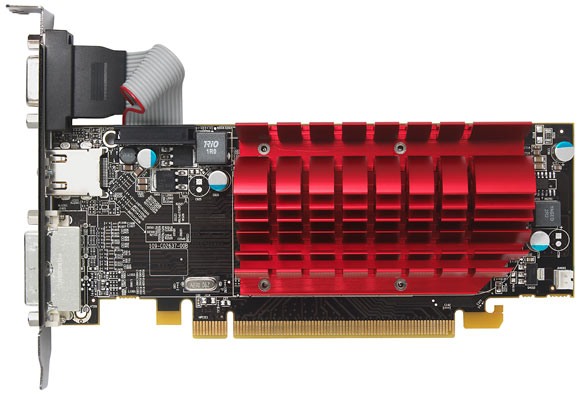
Specifically, the Radeon HD 5450 series GPU offers 1 SIMD engine with 80 total Stream Processing Units, 8 Texture Units, and 4 ROPs with a 128-bit GDDR3/2 memory interface. The actual GPU is manufactured using TSMC's 40nm process and is comprised of approximately 292 million transistors. The Radeon HD 5450 we'll be featuring in this article is the 512MB, passively cooled version, pictured above. It is a half-height card that features a relatively large heatsink that cools the GPU and RAM mounted on the front. Please note that the heatsink does encroach on an adjacent slot, so this card should be considered dual-slot. Typical idle board power is only 6.4w with peak power of around 19.1w, so there is no need for supplemental power connectors here--the 75w offered by a PCIe slot will do. The reference specifications call for a 650MHz GPU clock, with 800MHz memory, for an effective data rate of 1.6Gbps. At those clocks, the Radeon HD 5450 offers a peak texture fillrate of 5.2GTexel/s, 2.6GPixels/s, with 12.8GB/s of memory bandwidth and up to 104 GLOPS of compute performance. We should point out, however, AMD has authorized board partners to offer overclocked boards with memory clocked as high as 900MHz--and this reference card featured a 900MHz memory clock. |
| Test Setup and Vantage | ||||||||||||
HOW WE CONFIGURED THE TEST SYSTEM: We tested the graphics cards in this article on an Gigabyte GA-EX58-UD5 motherboard powered by a Core i7 965 quad-core processor and 6GB of OCZ DDR3 RAM. The first thing we did when configuring the test system was enter the system BIOS and set all values to their "optimized" or "high performance" default settings. Then we manually configured the memory timings and disabled any integrated peripherals that wouldn't be put to use. The hard drive was then formatted, and Windows 7 Ultimate x64 was installed. When the installation was complete we fully updated the OS and installed the latest hotfixes, along with the necessary drivers and applications.
Wow, not much to see here. The Radeon HD 5450 obviously was not designed with high-resolution gaming in mind, as is evident by the ultra low score it posted in 3DMark Vantage when run with the Extreme preset option. |
| Enemy Territory: Quake Wars | ||||||
Enemy Territory: Quake Wars ran perfectly find on the Radeon HD 5450, but playable framerates were not possible at resolutions of 1680x1050 or 1920x1200 with high-quality settings. |
| Left 4 Dead | ||||||
Our Left 4 Dead benchmark results look much like those from ET:QW on the previous page. Although the game works on the Radeon HD 5450, playable framerates will only be possible at lower resolutions with relativley low in-game quality settings. |
| Tom Clancy's H.A.W.X. | ||||||
The Radeon HD 5450 only managed single-digit framerates in the Tom Clancy: H.A.W.X. Once again, it would require lower resolutions and in-game image quality settings to achieve playable frame rated with the 5450 in this game. |
| Video Playback and Power Consumption | ||||
Looking back at the gaming performance of the Radeon HD 5450, it's obvious this card wasn't designed to please hardcore gamers. However, it's half-height form factor and passive cooling are sure to appeal the HTPC crowd. With that in mind we also tested the 5450 in a number of scenarios, playing back DVDs, Blu-Ray discs, MOV files, and ripped M2TS files. The Radeon HD 5450 was flawless during playback of all video types and CPU utilization was extremely low (as you can see in the screen-cap above). In addition, we should note that Adode now supports GPU acceleration of Flash video and the 5450 also performed well playing back HD vids from Hulu, Youtube and the like.
Before bringing this article to a close, we'd like to cover a few final data points--namely power consumption and noise. Throughout all of our benchmarking and testing, we monitored how much power our test system was consuming using a power meter. Our goal was to give you all an idea as to how much power each configuration used while idling and while under a heavy workload. Please keep in mind that we were testing total system power consumption at the outlet here, not just the power being drawn by the graphics cards alone. As you can see, the new Radeon HD 5450 is quite power friendly. The card put up the lowest power consumption scores at both idle and while under load. |
| Our Summary and Conclusion | ||||
Performance Summary: The Radeon HD 5450's gaming performance was quite low, relatively speaking of course. The card sports a DX11-class GPU, but its paltry compliment of stream processors, ROPs, and texture units, in conjunction with its low memory bandwidth result in sub-par framerates, even at relatively mainstream resolutions like 1680x1050. At lower resolutions, with low in-game image quality settings, the Radeon HD 5450 should be capable of producing playable framerates is some aging games, but not in modern titles. The Radeon HD 5450's video playback performance and power consumption, however, are top notch--which makes the card well suited to Home Theater PC applications.
Although the Radeon HD 5450 is likely to appeal to only a select group of you--namely quite-PC or HTPC aficionados--AMD should be commended for this card's release. In a matter of only 4 months, the company was able to not only retake a leadership position in terms of 3D performance, but release an entire top-to-bottom line-up of DirectX 11 capable GPUs. That is no small feat and AMD deserves some credit. As of today, users in the market for cutting edge graphics with DX11, Eyefinity, and UVD 2 support, have options ranging from $50 all the way up to over $600. That's quite a broad spectrum of products to release in approximately only 4 months. The Radeon HD 5450, in various configurations, should be available immediately from major on-line e-tailers with prices ranging from about $49 to $59. The Radeon HD 5450 obviously isn't for everyone. But if you've got the need for a silent, low-power, affordable graphics card, that will also fit into a half-height form factor, and gaming isn't a priority, the Radeon HD 5450 should fit the bill nicely.
|