Logo   Banner   TopRight
TopUnder
Transparent
ATI Mobility Radeon HD 4000 Series Preview
Transparent
Date: Mar 27, 2009
Section:Graphics/Sound
Author: Marco Chiappetta
Transparent
Introduction and Specifications

One of the ways AMD is able to test and qualify ATI Mobility Radeon GPUs, without having to design and build numerous mobile reference cards that fit in multiple notebook form factors, is to produce fully-loaded, custom reference cards that'll fit into standard PCI Express x16 slots. The cards won't be used in any actual retail product, but they allow AMD to test all of the various features and functionality, and experiment with clock speeds and voltages to fine tune and balance performance, thermal output, and power consumption.


ATI Mobility Radeon HD 4000 Series

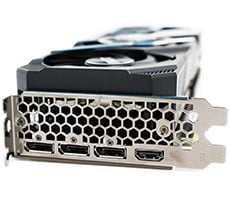
What you see pictured here is just such a card. The item pictured below is an ATI Mobility Radeon HD 4670, PCI Express-based reference card. We talked about the new mobility Radeon HD 4000 series during CES earlier this year; more details are available at this link. The reference card pictured here is equipped with every type of output supported by the GPU--Displayport, DVI, VGA, S-Video / HD component, and HDMI--and it even has CrossFire connectors for experimenting with multi-GPU configurations.  We've had a couple of Mobility Radeon HD 4670 and 4500 class reference cards in house for a while now, and have a sneak peek at approximate performance using a desktop platform for testing on the pages ahead.


ATI Mobility Radeon HD 4670 Reference Platform

The Mobility Radeon HD 4670 and 4500 series cards we received for evaluation looked nearly identical, save for the the memory chips used on each card, hence the single set of pictures above. The Mobility Radeon HD 4670 we tested features 320 stream processors, with a core GPU clock frequency of 675MHz, and 512MB of GDDR3 memory running at an even 800MHz. It's a relatively high performance offering that will be positioned in upper--mainstream market segments. The Mobility Radeon HD 4500 series offering sports only 80 stream processors, but with a 680MHz core GPU clock, and 256MB of GDDR3 frame buffer memory also running at 800MHz, but connected via a 64-bit interface--the 4670 has a 128-bit memory interface. The Mobility Radeon HD 4500 series will be positioned in thin and light market segments.

Transparent
3DMark Vantage and L4D

HOW WE CONFIGURED THE TEST SYSTEM: We tested the graphics cards in this article on an Gigabyte GA-EX58 Extreme motherboard powered by a Core i7 920 quad-core processor and 6GB of OCZ DDR3 RAM. The first thing we did when configuring these test system was enter the system BIOS and set all values to their "optimized" or "high performance" default settings. Then we manually configured the memory timings and disabled any integrated peripherals that wouldn't be put to use. The hard drive was then formatted, and Windows Vista Ultimate SP1 was installed. When the installation was complete we fully updated the OS, and installed the latest DX10 redist and various hotfixes, along with the necessary drivers and applications.

HotHardware's Test Systems
Core i7 Powered


Hardware Used:
Core i7 920 (2.66GHz)

Gigabyte EX58-Extreme
(X58 Express Chipset)

Mobility Radeon HD 4670 512MB
Mobility Radeon HD 4500 Series 256MB

6GB OCZ DDR3-1066 C7
(3 X 2GB)

Integrated Audio
Integrated Network

Western Digital "Raptor" 150GB
(10,000RPM - SATA)


Relevant Software:

Windows Vista Ultimate SP1
DirectX March 2009 Redist

ATI Catalyst v8.561 beta

Benchmarks Used:
3DMark Vantage v1.0.1
Left 4 Dead*
Enemy Territory: Quake Wars v1.5*

* - Custom
Benchmark

Futuremark 3DMark Vantage
Synthetic DirectX Gaming


3DMark Vantage

The latest version of Futuremark's synthetic 3D gaming benchmark, 3DMark Vantage, is specifically bound to Windows Vista-based systems because it uses some advanced visual technologies that are only available with DirectX 10, which y isn't available on previous versions of Windows.  3DMark Vantage isn't simply a port of 3DMark06 to DirectX 10 though.  With this latest version of the benchmark, Futuremark has incorporated two new graphics tests, two new CPU tests, several new feature tests, in addition to support for the latest PC hardware.  We tested the graphics cards here with 3DMark Vantage's Performance preset option, which uses a resolution of 1280x1024 no anti-aliasing and trilinear filtering.


Obviously the Mobility Radeon HD 4670's 320 stream processors, larger frame buffer, and wider memory interface allow it to significantly outpace the Mobility Radeon HD 4500 series offering in 3DMark Vantage.

Left 4 Dead
DirectX Gaming Performance


Left 4 Dead

Left 4 Dead is a co-operative, survival horror, first-person shooter that was developed by Turtle Rock Studios, which was purchased by Valve part-way into development. Like Half Life 2, the game uses the Source engine, however, the visual in L4D are far superior to anything seen in the Half Life universe to date. The game pits four Survivors of an apocalyptic pandemic against hordes of aggressive zombies. We tested the game at resolutions of 1280 x 720 and 1680 x 1050 with 4x anti-aliasing and 16x anisotropic filtering enabled and all in game graphical options set to their maximum values.

In out custom Left 4 Dead benchmark, the Mobility Radeon HD 4670 is again easily able to outperform the 4500 series GPU. It is worth noting, however, that we tested with all of the in-game graphics options cranked up to the maximum values, with anti-aliasing and aniso filtering enabled. Should the Mobility Radeon  HD 4500 series find its way into some attractive thin and light notebooks, it would definitely be able to run L4D at acceptable framerates with the image quality settings turned down a bit.

Transparent
ETQW and Power

Enemy Territory: Quake Wars
OpenGL Gaming Performance


Enemy Territory:
Quake Wars

Enemy Territory: Quake Wars is Based on a radically enhanced version of id's Doom 3 engine and viewed by many as Battlefield 2 meets the Strogg, and then some.  In fact, we'd venture to say that id took EA's team-based warfare genre up a notch or two.  ET: Quake Wars also marks the introduction of John Carmack's "Megatexture" technology that employs large environment and terrain textures that cover vast areas of maps without the need to repeat and tile many smaller textures.  The beauty of megatexture technology is that each unit only takes up a maximum of 8MB of frame buffer memory.  Add to that HDR-like bloom lighting and leading edge shadowing effects and Enemy Territory: Quake Wars looks great, plays well and works high end graphics cards vigorously.  The game was tested with all of its in-game options set to their maximum values with soft particles enabled in addition to 4x anti-aliasing and 16x anisotropic filtering.

The results from our custom Enemy Territory: Quake Wars benchmark looks much like those from Left 4 Dead on the previous page. The more powerful Mobility Radeon  HD 4670 puts up framerates more than twice as high as the 4500 series GPU.

Total System Power Consumption
Tested at the Outlet

We'd like to cover a few final data points before bringing this article to a close. Throughout all of our benchmarking and testing, we monitored how much power our test system was consuming using a power meter. Our goal was to give you an idea as to how much power each configuration used while idling and under a heavy graphics workload. Please keep in mind that we were testing total system power consumption at the outlet here, not just the power being drawn by the graphics cards alone.

Both of the experimental Mobility Radeon HD 4000 series graphics cards we tested consumed little power while idling--keep in mind they were tested in a Core i7-based desktop system and total idle power consumption was just slightly over 110 watts. Under load, the Mobility Radeon HD 4670 consumed an additional 33 watts and the 4500 series card and additional 21 watts. While those figures are somewhat higher than many integrated graphics solutions, they are relatively low for discreet graphics offerings.

Transparent
Our Conclusion

The experimental Mobility Radeon HD 4000 series cards we tested here exhibited very different performance. The higher-end Mobility Radeon HD 4670 showed that it is a capable GPU, that can handle fairly demanding graphics workloads with solid performance, without consuming very much power. The Mobility Radeon HD 4500 series GPU offered much lower 3D performance, but under full load it also consumed much less power, which is an important consideration for the GPU's thin and light target market segment.


To be perfectly honest, we can't really draw any solid conclusions on the Mobility Radeon HD 4670 and 4500 series based on the reference cards we've shown you in this preview. Without testing them in an actual notebook, constrained by the limitations of a mobile form factor, we can't intelligently comment on thermal output, battery life, acoustics, etc. All we can say, is that should the exact Mobility Radeon HD 4000 series configurations we tested here, with the same frequencies and memory compliments, find their way into some attractive notebooks, users in need of strong graphics performance in a mobile system will likely be pleased by this latest round of mainstream Mobility Radeon products.


The MSI EX625-227US Featuring The Radeon HD 4670

Currently, the Mobility Radeon HD 4670 with 512MB is available in the sub-$900 MSI EX625-227US Professional series notebook and the 4650 can be found in the Asus N81Vp, BenQ Joybook S57 (for Australia, Thailand and Malaysia), and the Toshiba Satellite 300. We have a request for any other information AMD can share regarding other design wins for these mainstream Mobility GPUs, but at this time there isn't much more the company can share until their parters go public with their own announcements. The higher-end 4800 series Mobility Radeons are somewhat easier to find, but the more mainstream 4600 and 4500 series offerings are currently much harder to come by. Hopefully, in time they'll find their way into more notebooks because AMD's base GPU architecture is sound, as is evidenced by ATI's recent success on the desktop.


Content Property of HotHardware.com