|
|
| Introduction & Specifications | |||||||||
| When AMD launched their current generation of Radeon 4800 series graphics cards last summer, they propelled themselves back into the ring against NVIDIA, who had previously been dominating the performance game for a few product cycles. The Radeon 4800 series provided decidedly high-end performance at a comfortable mid-range price that undercut NVIDIA's offerings at the time, forcing them to scramble to compete on price. Since then AMD has fleshed out their product line-up with a plethora of high, mid and low end products, but the original 4850 and 4870 remain extremely popular. It's been over half a year since they were initially announced but the Radeon 4800 series of graphics cards are still very much in the limelight, although they are now relegated to the mid-range segment by the newer dual-GPU solutions from both the red and green camps. Manufacturers continue to produce new takes on the Radeon 4800 series and there is a 4800 series product aimed at every consumer segment, from low cost reference designs to premium, built-in watercooling solutions. ASUS and Sapphire are two such manufacturers and they have both recently released new 4800 series products aimed at the higher end performance segment. ASUS recently announced a new line-up of video cards under their Republic of Gamers brand, the Matrix series. We took a look at the first available ASUS ROG Matrix series product, the EN9800GT Matrix, two months ago. Since then ASUS has introduced several more ROG Matrix cards and we will be evaluating the new 4850 and 4870 offerings in this article. We'll also be evaluating Sapphire's take on a pumped up non-reference 4870, which is a member of their premium Toxic line-up, that will be competing for your dollars in the same price segment as the Matrix cards. While Sapphire has had a Toxic 4870 product for several months, it only sported 512MB of onboard memory. Recently Sapphire announced an updated 1GB version of their Toxic 4870 and we'll be evaluating that today alongside the two ASUS cards.
One thing is certain, all three cards we are evaluating today sport radically different dual-slot cooling solutions and beefed up clock and memory speeds. Read on to find out if all this metal, heatpipes and fans can deliver on the manufacturer's claims. |
| ASUS ROG EAH4850 Matrix | ||||
| Most video cards have basic, built-in self-regulating capabilities where the fan speed is adjusted according to the temperature of the GPU core. The fan speed adjustments are generally built-in and handled by the firmware and drivers, and the user is often not given the option to alter the way this works other than to simply alter fan speeds in the driver control panel. This is the case for nearly all reference designs from both AMD and NVIDIA. For most people, this is fine, but some users would love to have more control over how the hardware functions and that is where the ASUS Matrix series comes in. The central concept behind the Matrix series of cards from ASUS is to provide much more advanced and robust controls for regulating how the video card functions; from cooling to performance. In order to achieve this, all ASUS Matrix series cards are equipped with a dedicated onboard controller chip ASUS calls the "Super Hybrid Engine" in conjunction with the "iTracker" software application. This chip performs a number of duties related to monitoring and regulating how the card behaves and the iTracker application allows the user to have a say on how the process works. Specifically, the chip monitors the card's GPU, memory and power subsystem in real-time for temperature, voltage, power consumption and loading. The chip uses this data to alter the fan speed and clock speed of the card in real time. The iTracker application can display all of the data being collected by the chip but it also allows the creation of custom performance profiles which gives the user full control over how the card responds to performance data. Everything from fan speed triggers to core and memory clock speed and even voltage can be set up in the profiles. Lastly, the iTracker software allows you to set different settings depending on whether the system is running in 3D mode or 2D mode. This means you can set your card to down-clock using a very low-noise fan profile for 2D mode for quiet computing while switching to 3D mode will engage a different profile that can overclock the card and switch to an aggressive fan profile. While in 2D mode, the fan can also automatically turn itself off completely and stay off as long as the temperatures remain below a certain point. All this is done rather seamlessly once the iTracker application is installed and the profiles are set up. Switching between the 2D and 3D modes is also automatic and happens any time a 3D application is launched, such as a game. Best of all, since most of the heavy lifting is done by the dedicated Super Hybrid Engine chip, there is essentially zero CPU overhead.
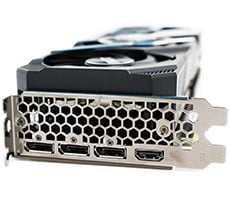
The first of the two ASUS ROG Matrix series cards we're evaluating in this article is the Radeon HD 4850 version. This card uses a dual-slot cooler that is identical to the one found on the ROG EN9800GT Matrix we reviewed two months ago. The EAH4850 Matrix's dual-slot cooler features a single blower-style fan that sucks in air and blows it through the body of the card, which is covered by a large heatsink, and out the rear of the card through a grill in the rear I/O panel. The heatsinks and fan are covered by a few pieces of plastic that help to guide the airflow as well as serve aesthetic purposes. The top of the plastic housing features the ASUS logo in white lettering and a Republic Of Gamers sticker is displayed on the fan's motor housing. Overall, it is one of the more appealing graphics card cooler designs we've seen. The cooler has three long heatpipes and they serve as the only thermal connection between the heatsink and the GPU. The heatsinks are elevated above the card by stand-off posts and don't make direct contact with the card. The first two heatpipes connect to the heatsink the fan is blowing into, which is directly over where the GPU is located. The third heatpipe connects to a second smaller heatsink that wraps around the fan itself. The onboard memory chips are cooled by two strips of ramsinks which sit snug under the primary heatsink. The voltage regulation chips are not covered by any heatsinks but the the fan is located directly over them and the residual airflow is enough to keep them cool. Overall, the cooler performs quite well and is fairly quiet, especially while the system is idle or experiencing low load. With the iTracker profile setup to operate as quietly as possible, the cooler can be near silent. While it is technically possible for the fan to switch off during low-usage while in 2D mode, it doesn't quite have the passive cooling capacity necessary to maintain stable temperatures in this mode and during our testing it never switched off. Overall the ROG EAH4850's cooler is a significant improvement over the little single-slot high-pitched and sometimes noisy reference cooler. The card gets additional power from a single 6-pin PCI-E power connector and the rear I/O panel features two DVI ports and a single HDTV port which can be used to output either S-video or composite through the use of included adapters. The accessories bundle included with the ROG EAH4850 Matrix is identical to the one included with the 4870 version which will be discussed on the next page. |
| ASUS ROG EAH4870 Matrix |
| The ROG EAH4870 Matrix is a significantly different beast than the 4850. While it still sports the same Super Hybrid Engine chip and iTracker application, the rest of the card is completely different. Although iTracker allows for overclocking, the 4850 is shipped at stock speed and does not have any sort of guaranteed factory overclocking. The 4870, on the other hand, does come factory overclocked to 770MHz core clock and 920MHz memory clock. That is a 20MHz overclock in core clock and 20MHz overclock of memory. This is hardly anything to write home about and doesn't come close to ASUS' own 4870 TOP which features a much higher overclock. However, top-end factory overclock isn't the purpose of the Matrix series. The ROG EAH4870 uses a very unique dual-slot cooler that features two fans. In a way, the cooler looks like a slightly longer, frankensteinian version of the single fan cooler found on the 4850 version. However, there are many significant differences between the two coolers. The most obvious difference is the extra fan, which is placed in the middle of the card, directly over where the GPU is located. The second difference is in the type of fans used. While the single fan cooler on the 4850 uses a blower style fan, the 4870 features two conventional low-profile fans, although the tips of the fan blades have been curved to give it a bit of a hybrid design. The cooler also sports four copper heatpipes. The heatsink is separated into four pieces with one heatpipe per piece. The first piece wraps around the second fan at the back of the card near the power connectors. The second and third heatsinks both wrap around the first fan located in the center of the card. The last heatsink is located at the front of the card near the I/O panel. The cooler also has very different operating characteristics compared to the one found on the 4850 version. In 2D mode, only the fan that is located in the middle of the card is turned on while the second fan is turned off completely. Switching to 3D mode will turn both fans on. We also found that this cooler has much better passive cooling abilities than the one found on the 4850 and both fans often turned off completely. However the passive cooling ability still isn't optimal and the fans can only stay off for 15-20 minutes before one of them needs to turn back on again to bring the temperature back down. We found the constantly toggling of the fans while in 2D mode to be quite annoying, as they turned on and off every 15 minutes or so. We also noticed that the fans on the 4870 are noticeably louder than the blower on the 4850 version. While the two fan's aren't individually any louder than the blower fan on the 4850, when combined at medium to full speed, they can produce quite a ruckus. They also produce a slightly higher pitched noise which we found to be more irritating and finally there was significant "wind" noise when both fans were on simultaneously, presumably due to the airflow of the two fans interfering with each other. Overall the cooler is very fancy and nice to look at but it isn't the most efficient model we've seen nor is it the quietest. In terms of noise, it isn't much better than the 4870 reference cooler. However it does get the job done at least as well as the reference cooler and with some tweaks in the iTracker application, the fans can be brought down to a more acceptable level. Both the ASUS ROG EAH4850 Matrix and the EAH4870 come packaged with the same bundle. Inside the box you'll find the following:
|
| Sapphire HD 4870 1GB TOXIC |
| The Toxic series of graphics cards is Sapphire's premium brand. For the last few generations, they have featured factory overclocking and custom non-reference coolers using Sapphire's Vapor Chamber Technology. The current version of the Vapor Chamber cooling system is called Vapor-X. The latest product to use the Vapor-X cooler is the new Sapphire HD 4870 1GB Toxic, an upgrade of the existing HD 4870 512MB Toxic. At a glance, the Sapphire Vapor-X cooler doesn't look very impressive. In fact it somewhat resembles a standard reference cooler. However the three large heatpipes protruding from the top of the plastic shroud hints at what's underneath. The Vapor Chamber is a large, hollow plate that makes direct contact with the GPU. Inside is a chamber with liquid. The heat from the GPU causes the liquid to vaporize and the vapor then passes through a condensation wick where it cools down and turns back into a liquid to begin the process all over again. This cycle of vaporization and condensation is a very efficient way of transferring heat and it is the same basic principle as that found in your average heatpipe. The chamber quickly and efficiently draws the heat away from the surface of the GPU and up to the top of the chamber, where the central heatsink and heatpipes are attached. The heatpipes help to disperse the heat further away from the center of the vapor chamber and throughout the large heatsink, which runs the entire length of the card. A single fan is mounted directly above the area where the GPU sits. This is a standard bladed fan and not a blower, which means it doesn't move through the body of the card from front to back. Instead, the fan sucks in air and blows it onto the heatsink where it then splits up into two separate air streams; one headed to the grill on the rear I/O plate and the other headed out the back of the card. A disadvantage of this design is some of the exhaust air will end up back in the case rather than being expelled out through the rear grill like in a standard blower design. Overall the Sapphire HD 4870 1GB Toxic performed and behaved very well during testing. While idle, we found the Toxic to be much quieter than both of the Matrix cards (using the default profile) as well as the standard reference cooler. While it isn't silent, it's quiet enough that it will likely be lost in the sound of your CPU and case fans as they will likely to louder. Under load, the fan speeds up quite a bit but we found the fan speed steppings that Sapphire chose were fairly relaxed and the fan remained relatively quiet. It did get louder to the point where we could hear it over the sound of a standard Intel stock cooler on an open air test bed, but it should be very quiet when tucked away inside a chassis. Compared to the 4870 reference cooler design, it is an overall significant improvement. The Sapphire HD 4870 1GB Toxic came with a slightly more elaborate bundle than the one included with the Matrix cards. Inside the box you'll find the following:
There are also two fun additions; 3DMark Vantage and Ruby ROM. The Ruby ROM disk contains a number of game demos, applications as well as wallpapers and screensavers. The included demos are for Call of Juarez and Stranglehold as well as the free online RPG Dungeon Runners. The included applications are Earthsim and Gameshadow. |
| Test Setup & 3DMark06 | ||||||||||||
| HOW WE CONFIGURED THE TEST SYSTEMS: We tested all of the graphics cards used in this article on an Asus P5K3 Deluxe motherboard powered by a Core 2 Duo E8400 dual-core processor and 2GB of RAM. The first thing we did when configuring these test system was enter the system BIOS and set all values to their "optimized" or "high performance" default settings. Then we manually configured the memory timings and disabled any integrated peripherals that wouldn't be put to use. The hard drive was then formatted, and Windows Vista Ultimate SP1 was installed. When the installation was complete we fully updated the OS, and installed the latest DX10 redist and various hotfixes, along with the necessary drivers and applications.
In our first benchmark, 3DMark06, we get our first taste of how these cards perform. The ASUS matrix 4850 sticks very close to the score posted by the stock reference 4850 since they are of similar clock speed. However, both the Matrix and Toxic 4870s have left the reference model in the dust thanks to factory overclocking. ![]() The shader 2.0 and 3.0/HDR test results give us a better breakdown of how performance differed between the cards. It's worth noting here that although the GeForce GTX 280 was faster overall, it was only due to better performance in shader 2.0. In the shader 3.0 and HDR tests, the 4870's performed about par with the GTX 280. |
| 3DMark Vantage | ||||||
The 3DMark Vantage Extreme test tells a similar story to the 3DMark06 test, although the GeForce seems to have gained a much larger advantage. The ASUS Matrix 4850 performs a bit better than the reference card thanks to the slight boost provided by iTracker. The Matrix and Toxic cards also beat the reference model by an even larger margin. The Toxic's higher overclock gives it the advantage. |
| Company of Heroes | ||||||
|
Company of Heroes displays some interesting results. Despite having a higher factory overclock, the Sapphire Toxic 4870 actually performs slightly worse than the ASUS Matrix 4870 at higher resolutions. The ASUS Matrix 4850 also performed exceptionally well in this test, completely leaving the reference 4850 in the dust. Once again all three cards are faster than their reference model counterparts, although Company of Heroes does not favor Radeons and the GTX 280 pulls ahead by a large margin. |
| Crysis | ||||||
Running Crysis at its "Very High" graphics setting puts a hurting on all of the cards we tested. The two 4870s are nearly neck and neck, although both beat the reference model. The Matrix 4850 also does well here but none of the Radeons can touch the GTX 280. |
| Enemy Territory: Quake Wars | ||||||
|
The Matrix 4870 and Toxic 4870 posted essentially identical scores in Enemy Territory: Quake Wars. They both performed very well and beat out the stock reference 4870 by a large margin. The Matrix 4850 on the other hand wasn't much faster than the stock model. |
| Far Cry 2 | ||||||
The two Matrix cards did not take well to Far Cry 2. Both the Matrix 4870 and 4850 displayed odd behavior during benchmarking at the 1680x1050 and 1920x1200 resolutions. All benchmarking was conducted with the iTracker software enabled and set to the "gaming" preset settings for the Matrix cards and we believe the software may have interfered with the Far Cry 2 benchmarking application. While the Matrix 4870 still managed to beat out the reference model, the 4850 didn't fare as well and benched lower than the stock reference 4850. |
| HL2 Episode 2 | ||||||
The two Matrix cards did very well in Half Life 2 and they both posted very good scores relative to the stock reference models. Despite having a slightly higher overclock than the Matrix 4870, the Toxic 4870 performed slightly worse here. |
| Unreal Tournament 3 | ||||||
The Unreal Tournament 3 benchmarks have interesting results. Here we see that the overclocks on the Matrix and Toxic cards have very little effect on the results. All of the Radeon 4870 cards performed similarly, as did the 4850 cards. |
| Performance Summary & Conclusion | ||||||||||||
Performance Summary: All three video cards evaluated in this article performed well. Except for a few anomalies, the two Matrix cards and the Toxic all performed better than their stock reference counterparts. The 4850 does not receive a factory overclock, however the included iTracker application allows it to overclock by a few MHz, which is enough to give it a noticeable lead over the stock reference card. Both the Matrix 4870 and the Toxic 4870 sport ample factory overclocks and this showed in the benchmarks. Both cards performed well with respect to the stock 4870. The Sapphire Toxic seems to be the faster of the two 4870s, but it benefits from a slightly beefier overclock and 1GB of memory while the Matrix 4870 only has 512MB.
Perhaps the best part of the iTracker application is its profile manager. It can manage a large number of performance profiles, each with their own performance and cooling settings. The iTracker application also allows for separate settings to be made for 2D and 3D use; switching between the two depending on the applications which are currently running. One of the neatest results of this configurability is the ability to set the card to automatically downclock for lower-power, quiet computing while using 2D applications on the desktop, then automatically and instantly switch to an overclocked mode when a 3D application like a game is launched. The best part is the switch between 2D to 3D modes is automated and once the profile is set up, no further tinkering is required from the user. The ROG 4850 Matrix also has the advantage of a rather beefy non-reference cooler which both performed well and is relatively quiet. During testing we found the cooler to be much quieter and generally more efficient than the reference cooler. The only disadvantage is the cooler has a dual-slot design, rather than the single-slot design of the reference cooler. However, in return for an extra slot, you receive very good thermal characteristics and low noise. As you might expect, these extra features come at a price premium and the ASUS ROG 4850 Matrix can be found for around $185, although there is a $30 mail in rebate running until February 28. Compare that to $145 for a reference-clone 4850 or $165 (minis $30 MIR) for ASUS' own highly overclocked TOP series model. So is the price premium worth it? Perhaps, but not if you're primarily interested in top performance, in which case ASUS' own 4850 TOP will probably serve you better. While the Matrix comes with a good cooler, it doesn't quite justify the price alone. However, if you are looking for advanced hardware monitoring and tweaking features on your 4850, the ASUS ROG EAH4850 Matrix should be at the top of your list. With a dedicated hardware monitoring chip, advanced tweaking options including voltage adjustments, and a slick software interface, the ROG EAH4850 Matrix is a tweaker's delight.
The cooler on the ROG 4870 Matrix is quite beefy and features two fans. While it can certainly provide some serious cooling, it's not optimally designed for quiet cooling. Positioning two fans right next to each other seems to produce quite a bit of extra noise as the airflow from the two fans interfere with each other, causing turbulence which results in wind noise. This was noticeable during testing whenever both fans were on, such as during benchmarking. The end result is the 4870 Matrix was about as loud as the 4870 reference cooler. The default fan profile is also too aggressive, spinning them up too much and generally making a lot of noise. Thankfully, the iTracker is very easy to use and a more relaxed fan profile helps to alleviate the problem, but prolonged stress will still cause the fans to spin up. The ROG 4870 Matrix also comes at premium over other reference clocked 512MB Radeon HD 4870 cards, to the tune of $250--again minus $30 for a mail in rebate running unit the end of the month. Compare that to the $190-$200 price of reference clocked 4870s and the Matrix looks somewhat less attractive. Especially considering that many cheaper 4870's offer higher factory overclocks and quieter coolers than than Matrix. Overall, we found the ROG EAH4870 Matrix to be less attractive than its 4850 stablemate. It's a good choice if you're really into tweaking your hardware or plan on heavy overclocking. However, the cooler is too loud in our opinion and the overclock too mediocre, which also conversly sets the price too high for what you get, in our humble opinion.
The Vapor-X is definitely the main attraction here. During our testing we found it be to very quiet. When the system is loaded lightly or idle, the fan is nearly silent and easily drowned out by the sounds of other fans in the system. While the fan does spin up under heavy load, it's still quieter than the stock reference cooler and the fan ramping is fairly passive. Next to the Matrix cards, the 4870 Toxic felt much more like a turn-key solution since there was no software to mess with and nothing to install (other than the card and drivers). However, just like the Matrix cards, the 4870 Toxic does come at a price premium and cost about $269. For the price you get a 1GB frame buffer, the excellent cooler as well as a decent GPU overclock to 780MHz (up from 750MHz stock) and a substantial memory overclock to 1000 MHz (up from 900MHz stock). While this isn't the highest factory overclock on a 4870, it's pretty close. You can also save a few bucks by going with the 512MB version of the 4870 Toxic, although it might cost you a few fps in certain applications, especially at higher resolutions. However, though its bundle is a litter nicer than the Asus bundle, its warranty comes up 1 year short of the Asus 3 year offering. Overall we liked the Sapphire HD 4870 1GB Toxic. It had the best out-of-box performance of the three cards evaluated in this article and it also behaved well, with excellent noise and thermal characteristics.
|