|
|
| Introduction and Product Specifications | ||||||
| As the holidays loom near, we're sure many of you are itching to add some hot new hardware to your wish lists. Whether you're looking to upgrade or are seeking that perfect piece of hardware for a friend or loved one, finding the right match can be daunting. Further complicating matters is the recent severe economic downturn which is affecting us all. While the weak economy has an effect on consumer purchasing power, it also opens the doors for drastic price cuts as competition increases and inventories sit, collecting dust. No doubt, as the end of the month approaches, there will certainly be some attractive deals to be had. Whether you are looking for a decent desktop graphics card, motherboard or gaming console, the extremely competitive holiday shopping season bodes well for consumers. Since our focus today is on affordable graphics cards, one item on our radar that seems to be an interesting mid-range solution is the the Asus EN9800GT Matrix GeForce 9800GT. The Asus EN9800GT Matrix GeForce 9800GT is an excellent candidate for those looking for solid desktop graphics without an excessive price tag. For a reasonable price point of around $150, the Asus EN9800GT Matrix GeForce 9800GT aims to deliver a wealth of features and strong performance, without taking a huge bite out of your holiday budget. In the pages ahead, we'll run this card through its paces with the latest games on the market to see how it stacks up to its peers. Then, we'll evaluate its position in the overall graphics market to see just how well this model ranks in overall value.
The Asus EN9800GT Matrix GeForce 9800GT comes with a good collection of essentials in its retail package, but doesn't offer any extras, like a free game for example. The package includes requisite cabling to take advantage of all the card's features, including a DVI-to-D-Sub Adapter, HDTV-Out Cable, a power PCI express power adapter and a S/PDIF cable. The only item missing is an HDMI cable, but that would have obviously bumped up the cost. On the software front, ASUS includes their typical ASUS Utilities and Driver CD which includes all necessary hardware drivers as well as some ASUS freebie software titles including GamerOSD for XP/Vista, Video Security Online and Asus iTracker. |
| The EN9800GT Matrix 9800GT Up Close |
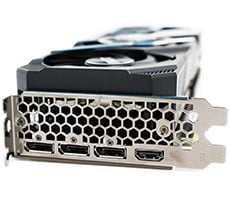
| Essentially a revamed 8800 GT, the Asus EN9800GT Matrix GeForce 9800GT is built around the the 55nm G92 GPU. The engine is clocked at 612MHz, 12MHz over reference specifications, while the Shader Clock runs at 1.512GHz. Unlike the slightly overclocked GPU, the unit's 512MB of GDDR3 comes clocked at 1.8GHz (900MHz DDR), following reference specifications. Measuring 9 inches long and 4.376 inches high, the SLI capable card is equipped with one DVI port supporting a maximum resolution of 2560x1600 while analog (requires adapter) has a maximum resolution of 2560x1536. The Asus EN9800GT Matrix GeForce 9800GT forgoes a second DVI port in lieu of an HDMI port for connecting to an HDTV or any other HDMI capable display. There is also a TV-Out port that supports YPbPR, S-Video and Composite output. As for its cooling, ASUS designed a custom solution that performs much better then the stock reference design. Asus claims this hybrid Matrix cooler is very quiet, and we couldn't agree more. During 2D usage, there was virtually no sound and when playing 3D games, the noise output was still very low, even when overclocking. The active cooling management available through ASUS' Advanced Dynamic GPU load detection also helps ensure proper thermal management, while improving overall power consumption. |
| HH Test System and 3DMark Vantage | ||||||||||||
The Asus EN9800GT Matrix trailed the Radeon 4850 and GeForce 8800GTX in all tests. The 8800GTX trumped both cards overall, while the Radeon 4850 held a 5.5% overall score advantage over the EN9800GT. When breaking things down further, the GPU 1 and 2 tests show the Radeon 4850 continues to hold onto its lead over the EN9800GT, averaging a 5 FPS advantage between the two tests. |
| Crysis: Warheard and Half-Life 2: EP2 | ||||||||||||
The ASUS EN9800GT Matrix turned the tables on the ATI Radeon 4850 with this test, pulling ahead of the ATI card by 2 FPS at 1280x1024 and 6 FPS at 1600x1200. The EN8800GTX was still the fastest of the three, but the EN9800GT was a close second with a 1-2 FPS difference.
In this test, the ATI Radeon 4850 posted the best results, even trumping the ASUS EN8800GTX by no less than 5 FPS. Overall, Half-Life 2: Episode Two wasn't terribly taxing on any of the three models, all of which broke triple digit frame rates at 1280x1024. At 1600x1200, the EN9800GT was the only model not to break 100 FPS, but still posted a very playable 86 FPS at this resolution. |
| Unreal Tournament 3 and FarCry 2 | ||||||||||||
This test was the most balanced we've run thus far. All three cards posted close results, with the EN8800GTX posting the best results at 1280x1024 and the ATI Radeon 4850 posting top scores at 1600x1200. Both the EN9800GT and ATI Radeon 4850 were tied at 1280x1024 while the Radeon held an 11 FPS advantage at 1600x1200 in this test.
With FarCry 2, the Radeon 4850 and the GeForce 8800GTX were the most closely matched in performance, with the Radeon 4850 holding a slight advantage. The EN9800GT trailed the other models by a little over 5 FPS at 1280x1024 while the margin widened at 1600x1200 by closer to 8 FPS. |
| Overclocking the Matrix EN9800GT | ||||
With its slight factory overclock and custom cooler, we were not certain what to expect when ramping up the clock speeds with the Asus EN9800GT Matrix. Loading NVIDIA's nTune software, we raised the GPU and Memory speeds as high as they would go while still being able to complete the built in GPU stress test. We then ran our Half-Life 2: Episode Two benchmark, throttling back the clock speeds as needed until the test would complete without issue. Our efforts proved fruitful, squeezing out an additional 78MHz of GPU speed and uncovering an additional 150MHz (300DDR) of memory speed. These gains had measurable effects on the benchmark results as well, tacking on 14 FPS at 1280x1024 and 12 FPS at 1600x1200. This equaled increases of 12% and 13.9% respectively; a sizable performance gain. These gains allowed the EN9800GT to nearly match the results of the EN8800GTX, however, the card was not able to eclipse the performance of the ATI Radeon 4850, which posted excellent results in this test. |
| Our Summary and Conclusion | ||||
Performance Summary: In the addortment of benchmarks used in this review, the Asus EN9800GT Matrix GeForce 9800GT was dominant in only one test. With FutureMark's 3DMark Vantage synthetic testing, the EN9800GT Matrix trailed the ATI Radeon 4850 by roughly 5.5% overall. When we shifted to real world gaming tests, the results vacillated with each test, with Crysis: Warhead being the only one that the EN9800GT Matrix topped the ATI card in both resolutions. Half-Life 2: Episode Two favored the Radeon 4850 while Unreal Tournament 3 had the two tied at 1280x1024, at 1600x1200, however, the EN9800GT Matrix slipped 11 FPS behind the Radeon 4850. Lastly, our FarCry 2 results were all relatively close, but the EN8800GTX and Radeon 4850 were a closer competition than the Asus EN9800GT Matrix GeForce 9800GT.
|