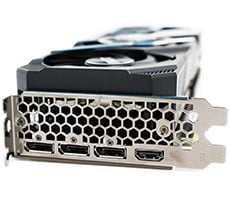
We have explained in numerous articles in the past that the bulk of GPU sales are made in the form of ether IGPs (Integrated Graphics Processors) or affordable, mainstream graphics cards. As powerful and exciting as the ATI Radeon HD 4870 X2 or GeForce GTX 280 cards may be, AMD and NVIDIA simply don't sell as many flagship products as they do mainstream cards.
It is because of this fact that both companies consistently refresh their mainstream offerings every few months or so, and continually push new features and performance down their respective product lines. As many of you may have expected, since AMD recently released the RV770 GPU, which is the foundation of the Radeon HD 4800 series, a new mainstream offering was obviously in the works. And today, we can finally show that card to you.
AMD is releasing a new salvo of mainstream graphics cards that should fall in the sub-$80 price segment, dubbed the Radeon HD 4670. The GPU at the heart of the 4670 is based on the RV770 architecture used on the Radeon HD 4800 series, sans a few stream processors, ROPs, and other assorted elements, but with what is essentially the same feature set as its more expensive counterparts. We've got a couple of these new cards on hand and plan to show you what they're capable of on the pages ahead. After reading, you may be surprised by what 80 bucks can get you these days...

ATI Radeon HD 4670
|
|
|
AMD ATI Radeon HD 4670 |
|
Specifications and Features | |
514 million transistors on 55nm fabrication process
PCI Express 2.0 x16 bus interface
GDDR3/DDR3/DDR2 memory interface (depending on model)
Microsoft DirectX 10.1 support
- Shader Model 4.1
- 32-bit floating point texture filtering
- Indexed cube map arrays
- Independent blend modes per render target
- Pixel coverage sample masking
- Read/write multi-sample surfaces with shaders
- Gather4 texture fetching
Unified Superscalar Shader Architecture
- 320 stream processing units
- Dynamic load balancing and resource allocation for vertex, geometry, and pixel shaders
- Common instruction set and texture unit access supported for all types of shaders
- Dedicated branch execution units and texture address processors
- 128-bit floating point precision for all operations
- Command processor for reduced CPU overhead
- Shader instruction and constant caches
- Up to 128 texture fetches per clock cycle
- Up to 128 textures per pixel
- Fully associative multi-level texture cache design
- DXTC and 3Dc+ texture compression
- High resolution texture support (up to 8192 x 8192)
- Fully associative texture Z/stencil cache designs
- Double-sided hierarchical Z/stencil buffer
- Early Z test and Fast Z Clear
- Lossless Z & stencil compression (up to 128:1)
- Lossless color compression (up to 8:1)
- 8 render targets (MRTs) with anti-aliasing support
- Physics processing support
Dynamic Geometry Acceleration
- High performance vertex cache
- Programmable tessellation unit
- Accelerated geometry shader path for geometry amplification
- Memory read/write cache for superior stream output performance
Anti-aliasing features
- Multi-sample anti-aliasing (2, 4 or 8 samples per pixel)
- Up to 24x Custom Filter Anti-Aliasing (CFAA) for superior quality
- Adaptive super-sampling and multi-sampling
- Gamma correct
- Super AA (ATI CrossFireX configurations only)
- All anti-aliasing features compatible with HDR rendering
Texture filtering features
- 2x/4x/8x/16x high quality adaptive anisotropic filtering modes (up to 128 taps per pixel)
- 128-bit floating point HDR texture filtering
- sRGB filtering (gamma/degamma)
- Percentage Closer Filtering (PCF)
- Depth & stencil texture (DST) format support
- Shared exponent HDR (RGBE 9:9:9:5) texture format support
OpenGL 2.0 support
ATI CrossFireX Multi-GPU Technology
- Scale up rendering performance and image quality with two GPUs
- Integrated compositing engine
- High performance bridge interconnect
|
ATI Avivo HD Video and Display Platform
- 2nd generation Unified Video Decoder (UVD 2)
- Enabling hardware decode acceleration of H.264, VC-1 and MPEG-2
- Dual stream playback (or Picture-in-picture)
- Hardware MPEG-1, and DivX video decode acceleration
- Motion compensation and IDCT
- ATI Avivo Video Post Processor
- Enhanced DVD up-conversion to HD
- Color space conversion
- Chroma subsampling format conversion
- Horizontal and vertical scaling
- Gamma correction
- Advanced vector adaptive per-pixel de-interlacing
- De-blocking and noise reduction filtering
- Detail enhancement
- Inverse telecine (2:2 and 3:2 pull-down correction)
- Bad edit correction
- Automatic dynamic contrast adjustment
- Full score in HQV (SD) and HQV (HD) video quality benchmarks
- Two independent display controllers
- Drive two displays simultaneously with independent resolutions, refresh rates, color controls and video overlays for each display
- Full 30-bit display processing
- Programmable piecewise linear gamma correction, color correction, and color space conversion
- Spatial/temporal dithering provides 30-bit color quality on 24-bit and 18-bit displays
- High quality pre- and post-scaling engines, with underscan support for all display outputs
- Content-adaptive de-flicker filtering for interlaced displays
- Fast, glitch-free mode switching
- Hardware cursor
- Two integrated DVI display outputs
- Primary supports 18-, 24-, and 30-bit digital displays at all resolutions up to 1920x1200 (single-link DVI) or 2560x1600 (dual-link DVI)
- Secondary supports 18-, 24-, and 30-bit digital displays at all resolutions up to 1920x1200 (single-link DVI only)
- Each includes a dual-link HDCP encoder with on-chip key storage for high resolution playback of protected content
- Two integrated 400MHz 30-bit RAMDACs
- Each supports analog displays connected by VGA at all resolutions up to 2048x1536
- DisplayPort output support
- Supports 24- and 30-bit displays at all resolutions up to 2560x1600
- Integrated HD audio controller with up to 2 channel 48 kHz stereo or multi-channel (7.1) AC3 enabling a plug-and-play cable-less audio solution
- HDMI output support
- Supports all display resolutions up to 1920x1080
- Integrated HD audio controller with up to 2 channel 48 kHz stereo or multi-channel (7.1) AC3 enabling a plug-and-play cable-less audio solution
- Integrated AMD Xilleon HDTV encoder
- Provides high quality analog TV output (component/S-video/composite)
- Supports SDTV and HDTV resolutions
- Underscan and overscan compensation
- Seamless integration of pixel shaders with video in real time
- VGA mode support on all display outputs
ATI PowerPlay Technology
- Advanced power management technology for optimal performance and power savings
- Performance-on-Demand
- Constantly monitors GPU activity, dynamically adjusting clocks and voltage based on user scenario
- Clock and memory speed throttling
- Voltage switching
- Dynamic clock gating
- Central thermal management – on-chip sensor monitors GPU temperature and triggers thermal actions as required
|
As the above list of specifications and features show, the new Radeon HD 4670 has essentially the exact same features as the cards in the Radeon HD 4800 series. The Radeon HD 4670 offers DX10.1 and Shader Model 4.1 support. These GPUs are manufactured on TSMC's 55nm process node and the cards support ATI's CrossFireX multi-GPU technology.
Since we've covered essentially all of the shared features of the Radeon HD 4800 and 4600 series cards before, we won't be going into them in depth again here. However, we would recommend taking a look at a few recent articles to brush up on the tech, if you're so inclined.
Reading the articles above will lay the groundwork for much of what we'll be showing you on the pages ahead. Because the new Radeon HD 4670 shares the same core architecture as the cards in the Radeon HD 4800 series, with some elements pared down to reduce die size, they have basically the same feature set and capabilities but differentiate in terms of performance.




;)