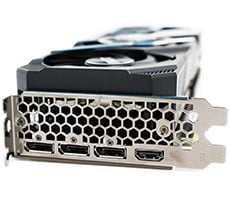
No matter what you think of AMD's ATI Radeon HD 4800 Series of video cards, you'd be crazy not to love what AMD did with the pricing of the first two cards (Radeon HD 4850 and HD 4870) from the series. As a result of AMD's aggressive pricing, NVIDIA felt compelled to lower the price of its latest GeForce video cards, the GeForce GTX 260 and the GTX 280. It's not often that ATI can actually make NVIDIA fans smile as big as its own or vice versa. Ultimately, though, you don't have to favor one brand over the other to appreciate the downward pressure that the new Radeon HD 4850 and Radeon HD 4870 put on pricing.
Overall, we've been quite impressed with what we've seen of the HD 4800 Series, especially considering the amount of power the cards offer for the price. In this article, we are going to take a look at a card from one of AMD/ATI's primary board partners, MSI. The card up to bat today is the MSI R4850 512M, which as you can no doubt surmise, is a Radeon HD 4850.

The R4850 512M sports 512MB of DDR3 and reference clock speeds. Although it does not feature a factory overclock, the card does sport a custom cooler that promises to keep the GPU much cooler than ATI's reference cooler. As we told you in our ATI Radeon HD 4800 Series launch article, the HD 4800 Series' RV770 GPU boasts 956 million transistors on a 55nm fabrication process. To see how well the MSI R4850 512M performs, we'll pit it against a Radeon HD 4870, a Radeon HD 3850, a GeForce GTX 260 and a couple GeForce 9800 GTXs.
|
|
|
AMD ATI Radeon HD 4800 Series |
|
Specifications and Features | |
- 956 million transistors on 55nm fabrication process
- PCI Express 2.0 x16 bus interface
- 256-bit GDDR3/GDDR5 memory interface
-
Microsoft DirectX 10.1 support
- Shader Model 4.1
- 32-bit floating point texture filtering
- Indexed cube map arrays
- Independent blend modes per render target
- Pixel coverage sample masking
- Read/write multi-sample surfaces with shaders
- Gather4 texture fetching
-
Unified Superscalar Shader Architecture
-
Dynamic Geometry Acceleration
- High performance vertex cache
- Programmable tessellation unit
- Accelerated geometry shader path for geometry amplification
- Memory read/write cache for improved stream output performance
-
Anti-aliasing features
- Multi-sample anti-aliasing (2, 4 or 8 samples per pixel)
- Up to 24x Custom Filter Anti-Aliasing (CFAA) for improved quality
- Adaptive super-sampling and multi-sampling
- Gamma correct
- Super AA (ATI CrossFireX configurations only)
- All anti-aliasing features compatible with HDR rendering
-
Texture filtering features
- 2x/4x/8x/16x high quality adaptive anisotropic filtering modes (up to 128 taps per pixel)
- 128-bit floating point HDR texture filtering
- sRGB filtering (gamma/degamma)
- Percentage Closer Filtering (PCF)
- Depth & stencil texture (DST) format support
- Shared exponent HDR (RGBE 9:9:9:5) texture format support
-
ATI PowerPlay
- Advanced power management technology for optimal performance and power savings
-
Performance-on-Demand
- Constantly monitors GPU activity, dynamically adjusting clocks and voltage based on user scenario
- Clock and memory speed throttling
- Voltage switching
- Dynamic clock gating
- Central thermal management – on-chip sensor monitors GPU temperature and triggers thermal actions as required
-
ATI Avivo HD Video and Display Platform
-
2nd generation Unified Video Decoder (UVD 2)
- Enabling hardware decode acceleration of H.264, VC-1 and MPEG-2
- Dual stream playback (or Picture-in-picture)
-
Hardware MPEG-1, and DivX video decode acceleration
- Motion compensation and IDCT
-
ATI Avivo Video Post Processor
- New enhanced DVD upconversion to HD new!
- New automatic and dynamic contrast adjustment new!
- Color space conversion
- Chroma subsampling format conversion
- Horizontal and vertical scaling
- Gamma correction
- Advanced vector adaptive per-pixel de-interlacing
- De-blocking and noise reduction filtering
- Detail enhancement
- Inverse telecine (2:2 and 3:2 pull-down correction)
- Bad edit correction
- Full score in HQV (SD) and HQV (HD) video quality benchmarks
-
Two independent display controllers
- Drive two displays simultaneously with independent resolutions, refresh rates, color controls and video overlays for each display
- Full 30-bit display processing
- Programmable piecewise linear gamma correction, color correction, and color space conversion
- Spatial/temporal dithering provides 30-bit color quality on 24-bit and 18-bit displays
- High quality pre- and post-scaling engines, with underscan support for all display outputs
- Content-adaptive de-flicker filtering for interlaced displays
- Fast, glitch-free mode switching
- Hardware cursor
-
Two integrated DVI display outputs
- Primary supports 18-, 24-, and 30-bit digital displays at all resolutions up to 1920x1200 (single-link DVI) or 2560x1600 (dual-link DVI)
- Secondary supports 18-, 24-, and 30-bit digital displays at all resolutions up to 1920x1200 (single-link DVI only)
- Each includes a dual-link HDCP encoder with on-chip key storage for high resolution playback of protected content4
-
Two integrated 400MHz 30-bit RAMDACs
- Each supports analog displays connected by VGA at all resolutions up to 2048x15363
-
DisplayPort output support
- Supports 24- and 30-bit displays at all resolutions up to 2560x16003
-
HDMI output support
- Supports all display resolutions up to 1920x1080
- Integrated HD audio controller with up to 2 channel 48 kHz stereo or multi-channel (7.1) AC3 enabling a plug-and-play cable-less audio solution
-
Integrated AMD Xilleon HDTV encoder
- Provides high quality analog TV output (component/S-video/composite)
- Supports SDTV and HDTV resolutions
- Underscan and overscan compensation
- MPEG-2, MPEG-4, DivX, WMV9, VC-1, and H.264/AVC encoding and transcoding
- Seamless integration of pixel shaders with video in real time
- VGA mode support on all display outputs
-
ATI CrossFireX Multi-GPU Technology
- Scale up rendering performance and image quality with two GPUs
- Integrated compositing engine
- High performance dual channel bridge interconnect
If you peruse the list of specs and features above, you see that the Radeon HD 4800 Series cards feature support for DirectX 10.1 and Shader Model 4.1. Additionally, the cards support ATI's CrossFireX Multi-GPU Technology, which is undoubtedly a must-have feature for enthusiasts.
Those of you who are familiar with the Radeon HD 3800 Series have probably noticed that there are a lot of similarities between the two lines. Because we've already extensively covered the technology behind both the HD 3800 and HD 4800 Series, we won't rehash those details here. If you want to learn more about the technologies employed by ATI, take a look at the following articles:
Now that we've introduced you to the HD 4800 Series, let's take a closer look at the MSI R4850 512M, starting with the card itself.
| |