|
|
| Introduction | ||||||
|
Throughout most of the 1990s, Diamond Multimedia was one of the major players in the graphics card world. Their well made cards with solid performance resulted in some of the most well known brand names of the time including the Speedstar, Stealth, and Viper. After merging with S3 Incorporated in 1999, the resounding failure of their joint contribution: the Diamond Viper II Z200 based on S3's Savage 2000, eventually led to the combined Diamond/S3 company backing away from third-party graphics cards.
INCLUDED BUNDLES: An odd thing about the cards we received is in regard to their associated bundles. Now, as you will see on the next page, the packaging and even the cards themselves are nearly identical. The driver CD and manual are also the same, which should be expected as the drivers are universal and there's only so many ways you can show someone how to install a PCI-Express card into their system.
What becomes odd, then, is the included cables and adapters. With the 1GB overclocked Viper, we found a collection of component and S-VIDEO out cables, as well as a power splitter for providing 6-pin power to the card. Two adapters, one for VGA and the other for HDMI complete the collection. On the other hand, with the 512MB version, there's a component video cable and the same adapters, but a CrossFire bridge replaced the S-Video cable and there's no power cable. We seriously doubt there is much cost saving in either direction, and there's nothing wrong, per se, with either bundle. We just like a little consistency now and then, and feel both cards should come with all of the pieces we found in the separate sets. The 1GB card especially should also include a CrossFire bridge at the very least. |
| Closer look at the Viper Radeon HD 3870s |
|
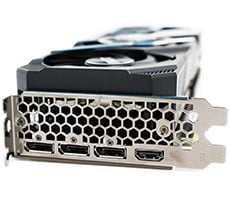
No, you're not seeing double here. The two HD 3870 variants that Diamond released are twins with the only immediately noticeable difference being the sticker placed over the cooling apparatus. The "standard" model is marked as the HD3870 DDR4, while the overclocked model remains known only as HD3870 - no mention is made to the overclocked status, nor the larger memory buffer found onboard. Other than these markings and Ruby's stern visage, there is little that Diamond has done differently when compared to ATI's initial design for the Radeon HD 3870. The dual slot cooler consists of a rear-mounted fan that starts out a bit noisy while booting up a PC, but quickly settles down during normal operation and doesn't produce enough noise output to become a bother. Heat that is transferred from the RV670 using a set of heatpipes to the copper heatsink mounted on top, running nearly the entire length of the card. Small vents in the plastic allow some heat dissipation, but the majority of the airflow rushes out the end of the card, and thus out of the chassis. Output consists of a standard dual-DVI setup, with a S-VIDEO/HD port thrown in between. Used in conjunction with the provided adapters, a user can connect their PC to a digital/analog combo, or two flatscreens using DVI and/or HDMI inputs. The sub-$200 price point of these cards makes them not only a good choice for running one card, but also running multiple cards as well in a CrossFire setup, using the connectors along the topside of the card (again, this is a reason why both cards should come with the bridge necessary to make such a connection). Before wrapping things up, we decided to get a closer look at the heatsink, and the memory ICs underneath. Unscrewing the brace on the backside of one of the cards, we easily popped off the copper plate, which uses adhesive tape to attach itself squarely to the memory and a smattering of thermal paste between the GPU and the back of the heatsink.. The 70mm fan comes by the way of Everflow, model R127015DL, which reaches a max speed of 3000rpm and can generate airflow of about 25 CFM at a sound level of 28 dB. Throughout our testing, we couldn't recall ever coming close to the highest rated speeds, meaning that temperatures were being held in check by the cooling methods combined with the relatively lower power consumption of the RV670. |
| Base System and 3DMark06 Results | ||||||||||||||
Diamond's two Vipers performed well, but not enough to overcome the two GeForce 8800 variants, nor the overclocked Radeon HD 3870 from Sapphire. The higher speeds of the 1GB-based Viper allow it to run slightly by the 512MB default version, but only by 1-2% in the overall score or individual shader model testing. Sapphire's Vapor-cooled HD 3870 Atomic manages to take the top spot for ATI's camp by leveraging the highest GPU and memory speeds on one card, whereas Diamond's samples have only default speeds on their GDDR4 version, and overclocked speeds for the core on the card mixed with the 1GB of slower GDDR3. |
| Half-Life 2: Episode 2 | ||||||
|
Half-Life 2 testing has both Diamond cards out in front of Sapphire's HD 3870 Atomic - although the delta was slight at best. The Viper HD 3870 1GB led by three frames at 1280x1024 with the Viper HD 3870 512MB in a dead heat with Sapphire's card. At 1600x1200, there's virtually no difference at all with less than a single frame separating the three cards. Of course, these three really aren't giving NVIDIA's cards much competition using this DX9-based game engine, with the 8800 GT and GTS outpacing the HD 3870s by anywhere from 10 frames per second at 1600x1200 to nearly 30fps at lower resolutions. |
| Company of Heroes | ||||||
|
GPU speeds count for just about all the differences in our testing of Company of Heroes, as the order of the Radeon HD 3870s seems to be dictated by the relative speeds: 830MHz for the Diamond HD 3870 1GB, 825MHz for Sapphire's HD 3870 Atomic, and 777MHz for the Diamond HD 3870 512MB. We somewhat expected the larger memory buffer to propel Diamond's 1GB card's performance higher than the others but here, at least, we didn't see any improvement. Once again, the tandem of GeForce 8800-based cards are head-and-shoulders faster than any of the HD 3870s we could throw at them. |
| Enemy Territory: Quake Wars | ||||||
|
Although the megatexturing techniques used in Quake Wars require a smaller amount of a card's memory buffers, we found that the 1GB laden Viper HD 3870 outperformed all other cards except the 8800 GTS 512. Even more surprising was the placement of NVIDIA's GeForce 8800 GT, which found itself in an unfamiliar location: the basement in our house of cards. The Diamond Vipers' performance levels bookend themselves around Sapphire's entry, with the 1 GB mostly on one end, and the 512 MB version on the other. |
| Crysis | ||||||
|
Again, with Crysis, we had really expected to see a larger memory buffer come into play. Instead, the Radeons in our group rely on pure GPU speed to push frame rates along, and Sapphire's high clock speeds garner it the fastest framerates. That being said, even the fastest Radeon HD 3870 was still 20% slower than PNY's 8800 GTS 512, and 6 percent or so behind the 8800 GT from NVIDIA. |
| Bioshock | ||||||
|
Bioshock benchmarking results in an extreme blowout for the Radeon HD 3870s, completely unable to keep up with these mid-range 8800-based cards - nevermind what would happen against a GTX or Ultra model. Within their own camp, however, the Radeon HD 3870s find themselves in a tight grouping. There's almost no difference at all amongst the three cards at 1280x1024. At 1600x1200, we do see a small gain by the Sapphire version as it picks up an additional 2 frames per second over Diamond's dynamic duo. |
| Overclocking Results | ||||
|
ATI's reference specs call for 777 MHz for the GPU and 1126 MHz for the memory, and that's exactly what the Viper Radeon HD 3870 512MB is running at. The 1GB model, however, not only has that extra 512MB of memory added to it, but its core is running at a sweet 830MHz, with the GDDR3 memory at 870MHz. Great overclock already on the GPU, but we would like to tweak things even further.
We found that the range offered to us using the Overdrive section of the Catalyst drivers was quite stifling when running the 1GB version: only a mere 830-850MHz was listed for the GPU. Instead, we decided to install ATI Tray Tools and plug in some numbers ourselves. It turns out that Overdrive might not have been too far off as the best stable speed we could run at was 850MHz for the core, and 968 MHz for the memory. With the 512MB version, we weren't able to reach as high, but we still added 50MHz on the GPU, settling in at 827MHz. Memory speeds also saw a similar boost, ending up at 1170 MHz.
While both cards got a little boost by the GPU and memory speed tweaking, we found that the 512 MB version profited the most. Trailing the 1 GB model in both original runs through Quake Wars and Half-Life 2, the larger compartive increase in GPU speed coupled with the much faster operation of the GDDR4 put the Radeon HD 3870 512 ahead by one to three frames per second when overclocked. |
| Performance Summary and Conclusion | ||||
Performance Summary: Currently, the Radeon HD 3870 is ATI's mid-range GPU offering, and Diamond has produced two cards that did not disappoint. The first is essentially just a re-brand, using the core and memory speeds called for by ATI's specs, while the second is an overclocked version stocked with 1GB of memory, albeit slower GDDR3. Both performed well throughout our testing suite, but the edge overall will go to the 1GB-laden Viper, whose frame rates typically eclipsed its brethren by a few percentage points.
Diamond Viper Radeon HD 3870 512MB GDDR4 / 1GB GDDR3
|