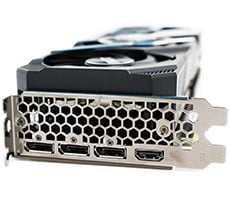
Just last week, we posted an evaluation of a Radeon HD 3650 card by Diamond Multimedia, where said manufacturer decided to one-up ATI's reference specifications by raising the amount of on-board memory to a full one gigabyte. The results, unfortunately, were not overly favorable as the memory happened to be of the inexpensive, low-speed DDR2 variety.
Today, however, we take a look at two more HD 3650s, one each from ASUS and HIS, where the emphasis was placed more on clock speeds than on memory buffer size. While the default speeds set forth by ATI's reference specifications were listed as 725 MHz for the GPU core and 800 MHz for the memory, the two cards represented in this article are decidedly faster: 800 / 900 MHz for ASUS and 790 / 890MHz for HIS. The 10 MHz variance is not the only thing that separates the two cards, however. ASUS' EAH3650 TOP comes with the standard 256 MB frame buffer, whereas HIS doubles this to 512 MB on their Radeon HD 3650 IceQ Turbo. One card has slightly higher speeds, the other has twice the memory - let's see who wins this showdown of overclocked Radeon HD 3650s.

|
|
| ATI Radeon HD 3650 |
| Features & Specifications | |
|
- 378 million transistors on 55nm fabrication process
- PCI Express 2.0 x16 bus interface
- 128-bit DDR2/GDDR3 memory interface
- Microsoft DirectX 10.1 support
- Shader Model 4.1
- 32-bit floating point texture filtering
- Indexed cube map arrays
- Independent blend modes per render target
- Pixel coverage sample masking
- Read/write multi-sample surfaces with shaders
- Gather4 texture fetching
- Unified Superscalar Shader Architecture
- 120 stream processing units
- Dynamic load balancing and resource allocation for vertex, geometry, and pixel shaders
- Common instruction set and texture unit access supported for all types of shader
- Dedicated branch execution units and texture address processors
- 128-bit floating point precision for all operations
- Command processor for reduced CPU overhead
- Shader instruction and constant cache
- Up to 40 texture fetches per clock cycle
- Up to 128 textures per pixel
- Fully associative multi-level texture cache design
- DXTC and 3Dc+ texture compression
- High resolution texture support (up to 8192 x 8192)
- Fully associative texture Z/stencil cache designs
- Double-sided hierarchical Z/stencil buffer
- Early Z test, Re-Z, Z Range optimization, and Fast Z Clear
- Lossless Z & stencil compression
- Lossless color compression
- 8 render targets (MRTs) with anti-aliasing support
- Physics processing support
- Dynamic Geometry Acceleration
- Programmable tessellation unit
- Accelerated geometry shader path for geometry amplification
- Memory read/write cache for improved stream output performance
- Anti-aliasing features
- Multi-sample anti-aliasing (2, 4 or 8 samples per pixel)
- Up to 24x Custom Filter Anti-Aliasing (CFAA) for improved quality
- Adaptive super-sampling and multi-sampling
- Temporal anti-aliasing
- Gamma correct
- Super AA (ATI CrossFireX configurations only)
- All anti-aliasing features compatible with HDR rendering
- Texture filtering features
- 2x/4x/8x/16x high quality adaptive anisotropic filtering modes (up to 128 taps per pixel)
- 128-bit floating point HDR texture filtering
- Bicubic filtering
- sRGB filtering (gamma/degamma)
- Percentage Closer Filtering (PCF)
- Depth & stencil texture (DST) format support
- Shared exponent HDR (RGBE 9:9:9:5) texture format support
- OpenGL 2.0 support
|
ATI Avivo HD Video and Display Platform
Dedicated unified video decoder (UVD) for H.264/AVC and VC-1 video formats
- High definition (HD) playback of both Blu-ray and HD DVD formats
- Hardware MPEG-1, MPEG-2, and DivX video decode acceleration
- Motion compensation and IDCT
- ATI Avivo Video Post Processor
- Color space conversion
- Chroma subsampling format conversion
- Horizontal and vertical scaling
- Gamma correction
- Advanced vector adaptive per-pixel de-interlacing
- De-blocking and noise reduction filtering
- Detail enhancement
- Inverse telecine (2:2 and 3:2 pull-down correction)
- Bad edit correction
Two independent display controllers
- Drive two displays simultaneously with independent resolutions, refresh rates, color controls and video overlays for each display
- Full 30-bit display processing
- Programmable piecewise linear gamma correction, color correction, and color space conversion
- Spatial/temporal dithering provides 30-bit color quality on 24-bit and 18-bit displays
- High quality pre- and post-scaling engines, with underscan support for all display outputs
- Content-adaptive de-flicker filtering for interlaced displays
- Fast, glitch-free mode switching
- Hardware cursor
- Two integrated DVI display outputs
- Primary supports 18-, 24-, and 30-bit digital displays at all resolutions up to 1920x1200 (single-link DVI) or 2560x1600 (dual-link DVI)
- Secondary supports 18-, 24-, and 30-bit digital displays at all resolutions up to 1920x1200 (single-link DVI only)
- Each includes a dual-link HDCP encoder with on-chip key storage for high resolution playback of protected content
- Two integrated DisplayPort outputs
- Supports 24- and 30-bit displays at all resolutions up to 2560x1600
- 1, 2, or 4 lanes per output, with data rate up to 2.7 Gbps per lane
- Two integrated 400 MHz 30-bit RAMDACs
- Each supports analog displays connected by VGA at all resolutions up to 2048x153623
- HDMI output support
- Supports all display resolutions up to 1920x1080
- Integrated HD audio controller with up to 2 channel 48 kHz stereo or multi-channel (5.1) AC3 enabling a plug-and-play cable-less audio solution
- Integrated AMD Xilleon HDTV encoder
- Provides high quality analog TV output (component/S-video/composite)
- Supports SDTV and HDTV resolutions
- Underscan and overscan compensation
- MPEG-2, MPEG-4, DivX, WMV9, VC-1, and H.264/AVC encoding and transcodingSeamless integration of pixel shaders with video in real time
- VGA mode support on all display outputs
ATI PowerPlay
- Advanced power management technology for optimal performance and power savings
- Performance-on-Demand
- Constantly monitors GPU activity, dynamically adjusting clocks and voltage based on user scenario
- Clock and memory speed throttling
- Voltage switching
- Dynamic clock gating
- Central thermal management – on-chip sensor monitors GPU temperature and triggers thermal actions as required
ATI CrossFireX Multi-GPU Technology
- Scale up rendering performance and image quality with two GPUs
- Integrated compositing engine
- High performance dual channel bridge interconnect
|
ASUS HIS
With the Radeon HD 3650 marketed as a low-cost alternative for gaming on a budget, it's no surprise that each card's accompanying accessories are a little light. Each company includes a multi-language user's installation guide and a drivers CD, and ASUS also provides a digital copy of the guide on a second CD-ROM as well. To cover the various setup options, each card also ships with a single VGA-DVI adaptor and an additional HDMI-DVI adaptor. The major difference between the two bundles comes down to a single cable. ASUS plays it safe by offering one last S-Video connection cable. HIS, however, hope users may choose to purchase a second card, thus needing the CrossFire bridge found here. HIS also throws in a case badge for good measure.




;)
;)

;)
;)