Logo   Banner   TopRight
TopUnder
Transparent
NVIDIA GeForce 9600 GT Launch and 3-Way Shootout
Transparent
Date: Feb 21, 2008
Section:Graphics/Sound
Author: Chris Connolly
Transparent
Overview

If the blockbuster successes of games like World of Warcraft and Counterstrike, compared to the lack-luster reception of ultra-high-end titles like Crysis, have taught us anything, it is that the vast majority of PC gamers are not running games which are incredibly graphics intensive. As low-cost gaming consoles continue to steal many of these casual gamers away from the PC, component manufacturers for the PC platform are starting to think differently about how to approach the gaming market. As of late, we’re seeing a significant and refreshing shift towards lower-cost components for the mainstream market. Getting more performance for your dollar is now more exciting than getting the largest amount of raw performance, no matter what the cost.


NVIDIA GeForce 9600 GT - Angled View


NVIDIA GeForce 9600 GT - Top Down

This isn’t an entirely new concept, as CPU and GPU makers realize that their high-end components only make up a fraction of the total available market (TAM), and that the real money is made in large volume OEM deals for mid-range components. However, they’ve continued to push their high-end components in the same formula before, releasing high-end products first than letting the technology trickle down to varying price points over time. For this launch, something in the air might be changing, and NVIDIA feels there’s no bigger showcase of this change than the card we’re looking at today, the new GeForce 9600 GT.

The new GeForce 9600 GT is the first release of NVIDIA's GeForce 9 series that we’re taking a look at today. Typically, when NVIDIA launches a new lineup of graphics cards, we see a high-end component released first, which blows away previous benchmarks and instantly makes your current graphics card worthless. However, with the GeForce9 lineup, we’re seeing NVIDIA take a drastically different approach, releasing a mid-range card first. The first (and only) member of the GeForce9 series is, at the moment, available at a sub-$200 price point. While this certainly shouldn’t be perceived as NVIDIA giving up on the high-end of the market, the sea change we’re seeing in the PC gaming space simply cannot be denied.

The GeForce 9600 GT is a card that NVIDIA is promising will hit a sweet spot for gamers, offering excellent performance while simultaneously being easier on the wallet.  In short, this is what the vast majority of gamers perennially ask for - rather than a massive three-way SLI setup that requires a kilowatt power supply and a small army of fans to keep cool. This, in our humble opinion, is where the industry should be heading; getting the most power-efficient performance possible, while keeping price and environmental aspects as primary concerns, not afterthoughts.  Let's meet the GeForce 9600 GT.

Transparent
The Architecture

The GeForce 9600 GT is not based on an entire new architecture from the ground up, as its name implies. Rather, the architecture of the GeForce 9600 graphics processor heavily calls upon the latest generation GeForce 8800 series architecture, which of course isn’t too shabby of an architecture to pull from. NVIDIA’s latest round of GeForce 8800 releases have been hugely successful and have delivered some of the best price to performance ratios in recent history. Borrowing from this lineup seems like a reasonable thing to do – although after reading through the specification sheets, we can’t help be slightly underwhelmed that we’re not seeing something radically new or different from NVIDIA. 

The GeForce 9600 GT is based on the NVIDIA G94 graphics processing unit. This GPU is manufactured on a 65nm process and is built upon a 64 stream processor architecture. To put that in perspective, NVIDIA’s previous generation mid-range component (the 8600 GT) had half that at 32 stream processors, whereas their recently launched 8800 GTS 512 has a total of 128 stream processors. With such a small amount of stream processors and a 65nm design, the 9600 GPU is quite small and won’t cost as much to produce in volume.  Judging by the fact that we’ve received three of these cards for the launch itself, we are pretty certain that consumers will be able to get their hands on one of these cards quite easily.  Regardless, this new GPU still features a unified shader design and support for Shader Model 4.0, meaning that it's fully DirectX 10 compliant.  No mention has been made regarding DirectX 10.1 support on this product or future products from NVIDIA just yet.  


NVIDIA's G94 graphics processor, the heart of the GeForce 9600 GT at 650MHz

As for NVIDIA's reference design, their recommended clock speed for the GeForce 9600 GT GPU is 650 MHz with its shader clock at 1.625 GHz. If those numbers seem strangely familiar, you may be on to something – as they are the identical clock speeds of the (recently launched) GeForce 8800 GTS 512 graphics card – which runs at the same clock speeds but has twice the rendering power with double the amount of stream processors. The similarities don’t end there, as you’ll see in a bit. However, in terms of architecture, the GeForce 9600 can be considered roughly a halved version of the GeForce 8800 GTS 512. NVIDIA has made some improvements along the way, but in terms of pure GPU power, this is roughly what we have to work with.

The NVIDIA G94 graphics processor supports either 256MB or 512MB memory configurations, and actually should perform reasonably well even with 256MB, thanks to a new texture compression technology that is a new addition to the GeForce9 lineup. However, we don’t currently have a 256MB available to us, as the 512MB version is going to be the most common option of these cards available. NVIDIA’s reference memory clock rate for the 9600 GT is 1.8 GHz, and the board uses GDDR-3 memory. The memory is connected via a 256-bit memory interface to the GPU, that allows for 57.6 GB/s of memory bandwidth. This amount of memory bandwidth is identical to the 8800 GT, but slightly lower than the 8800 GTS lineup.


  GeForce 9600 GT GeForce 8800 GT GeForce 8800 GTS 512 GeForce 8800 GTX
GPU Clock Speed 650 MHz 600 MHz 650 MHz 575 MHz
Shader Clock Speed 1625 MHz 1500 MHz 1625 MHz 1350 MHz
Stream Processors 64 112 128 128
Manufacturing Process 65nm 65nm 65nm 90nm
Memory Clock Speed 1800 MHz 1800 MHz 1940 MHz 1800 MHz
Memory Interface 256-bit 256-bit 256-bit 384-bit
Memory Bandwidth 57.6 GB/s 57.6 GB/s 62.1 GB/s 86.4 GB/s


Also keep in mind that these are the NVIDIA recommended clock speeds, and just as with prior generations of GeForce products, NVIDIA’s partners are launching overclocked, superclocked, and hyperclocked variants of the base card, depending on their cooling systems and outright bravado. Right out of the gate, we already have cards running at well over 700 MHz GPU clock speed with memory clock speeds at 2GHz, depending on manufacturer. We're also seeing board manufacturers take much more liberty in terms of output ports and cooling systems than we've seen with prior first round launches.


NVIDIA's GeForce 9600 GT reference design, sans cooler.

However, many board manufacturers will simply follow the NVIDIA reference design, and this is likely what will end up in the majority of OEM system builds as well. NVIDIA’s reference board design is virtually identical to that of the GeForce 8800 GT, which really isn’t that surprising considering the similarities between these two products. Both the 8800 GT and 9600 GT share the same single slot cooling system and basic PCB design.

All GeForce 9600 GT cards have a single set of “golden fingers” as a card-edge connector at the top of the boards, allowing for SLI connectivity. Unfortunately, NVIDIA has decided to leave out 3-way SLI support for this new series of cards, although 2-way SLI remains alive and well. In fact, NVIDIA is hyping these cards to be a “sweet spot” for gamers looking to pick up a pair in an SLI configuration. And of course, we’ve got a pair of these new cards, and we’ve got 9600 GT SLI numbers in the following pages. In terms of performance, NVIDIA is positioning the GeForce 9600 between the prior generation GeForce 8600 and the GeForce 8800 GT. It’s definitely interesting to see a GeForce 9 stuck in the middle of the performance charts, while GeForce 8800 GTX/Ultra cards are still NVIDIA’s high-end product of choice.

As far as we can tell, the only architectural-level improvement is a new texture compression technology which NVIDIA is touting. They claim that this new algorithm can improve performance by 15% in newer titles like Crysis compared to prior generation G80 processors (note – this is against G80, not their recently launched G92, that the G94 is very similar to). However, since we don’t have any in-depth knowledge of this compression schema, all we can say it that any improvements in this regard are appreciated (assuming they don’t hurt image quality), and that will just be that. Feature wise, there’s nothing else truly new here you can’t already find on a GeForce 8800 GT/GTS product.

The most interesting element of this card is its intended price point. NVIDIA is claiming that GeForce 9600 GT cards will hit shelves at $169 - $189, and that cards will be available on the day of launch. At this price point, NVIDIA is targeting ATI’s Radeon HD3850 and HD3870 products, which can be had for between $175 and $210 in 512 MB variants. We’re betting that reference design GeForce 9600 GT cards will be available at the price point of a nice HD3850 card, whereas custom, overclocked 9600 GT products will likely hit HD3870 price points.

However, keep in mind that prices of NVIDIA’s “one-step-up” GeForce 8800 GT have been dropping steadily since their release, and now you can grab one of these cards with 512 MB of memory for as low as $229. We’ve got a whole mess of high-performance cards in the mid-range market place now (a good problem to have), and we’ll let our benchmarks sort out which is the best for your hard earned paper. Next, let’s take a look at the variety of GeForce 9600 GT cards which have made it to our testbeds in time for the launch.

Transparent
The Boards

The Boards

We were lucky enough to work with three of NVIDIA’s top partners to get GeForce 9600 GT cards tested and ready for your perusal before the launch date. These partners were Asus, eVGA, and Palit. All three of their cards are unique in their own separate way, and all varied in terms of clock speeds and feature-sets. The differences are best explained in our simple charts, seen below.


Asus EN9600GT GeForce 9600 GT


  • NVIDIA G94 Graphics Processing Unit
  • 650 MHz GPU Clock Speed
  • 64 Stream Processors
  • 1625 MHz Shader Clock Speed
  • 512 MB GDDR-3 Memory
  • 256-bit Memory Interface
  • 1,800 MHz Memory Clock Speed
  • 57.6 GB/s Memory Bandwidth
  • Shader Model 4.0 (DirectX 10) Support
  • PCI Express 2.0 Interface
  • 6-pin PCI Express Power Connector
  • Supports 2-Way SLI Configurations
  • Single-Slot Cooling System (Reference)
  • HDCP Ready
  • 2-Phase Power Design
  • 2 x Dual-Link DVI, 1 x HDTV/S-Video Outputs, 1 x DVI to HDMI Adapter

eVGA GeForce 9600 GT SSC


  • NVIDIA G94 Graphics Processing Unit
  • 740 MHz GPU Clock Speed
  • 64 Stream Processors
  • 1835 MHz Shader Clock Speed
  • 512 MB GDDR-3 Memory
  • 256-bit Memory Interface
  • 1,950 MHz Memory Clock Speed
  • 62.4 GB/s Memory Bandwidth
  • Shader Model 4.0 (DirectX 10) Support
  • PCI Express 2.0 Interface
  • 6-pin PCI Express Power Connector
  • Supports 2-Way SLI Configurations
  • Single-Slot Cooling System (Reference)
  • HDCP Ready
  • 2-Phase Power Design
  • 2 x Dual-Link DVI, 1 x HDTV/S-Video Outputs

Palit GeForce 9600 GT Sonic


  • NVIDIA G94 Graphics Processing Unit
  • 700 MHz GPU Clock Speed
  • 64 Stream Processors
  • 1750 MHz Shader Clock Speed
  • 512 MB GDDR-3 Memory
  • 256-bit Memory Interface
  • 2,000 MHz Memory Clock Speed
  • 64.0 GB/s Memory Bandwidth
  • Shader Model 4.0 (DirectX 10) Support
  • PCI Express 2.0 Interface
  • 6-pin PCI Express Power Connector
  • Supports 2-Way SLI Configurations
  • Dual-Slot Cooling System (Custom)
  • HDCP Ready
  • 3-Phase Power Design
  • 2 x Dual-Link DVI, 1 x HDMI (w/ Optical S/PDIF Audio Input Port), 1 x DisplayPort Outputs
Transparent
Asus EN9600 GeForce 9600 GT

Despite being the largest of the three companies in our GeForce 9600 GT shootout, along with the one with the most amount of resources for custom card designs, Asus has gone the safe route this time around, as their EN9600GT card is based on the stock NVIDIA reference design with no changes whatsoever. Well, of course, unless you consider the lady in front of cherry blossoms a change for the better. If nothing else, it’s nice to see something graphically different beyond spaceships, aliens, and soldiers, though we can’t see this design wooing a great deal of gamers out there.


Asus EN9600 GeForce 9600 GT with retail box.

The EN9600 GT features NVIDIA’s G94 graphics processor at a stock clock of 650 MHz for the GPU along with 1625 MHz for the shader clock. The GPU is connected to 512 MB of GDDR-3 memory which is also clocked at stock levels of 1,800 MHz. This gives the card 57.6 GB/s of memory bandwidth, which is certainly not bad for a mid-range card, but is quite a bit less compared to other cards in our shootout. The reference clock speeds which Asus has decided to go with in comparison to the other cards which are overclocked means that right off the bat, this will likely be the slowest card of the bunch. However, it’s also the most likely to hit at NVIDIA’s $189 price point, whereas the other cards will likely hit $200+.

The EN9600 GT uses the NVIDIA reference single slot cooling system, identical to that of the majority of GeForce 8800 GT cards on the market today. The cooling system utilizes an array of a copper base, copper heatpipes, and aluminum alloy thin-fins to rid the GPU of all that nasty heat, and it does it all in a single-slot design. The EN9600 GT is a quiet card, even under heavy load, and will likely be inaudible in a closed chassis environment. Since the card runs at slower clock speeds, it doesn’t tax the cooling system as much. During testing, we did not hear the card spin up to more than its lowest fan level.


Asus EN9600 GeForce 9600 GT - Left


Asus EN9600 GeForce 9600 GT - Right

The card is equipped with two dual-link DVI ports along with an S-Video/HDTV output port. Asus also bundles a DVI to HDMI adapter with their board, which can be connected to an audio source via a 2-pin S/PDIF cable to provide full audio and video through HDMI. Other standard features like PCI Express 2.0 support and PureVideo HD support are certainly in the mix as well. The board requires a single 6-pin PCI Express connector to run, and a power adapter is bundled with the board.

One of the side benefits of running at a lower stock clock speed is that the card runs fairly cool, even with NVIDIA’s single-slot cooling system.    Our Asus EN9600 card was able to idle at just over 110ºF, whereas it hit a peak temperature of 144ºF under sustained load, 10ºF cooler compared to eVGA’s card which uses an identical cooling system.       

While the card’s clocks  aren’t super impressive out of the box, that does not directly affect its overclockability.   The Asus EN9600 GT card was able to hit a peak GPU clock speed of 750 MHz and retain full stability, which is a 15% boost in raw rendering power.  The card's memory was even more impressive, as it was able to overclock up from 1,800 MHz to 2,200 MHz, which was actually an even larger percentage gain at 22%.  This overclock gave the card peak memory bandwidth levels of over 60 GB/s, which allowed for noticeably better performance in high-end games. 

All in all, the Asus EN9600 card provides the performance and features that one should expect from a reference GeForce 9600 GT card.  It’s got a couple nice extras, and our particular unit overclocked quite well.  If they can keep the price down, this card should move off retail and etail shelves.

Transparent
eVGA GeForce 9600 GT SSC Edition

eVGA has been known to take a few chances here or there when it comes to overclocking and custom cooling systems in the past, but for the release of their GeForce 9600 GT product, we see them taking a surprisingly conservative approach. eVGA’s first GeForce 9600 GT release is their e-GeForce 9600 GT SSC Edition, which comes factory overclocked out of the box and runs significantly faster than NVIDIA’s recommended clock speeds. However, beyond clock speeds, this is more or less a run-of-the-mill reference designed product.


eVGA GeForce 9600 GT with retail box.

Of course, that’s not a terrible thing, as NVIDIA’s reference design is compact, quiet, and doesn’t run the risk of any unforeseen issues down the line, as this is a purebred NVIDIA design from the ground up. eVGA bundles their board in an attractive, simple, and confident box with a matching design on the cooling system.  eVGA’s GeForce 9600 GT SSC Edition card runs at 740 MHz GPU clock speed by default, which is a whopping ~14% boost over reference clocks, and can make a sizable difference when it comes to performance. The GPU is supported by 512MB of GDDR-3 memory which clocks in at 1,950 MHz, a solid 8% boost in speed. This kicks up memory bandwidth levels up to 62 GB/s, which is quite impressive for a sub-$200 graphics card.

The cooling system is based on NVIDIA’s reference design, which is the same cooler that was used for the GeForce 8800 GT lineup as well. This cooling system is a single-slot design, which is remarkably heavy given its size. The unit features a copper core, copper heatpipes, and a dense array of thin-fins for dissipating heat. Embedded on the right side of the board is a thin 60mm sized cooling fan, that ran very quiet throughout all of our tests. We did hear the fan kick up once or twice during our high-resolution Crysis benchmarking, although even when it was running at higher speed grade, it was not loud and/or annoying.


eVGA GeForce 9600 GT - Left


eVGA GeForce 9600 GT - Right

The single-slot design does affect temperatures, however, as we measured our GPU hitting peak temperature levels of 154ºF under sustained loads, while idling at about 118ºF. While these temperatures are well within the thermal bounds of the GPU, they are quite warm. However, never once did we see any abnormal affects due to this temperature, even at the card’s factory overclocked levels. Even better, the card is quite overclockable as well, as we were able to hit 775 MHz GPU clock speeds along with 2200 MHz GDDR-3 memory clock speeds in our testbed.

The board has a PCI Express 2.0 x16 interface (as with all 9600GTs), along with two dual-link DVI ports and an S-Video/HDTV output port. A 6-pin PCI Express power connector is also required, as expected, as the board pulls about 25% more power than the PCI Express slot can deliver. All in all, eVGA's offering is a very solid entry to the GeForce 9600 GT lineup, albeit a bit bland when it comes to design.

Transparent
Palit GeForce 9600 GT Sonic

Even though the GeForce 9600 GT is brand new to market, it’s a good bet that Palit’s GeForce 9600 GT Sonic will take the cake for the most bizarre looking release based on this GPU. From its reflective green box emblazoned with some sort of Terminator robot frog, to its bright orange heatsink shroud, Palit has the oddball marketed cornered. It’s definitely a sight to behold. Those who have seen the card and box in person just stand there, mouth agape, trying to make sense of what is going on here. Frankly, we still don’t know.


Palit GeForce 9600 GT Sonic with retail box.

However, while it may look to be an odd-duck, in reality Palit has created what is likely the most interesting GeForce 9600 GT release that we've seen thus far. Palit’s Sonic lineup is their high-end line, and this card will retail for about $220, which is in the same price lineup as a GeForce 8800 GT 512 MB. Palit will also be releasing a less eye-catching version with lower clock speeds soon after to fit into the sub-$200 market, but we haven’t laid our hands on this product. The Palit 9600 GT Sonic features a unique blend of non-reference clock speeds, a custom cooling system, and a port cluster unlike anything we’ve seen to date.

In terms of raw performance, the Palit 9600 GT Sonic does ship factory overclocked, at a clock speed of 700 MHZ (7.7% over reference) along with 512 MB of GDDR-3 memory running at 2,000 MHZ (11% over reference). This bumps the memory bandwidth level up to a hefty 64 GB/s, compared to 57.6 GB/s on the reference design.

Despite the bump in clock speeds, the card actually runs far cooler compared to boards running a single-slot reference cooler, as Palit has included a double-slot cooling system which features a copper base, copper heatpipes, and aluminum thin-fins. Centered in the middle is a 70mm PWM-enabled fan which runs extremely quiet. During intensive testing, we found that this cooling system allowed the GPU to run roughly 30F cooler compared to NVIDIA’s reference cooling system, and quieter as well. The entire cooler is surrounded by Palit’s bizarre orange plastic shroud, which features airflow cutouts and space for the heatpipes and power connectors. We wish Palit would have gone for a metal-based system to help grab some heat, along with a less eye-grabbing color, but we’re just nit-picking. The cooler is very efficient and does its job very well.


Palit GeForce 9600 GT Sonic - Left


Palit GeForce 9600 GT Sonic - Right

Even though its factory overclcoked out of the box, we were able to push this card up to 775 MHz GPU clock speed along with memory clock speeds of 2.1 GHz, which is quite impressive considering this board is already factory overclocked. This equaled out to another 5% or so in terms of raw graphics performance compared to its stock speed, and basically right on par with a GeForce 8800 GT card.

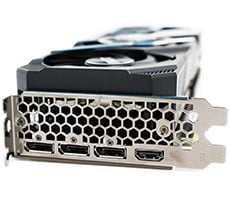
However, the real attraction is the port cluster. Palit not only includes two dual-link DVI ports, but it also includes HDMI and DisplayPort functionality. DisplayPort enabled monitors are just hitting the market, and now you can connect to them via a slim, sexy cable compared to a bulky DVI connector. HDMI is popular with home-theater environments of course as well, and works in conjunction with the S/PDIF audio inputs on the board in order to push audio and video through a single HDMI port. The board features an optical S/PDIF input port on the rear, along with a 2-pin S/PDIF connector on the top of the board next to its SLI connector. Palit’s card does not feature an S-Video output port, but when you’ve got a much more impressive HDMI output as a backup, we’re plenty fine with it.


HDMI, DisplayPort, 2x Dual-Link DVI and S/DPIF Optical Audio (Input Only)

All in all, the Palit 9600 GT Sonic card is the best showcase for how flexible NVIDIA’s new graphics processor is, both in terms of output ports and clock speeds. The board features just about everything we could want in a GeForce 9600 GT product, with the exception being its alarmingly orange heatsink shroud. Judge this one on its performance and features, folks, not by its looks. It’s got personality that's for sure.

Transparent
Power Consumption
Power consumption is an interesting variable which many people are curious about. Since NVIDIA’s new G94 is largely based on its G92 (GeForce 8800 GTGTS 65nm) predecessor, which was fairly modest in terms of power consumption, many are hoping that this new generation of mid-range components will perform even better in this regard. In order to prove this out, we used a hardware AC wattage monitor and tested our boards sitting at the windows desktop, along with running a GPU intensive application for a prolonged amount of time. This scenario also let us test minimum and maximum GPU thermal levels.


While the G94 has less stream processors compared to the G92 featured in the GeForce 8800 GT, we don’t see a huge decrease in power consumption.  Under heavy load, we see about a 10 Watt difference between a stock clocked 8800 GT and a stock clocked GeForce 9600 GT and our overclocked GeForce 9600 GT cards close that gap a little.    In general, power consumption for these new GeForce 9600 GT cards is very tolerable, although we didn’t see any large gains in efficiency like we would have hoped for.  All of our GeForce 9600 GT cards consumed slightly more power compared to the AMD Radeon HD3870/3850 cards we tested.

Transparent
Testbed and 3DMark
Test System Details
Specifications and Revisions

  • Intel Core 2 Exteme QX6750 (3.0 GHz Quad-Core, 65nm)
  • eVGA Nvidia nForce 680i LT SLI Motherboard
  • Kingston HyperX DDR2-800 Memory (4 x 1 GB, CAS 4-4-4-12)
  • Western Digital Raptor 74 GB Hard Drive)
  • Plextor PX-755SA DVD+/-RW Drive
  • Corsair HX620W 620W Power Supply
  • Microsoft Windows Vista Ultimate Edition (32-bit, SP1)

  • Asus EN9600 GeForce 9600 GT 512 MB (650/1800)
  • eVGA GeForce 9600 GT 512 MB SSC (740/1950)
  • Palit GeForce 9600 GT 512 MB Sonic (700/2000)
  • Nvidia GeForce 8800 GT 512 MB (600/1800)
  • ATI Radeon HD3870 512 MB (775/2400)
  • ATI Radeon HD3850 512 MB (735/1960)

  • Nvidia Driver 169.25 (8800 GT)
  • Nvidia Driver 174.12 (Beta, For 9600 GT Cards)
  • ATI Catalyst 8.2 Driver
Synthetic Gaming
Futuremark 3DMark06 - Default Benchmark


Synthetic Gaming
Futuremark 3DMark06 - Shader Model 3.0 Performance


A couple of synthetic benchmarks to get things started, and we see that the GeForce 9600 GT performs just where NVIDIA wants it to.  At stock reference clock speeds (Asus 9600 GT), the 9600 GT performs slightly better than a Radeon HD3850 but slightly below a GeForce 8800 GT.    Our overclocked 9600 GT cards close the gap between the 9600 GT and 8800 GT lineup substantially, delivering nearly all of the 8800 GT’s performance, but at a lower price.


Transparent
Crysis
Crysis Demo
Integrated GPU Stress Test Benchmark


Sadly, the GeForce 9600 GT doesn’t really have enough horsepower to run Crysis at a decent resolution and keep a 30+ FPS framerate.  All of our mid-range cards are stuck in the 20 FPS range at 1680 x 1050, and the situation gets worse the higher you bump the resolution to.   Our overclocked GeForce 9600 GT cards do, however, give performance on par with the 8800 GT and best the Radeon HD3870 in the majority of these tests, which can be perceived as a win.  For the record, these tests were all run at Crysis in-game graphics quality settings on high.


Transparent
World In Conflict
World In Conflict Demo
Integrated Performance Benchmark


World in Conflict runs great on the GeForce 9600 GT lineup, as long as you keep the resolution to 1920 x 1200 and under.  At these levels, the GeForce 9600 GT provides performance on par with the 8800 GT and Radeon HD3870 cards.


Transparent
Company of Heroes
Company Of Heroes
Integrated Performance Benchmark


Company of Heroes showed some oddball (but repeatable) performance numbers with the GeForce 9600 GT lineup, as the (lower-clocked) Asus GeForce 9600 GT card is able to outperform the higher-clocked Palit card.  The eVGA 9600 GT card with its 740 MHz GPU clock speed takes the lead of this pack, giving solid competition against ATI’s Radeon HD3870 product.


Transparent
Half Life 2 : Episode Two
Custom Designed GPU Heavy Performance Benchmark


The 9600 GT handles Half Life 2 beautifully, and even can run this title at 2560 x 1600 at very playable speeds, although I found 1920 x 1200 to be the sweet spot.    In this title, the 9600 GT is neck and neck with the more expensive GeForce 8800 GT card at lower resolutions, although the 8800 GT uses its horsepower to grab victories when the resolution gets pushed higher.   Nevertheless, in this title, the 9600 GT boasts visible performance gains over the Radeon HD3870/3850 lineup.


Transparent
Enemy Territory : Quake Wars
"Village" Timedemo


NVIDIA's GeForce 9600 GT cards put up a good showing in Quake Wars, giving performance right on par with the Radeon HD3870 with the overclocked 9600 GT cards, while remaining on par with the Radeon HD3850 for non-overclocked cards.  The GeForce 8800 GT retains a slight performance edge on the high-end, but the difference is quite small.  The 9600 GT maintains solid performance up to 1920 x 1200 resolution, which is quite good considering the price points of these cards.


Transparent
GPGPU Computing
General Purpose GPU (GPGPU) Computing Performance
Monte Carlo Algorithm


Looking to crunch some numbers with your GPU?   Well, when looking at these mid-range cards, NVIDIA certainly is a better choice.  These tests showcase the time it takes to crunch a set of samples, wherein we see NVIDIA’s product line besting ATI’s mid-range cards by quite a bit.   On the raw GPU level, we see almost no difference between the 9600 GT and 8800 GT, which isn’t too surprising considering how close they are, architecturally.


Transparent
Conclusion

NVIDIA’s decision to launch a mid-range product as the first member of the GeForce9 lineup will no doubt be met with some mild confusion on the part of gamers who are use to NVIDIA’s normal "big guns first" release schedule. We’ll admit, having NVIDIA state that the GeForce 8800 lineup is still the best for performance while the GeForce 9 is launching is a somewhat strange scenario, but in any case, we’re happy to see NVIDIA pushing better performing cards to lower price points, and that’s exactly what the GeForce 9600 GT aims to do.

The GeForce 9600 GT doesn’t change the mid-range lineup drastically, as it delivers similar performance levels to that of the GeForce 8800 GT and Radeon HD3870 graphics cards at a slightly lower price point. Depending on which game you run, any one of these three cards can potentially come out the victor, but in general, they are all very close in the performance charts and are available at comparable price points. NVIDIA’s GeForce 9600 GT is targeted a bit lower on the price spectrum, which makes its performance level more appreciable, but we’ll have to wait and see the street prices for these new cards before making any final judgements on that front. All in all, though, we’re not dealing with any earth-shattering changes compared to the mid-range graphics cards we currently have on the market today. The GeForce 9600 GT simply wedges itself in between the GeForce 8600 GT and 8800 GT cards in NVIDIA’s lineup, and directly competes against ATI’s Radeon HD3850 and 3870 products, and does so very favorably.

NVIDIA’s new G94 graphics processor delivers surprisingly solid performance, considering it has a little more than half the stream processors than its bigger brother, the GeForce 8800 GT. Even so, through boosting the clock speeds, new compression algorithms, fast memory chips, and driver optimizations, NVIDIA can nail the same performance level while using less power and with a physically smaller GPU. For NVIDIA, this is certainly a win.  For consumers, time will tell as street prices fall in line. It’s certainly a wicked fast little chip considering its sub-$200 price point, and we’re certain that NVIDIA will sell them by the truckload.  However, don’t expect your shiny new GeForce9 card to blow away your friend’s GeForce 8800 Ultra card in benchmarks. Not going to happen.  That's not what this GeForce 9 release is about.

For gamers with 20-24” widescreen displays, the GeForce 9600 is a pretty great companion graphics card. If you’re going beyond 24”, we’d recommend going for one of the higher-end members of the GeForce 8800 series (GTS, GTX) to see solid performance at 1920X1200 or 2560x 1600. Or, pick up a pair of the 9600 GT’s in SLI and get roughly the same performance from a pair of G94 GPU’s. This new GPU does handle SLI configurations quite well, in performance, power consumption, and overall heat/noise output. While we’re not convinced it hits some sort of sweet spot that other cards had not, we will say that a pair of these in SLI make for a potent combo for a gaming system.

Of course, this is not the only GeForce9 series card in the pipeline, and we’re certain to all catch wind of future products from this new NVIDIA GPU family in the near future as well.  All we can say at this point is that NVIDIA is off to another good start with the GeForce 9600 GT.  We’re looking forward to seeing what else they have up their sleeve next.

Asus EN9600 GT

  • Highly Overclockable
  • HDMI Adapter Included
  • Lowest Retail Price - $189
  • Stock Clock Speeds
  • Lacks Killer Feature
  • Stock Reference Design


eVGA GeForce 9600 GT SSC Edition

  • Highest Clocked GPU Out Of The Box
  • Overclockable Beyond That Level, Too.
  • Hottest Running Card Of The Bunch
  • No HDMI Support
  • Expensive at $200+


Palit GeForce 9600 Sonic

  • Highest Clocked Memory Modules
  • Quietest Cooling System
  • HDMI and DisplayPort Connectors

  • Strange and Bizarre Artwork
  • Occupies Two Case Slots
  • Most Expensive @ $219


Content Property of HotHardware.com