|
|
| Introduction, Specs, and Related Info | ||||
Intel started slowly leaking information about an ultra high-end enthusiast platform dubbed Skulltrail at right about the same time that AMD’s now defunct QuadFX platform was set to be released. Over time we learned that Skulltrail, like QuadFX, would be a dual-socket platform that could accommodate a pair of Intel’s fastest quad-core processors, for a grand total of eight execution cores in one desktop system. But other details regarding the platform were somewhat scarce to say the least. As time progressed, however, Intel was more and more forthright with information regarding Skulltrail. Soon we learned that the platform would require DDR2 FB-DIMMs and that it would officially support a 1600MHz front side bus frequency. Then later Intel disclosed that Skulltrail would support not only ATI’s CrossFire multi-GPU technology, but NVIDIA’s SLI as well. Then at IDF last year we were treated to our first glimpse of a fully assembled Skulltrail system that featured dual 3.2GHz quad-core processors and were even privy to some preliminary benchmark results. And finally, at this year’s Consumer Electronics Show, Intel showed off a couple of Skulltrail-based rigs complete with air and water-cooled processors running at a cool 4GHz. At this point we knew Skulltrail was almost ready for prime time. After meeting with Intel at CES, representatives informed us that Skulltrail would be available for testing and evaluation in just a few weeks. And they were true to their word. We’ve been banging on a Skulltrail setup complete with a matched pair of 3.2GHz Core 2 Extreme QX9775 processors and DDR2-800 FB-DIMMs for a couple of weeks now and will be presenting the results of our testing for you all right here. Strap yourself in and prepare for the eventual feelings of CPU envy that will ensue. Skulltrail is a beast in every sense of the word...
We have posted a myriad of information related to the Skulltrail platform in recent articles here at HotHardware. If you’d like more details regarding Intel’s Core 2 micro-architecture or want to see all of the early information regarding Skulltrail that we have posted in the past, we recommend perusing these articles:
|
| Skulltrail and Bonetrail Motherboards |
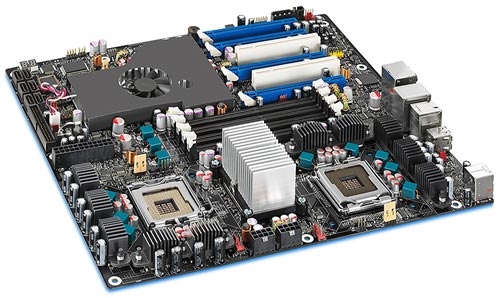
There are a lot of subtle details that hint at the Intel D5400XS motherboard’s enthusiast-class nature. The first thing we want to point out is that although the motherboard supports Intel’s LGA771 Xeon processors, the sockets are configured to accept LGA775 heatsinks and coolers. If you’ve ever shopped for LGA771 coolers, you’ll know that it is much more difficult to find quiet, yet powerful LGA771 coolers, but with this motherboard that problem has been eliminated. Early iterations of Skulltrail featured basic heatsinks on the motherboard’s chipset and PCI Express switches, but the D5400XS that will eventually be for sale features a single large heatsink on the MCH and a wide, flat active cooler that links the Southbridge and nForce 100 chips. This cooler and its associated shroud are definitely two of this motherboard’s flaws. Throughout testing we found the Southbridge cooler’s fan to be excessively loud and the shroud was held in place with double-stick tape that gave way and popped off a couple of days into testing. Unless we got a bum sample, we can’t see the shroud’s double-stick tape holding up in a warm enclosure over an extended period of time, so do yourself a favor and remove it if you should be one of the lucky few who end up buying a D5400XS.
As for the board’s I/O configuration, it has six internal SATA ports, a single IDE port, and headers for additional USB and Firewire ports. On the I/O backplane, there are no legacy connectors to be found, but it does have six USB ports, dual eSATA ports, single Firewire and Gigabit Ethernet jacks, and analog and digital HD audio inputs / outputs.
As you can see, the DX38BT also has nearly the exact same I/O port configuration as the D5400XS in its backplane. Like the D5400XS, the DX38BT has dual eSATA ports, single Firewire and Gigabit Ethernet jacks, and analog and digital HD audio inputs / outputs. The DX38BT, however, features eight USB 2.0 ports here, instead of Skulltrail's six. |
| Our Test Systems and SANDRA | ||||||||||||||||||
How we configured our test systems: When configuring our test systems for this article, we first entered their respective system BIOSes and set each board to its "Optimized" or "High performance Defaults". We then saved the settings, re-entered the BIOS and set memory timings for either DDR2-1066 (AMD) with 5,5,5,15 timings, DDR3-1333 - 1600 with 7,7,7,20 timings (Intel), or DDR2-800 5-5-5-15 (Skulltrail). The hard drives were then formatted, and Windows Vista Ultimate was installed. When the Windows installation was complete, we updated the OS, and installed the drivers necessary for our components. Auto-Updating and Windows Defender were then disabled and we installed all of our benchmarking software, defragged the hard drives, and ran all of the tests.
We began our testing with SiSoftware's SANDRA XII, the System ANalyzer, Diagnostic and Reporting Assistant. We ran six of the built-in subsystem tests that partially comprise the SANDRA XII suite on the Skulltrail system (CPU Arithmetic, Multimedia, Multi-Core Efficiency, Memory, Cache, and Memory Latency). All of the scores reported below were taken with the processors running at their default clock speed of 3.2GHz with DDR2-800 FB-DIMMs. |
| PCMark Vantage | ||||
For our next round of benchmarks, we ran all of the modules built into Futuremark's PCMark Vantage test suite. Vantage is a new benchmarking tool that we've incorporated into our arsenal of tests here at HotHardware. Here's how Futuremark positions their new benchmarking tool:
The Skulltrail system and similarly clocked Core 2 Extreme QX9770 perform at similar levels in the overall PCMark Vantage suite. Only a few pecentage points separate Intel's highest end platforms here, which is to say they beoth perform quite well.
Memories 1 - Two simultaneous threads, CPU image manipulation and HDD picture import
PCMark Vantage's Memories test mirrors the overall results, with the Skulltrail rig and Core 2 Extreme QX9770 performing within a few pecentage points of each other.
TV and Movies 1 - Two simultaneous threads, Video transcoding: HD DVD to media server archive, Video playback: HD DVD w/ additional lower bitrate HD content from HDD, as downloaded from the net
Once again, we see a similar pattern, with Skulltrail just edging out the QX9770.
Gaming 1 - GPU game test Vantage's gaming test, which utilizes a maximum of three threads, also performs similarly on Skulltrail and the QX9770, which is to be expected considering both platforms are clocked at the same level and utilized the same supporting hardware (video card and hard drive). |
| PCMark Vantage (Continued) | ||||
We continue our test coverage with a few more modules from the comprehensive PCMark Vantage suite of benchmarks.
Music 1 - Three simultaneous threads, Web page rendering – w/ music shop content, Audio transcoding: WAV -> WMA lossless, HDD: Adding music to Windows Media Player
The Skulltrail system faultered in Vantage's Music benchmark module, presumably due to the platform's memory bandwidth disadvantage versus the DDR3 equipped Core 2 Extreme QX9770.
Vantage Communications suite includes the following tests: Communications 1 - Three simultaneous threads, Data encryption: CNG AES CBC, Data compression, Web page rendering: graphics content, 1024x768, windowed
PCMark Vantage's Communication test suite proved to be somewhat of a strong point for the Skulltrail system. In this test, the Skulltrail system finished over 150 points ahead of the next fastest system.
Vantage Productivity suite includes the following tests: Productivity 1 - Two simultaneous threads, Text editing, HDD: application loading
PCMark Vantage's Productivity test suite reported similar scores for the QX9770 and Skulltrail system, with the Core 2 Extreme QX9650 finishing not too far behind. The moral of the PCMark Vantage story? If four or fewer threads are used, an eight core system is going to perform much like a four core system with similar clock speeds. As you'll see later, this is not the case with true multi-threaded applications. |
| Cinebench R10 and POV-Ray | ||||||||
Cinebench R10 is an OpenGL 3D rendering performance test based on Cinema 4D. Cinema 4D from Maxon is a 3D rendering and animation tool suite used by 3D animation houses and producers like Sony Animation and many others. It's very demanding of system processor resources and is an excellent gauge of pure computational throughput.
In Cinebench R10's single-threaded benchmark, the Skulltrail platform, powered by a pair of 3.2GHz QX9775 processors performs much like the similarly clocked Core 2 Extreme QX9770. In the multi-threaded benchmark, however, Skulltrail's eight cores propel the system to the front of the pack, by a wide margin. In fact, Skulltrail nearly doubles the performance of the QX9770 in the multithreaded test.
POV-Ray's multithreaded SSE2 benchmark tells essentially the same story as Cinebench R10. The immense performance of eight cores clocked at 3.2GHz allow the Skulltrail system to significantly outpace every other system. |
| Kribibench and 3DMark06 | ||||||||
For this next batch of tests, we ran Kribibench v1.1, a 3D rendering benchmark produced by Adept Development. Kribibench is an SSE aware software renderer where a 3D model is rendered and animated by the host CPU and the average frame rate is reported.
Kribibench tells an interesting story. In the sponge explode model test, the Skulltrail system performs much like the QX9770, despite the fact that this is a multi-threaded benchmark. With the more taxing Ultra model, however, the Skulltrail rig pulls way out in front. We beleive this is happening because the sponge explode test is completed so quickly, that all eight cores never hit 100% utilization.
3DMark06's built-in CPU performance module had the Skulltrail rig outperforming the next fastest system, the QX9770 by exactly 1500 points, a delta of just over 30%. |
| LAME MT Encoding | ||||
In our custom LAME MT MP3 encoding test, we convert a large WAV file to the MP3 format, which is a popular scenario that many end users work with on a day-to-day basis to provide portability and storage of their digital audio content. LAME is an open-source mid to high bit-rate and VBR (variable bit rate) MP3 audio encoder that is used widely around the world in a multitude of third party applications.
Despite the "MT" in LAME MT's name, this test utilizes only two threads. As such, the Skulltrail rig performs identically to the similarly clocked Core 2 Extreme QX9770 based system, which is to say it finished the test at the head of the pack. |
| Gaming: Crysis and F.E.A.R. | ||||
For our last set of game tests, we moved on to some in-game benchmarking with Crysis and F.E.A.R. When testing processors with Crysis or F.E.A.R, we drop the resolution to 800x600, and reduce all of the in-game graphical options to their minimum values to isolate CPU and memory performance as much as possible. However, the in-game effects, which control the level of detail for the games' physics engines and particle systems, are left at their maximum values, since these actually do place some load on the CPU rather than GPU.
Crysis and F.E.A.R. tell two very different stories. In the Crysis CPU benchmark, the Skulltrail rig performs quite well, but it can't keep pace with the QX9650 or QX9770. The QX9650 and QX9700 based systems were equipped with much faster DDR3 memory, which offers far more memory bandwidth, and as such the systems are able to outpace Skulltrail. |
| Power Consumption and Acoustics | ||||
We have a couple of final data points we'd like to cover before bringing this article to a close. Our goal was to give you all an idea as to how much power each of the system configurations we tested used while idling and running under load. And also speak a bit about Skulltrail's acoustic profile.
|
| Our Summary and Conclusion | ||||
Performance Summary: It is very easy to summarize Skulltrail’s performance. Due to the system’s relatively high-clock speeds and eight processor cores, Skulltrail significantly outperforms every other platform in multi-threaded applications that can utilize all of the system’s CPU resources. In single-threaded situations as well, the 3.2GHz QX9775 processors with their 1600MHz FSB frequency also allow Skulltrail to finish at or near the head of the pack in most tests. It’s only in memory bandwidth limited situations, where all of the CPU cores aren’t utilized, that Skulltrail doesn’t dominate due to the use of DDR2-800 FB-DIMMs.
Let’s get the obvious information out of the way first – Intel’s dual Core 2 Extreme QX9775-powered Skulltrail platform is the highest performing setup we have ever tested. With its eight processor cores and high-clock speeds, Skulltrail is simply in a league of its own. Due to the unique configuration of the D5400XS motherboard, Skulltrail is also a flexible platform. Users can run one or two processors, use any LGA775 heatsink, and even take advantage of either ATI’s or NVIDIA’s multi-GPU technology. About the only major drawback of the D5400XS is its use of FB-DIMMs.
|