When AMD released the Radeon HD 2900 XT in May of last year, we were left with a bitter taste in our mouths. Not because the product was all that bad, but because it seemed AMD was content to leave NVIDIA uncontested at the high-end of the 3D graphics card market. If you remember, when the Radeon HD 2900 XT launched AMD had targeted the mid-range GeForce 8800 GTS, and not NVIDIA’s high-end 8800 GTX or Ultra. It seemed as if AMD just didn’t want to be in the fight for 3D graphics supremacy any longer and enthusiasts like yourselves, who seek nothing but the highest performing products, were left with only a single option.
Thankfully things have changed in the last few months. After the R600 shipped, AMD’s engineers went right back to work. And in November AMD released the Radeon HD 3800 series of products, which were based on an updated GPU design that performed much like the R600, but with more moderate power and thermal characteristics. The new GPU, formerly codenamed RV670, still wasn’t quite as fast as NVIDIA’s higher-end offerings, but its low power profile gave AMD the ability to engineer the product we’ll be showcasing here today, the Radeon HD 3870 X2.
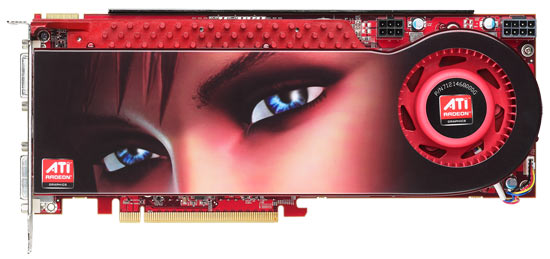
The Radeon HD 3870 X2 was codenamed R680 throughout its development. Although that codename implies the card is powered by a new GPU, it is not. The Radeon HD 3870 X2 is instead powered by a pair of RV670 GPUs linked together on a single PCB by a PCI Express fan-out switch. In essence, the Radeon HD 3870 X2 is “CrossFire on a card”. Take a look...

ATI Radeon HD 3870 X2
|
|
| ATI Radeon HD 3870 X2 |
| Features & Specifications | |
| 666 million transistors on 55nm fabrication process (x2)
256bit 8-channel GDDR3/4 memory interface (x2)
Ring Bus Memory Controller
- Fully distributed design with 512-bit internal ring bus for memory reads and writes
- Optimized for high performance HDR (High Dynamic Range) rendering at high display resolutions
Unified Superscalar Shader Architecture
- 320 stream processing units (x2)
- Dynamic load balancing and resource allocation for vertex, geometry, and pixel shaders
- Common instruction set and texture unit access supported for all types of shaders
- Dedicated branch execution units and texture address processors
- 128-bit floating point precision for all operations
- Command processor for reduced CPU overhead
- Shader instruction and constant caches
- Up to 80 texture fetches per clock cycle
- Up to 128 textures per pixel
- Fully associative multi-level texture cache design
- DXTC and 3Dc+ texture compression
- High resolution texture support (up to 8192 x 8192)
- Fully associative texture Z/stencil cache designs
- Double-sided hierarchical Z/stencil buffer
- Early Z test, Re-Z, Z Range optimization, and Fast Z Clear
- Lossless Z & stencil compression (up to 128:1)
- Lossless color compression (up to 8:1)
- 8 render targets (MRTs) with anti-aliasing support
- Physics processing support
Full support for Microsoft DirectX 10 / 10.1
- Shader Model 4.0
- Geometry Shaders
- Stream Output
- Integer and Bitwise Operations
- Alpha to Coverage
- Constant Buffers
- State Objects
- Texture Arrays
Dynamic Geometry Acceleration
- High performance vertex cache
- Programmable tessellation unit
- Accelerated geometry shader path for geometry amplification
- Memory read/write cache for improved stream output performance
Anti-aliasing features
- Multi-sample anti-aliasing (up to 8 samples per pixel)
- Up to 24x Custom Filter Anti-Aliasing (CFAA) for improved quality
- Adaptive super-sampling and multi-sampling
- Temporal anti-aliasing
- Gamma correct
- Super AA (CrossFire configurations only)
- All anti-aliasing features compatible with HDR rendering
CrossFire Multi-GPU Technology
- Scale up rendering performance and image quality with 2 or more GPUs
- Integrated compositing engine
- High performance dual channel interconnect
|
Texture filtering features
- 2x/4x/8x/16x high quality adaptive anisotropic filtering modes (up to 128 taps per pixel)
- 128-bit floating point HDR texture filtering
- Bicubic filtering
- sRGB filtering (gamma/degamma)
- Percentage Closer Filtering (PCF)
- Depth & stencil texture (DST) format support
- Shared exponent HDR (RGBE 9:9:9:5) texture format support
ATI Avivo HD Video and Display Platform
- Two independent display controllers
- Drive two displays simultaneously with independent resolutions, refresh rates, color controls and video overlays for each display
- Full 30-bit display processing
- Programmable piecewise linear gamma correction, color correction, and color space conversion
- Spatial/temporal dithering provides 30-bit color quality on 24-bit and 18-bit displays
- High quality pre- and post-scaling engines, with underscan support for all display outputs
- Content-adaptive de-flicker filtering for interlaced displays
- Fast, glitch-free mode switching
- Hardware cursor
- Two integrated dual-link DVI display outputs
- Each supports 18-, 24-, and 30-bit digital displays at all resolutions up to 1920x1200 (single-link DVI) or 2560x1600 (dual-link DVI)
- Each includes a dual-link HDCP encoder with on-chip key storage for high resolution playback of protected content
- Two integrated 400 MHz 30-bit RAMDACs
- Each supports analog displays connected by VGA at all resolutions up to 2048x1536
- HDMI output support
- Supports all display resolutions up to 1920x1080
- Integrated HD audio controller with multi-channel (5.1) AC3 support, enabling a plug-and-play cable-less audio solution
- Integrated Xilleon HDTV encoder
- Provides high quality analog TV output (component / S-video / composite)
- Supports SDTV and HDTV resolutions
- Underscan and overscan compensation
- HD decode for H.264/AVC, VC-1, DivX and MPEG-2 video formats
- Flawless DVD, HD DVD, and Blu-Ray playback
- Motion compensation and IDCT (Inverse Discrete Cosine Transformation)
- HD video processing
- Advanced vector adaptive per-pixel de-interlacing
- De-blocking and noise reduction filtering
- Edge enhancement
- Inverse telecine (2:2 and 3:2 pull-down correction)
- Bad edit correction
- High fidelity gamma correction, color correction, color space conversion, and scaling
- MPEG-2, MPEG-4, DivX, WMV9, VC-1, and H.264/AVC encoding and transcoding
- Seamless integration of pixel shaders with video in real time
- VGA mode support on all display outputs
PCI Express 2.0 x16 bus interface
OpenGL 2.0 support
|
ATI Really Wanted To Protect This Baby
To get more familiar with AMD's new ATI Radeon HD 3870 X2, the company's previous GPU architectures, and their key features, we recommend you read a few recent articles we've posted here at HotHardware. The Radeon HD 3870 X2's pair of RV670 GPUs are derived from of the R600, and as such they have a number of key features in common that we've already covered in much greater detail that we will here today. The articles we suggest you check out include:
If you haven't already done so, we recommend scanning through our Radeon HD 3800 and 2900 series coverage, our CrossFire Multi-GPU technology preview, and the Radeon X1950 Pro with Native CrossFire article. In those four pieces, we cover a large number of the features offered by the new Radeon HD 3870 X2 and explain many of the features of DirectX 10 and 10.1. We recommended reading these articles because there is quite a bit of background information in them that'll make it easier to fully digest what we're going to showcase here today.





;)
;)
;)