|
|
| Introduction and Specifications | ||||||
A few months ago, we rounded up some of the fastest DDR3 memory kits that were available and came away impressed by how well frequencies and performance had scaled in the short time since DDR3 had been introduced on the desktop. Since that article was published, however, not much has changed on the DDR3 front in terms of overall performance. 1800MHz kits are still the cream of the crop and the latency of the top kits hasn’t dropped below CAS 7. The landscape has changed a bit though, thanks to ever dropping prices, maturity, and some newly introduced features. At the time our round-up was published, we praised one of Corsair’s kits in particular, the TWIN3X2048 - 1800C7D, for its strong performance, overclockability, and excellent cooling solution. In this article, we’re going to take a look at an update to that kit, the TWIN3X2048-1800C7DFIN G, that offers support for Intel’s Extreme Memory Profiles. If you’re unfamiliar with Extreme Memory Profiles, think of them as Intel’s DDR3 equivalent to NVIDIA’s EPP. With XMP, like EPP, a portion of the memory’s on-board SPD is used to store vital settings for the memory, which can be accesses and automatically configured when used with the right motherboard.
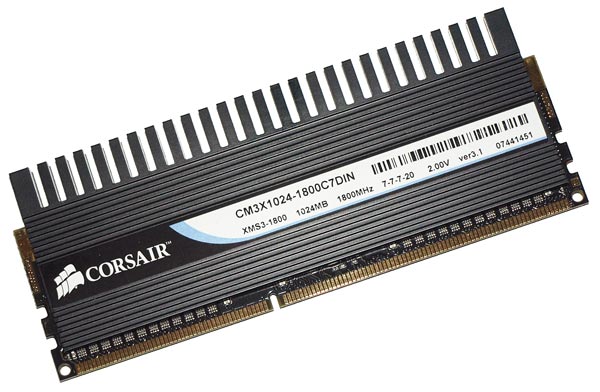
"The TWIN3X2048-1800C7DFIN G is a 2048MByte kit of DDR3 SDRAM DIMMs based upon Corsair’s ultra performance DOMINATOR family of memory which includes Intel’s Extreme Memory Profiles (XMP). XMP is a JEDEC based performance specification for DDR3 memory SPD optimizations developed by Intel and its performance memory module partners. This enables a robust, profile based high performance DDR3 over-clocking solution for Intel platforms targeted for enthusiasts, gamers and overclockers who want to extract maximum performance from their platforms. Built using Corsair’s Dual-path Heat Xchange (DHX) technology coupled with a Corsair Airflow Fan, this part delivers outstanding performance with the Intel’s Extreme Series of DDR3-based motherboards and has been tested extensively to ensure compatibility and performance at its rated speed. This memory has been verified to operate at 1800MHz at latencies of 7-7-7-20 at 2.0V VDIMM."
The memory chips on both sides of the PCB are outfitted with their own dedicated, oversized heatsinks to help cool the chips as well. Having two paths from which heat can be drawn out of the modules is what Corsair is calling DHX technology, or Dual-Path Heat Xchange. And the Dominator fan included with some of Corsair's kits is the third component that aids in cooling, which in turn enhances stability, longevity, and overclockability. In addition to DHX, Corsair is aggressively binning the memory chips used on the Dominator kits and is using only select samples th at can operate reliably at their rated latencies and frequencies. The end result of Corsair's efforts is a 2GB memory kit that's rated for operation at over 1.8GHz with 7-7-7-20 timings. We should note, however, that the TWIN3X2048-1800C7DFIN G memory requires 2.0v to operate at its rated speed whereas many other DDR3 kits require only 1.7v to 1.8v. |
| Test System and Stock Performance | ||||||||||||||||||||||||||||||
How we configured our test systems: When configuring our test system for this review, the first thing we did was enter the system BIOS and set the motherboard to its default configuration. The hard drive was then formatted, and Windows XP Professional (SP2) was installed. When the installation was complete, we installed all of the necessary drivers for our components, and removed Windows Messenger from the system. Auto-Updating and System Restore were also disabled, and we setup a 1024MB permanent page file on the same partition as the Windows installation. Lastly, we set Windows XP's Visual Effects to "best performance", installed all of our benchmarking software, defragged the hard drive and ran all of the tests. Throughout all our benchmarking, we had the memory voltage set to their default values, unless otherwise noted.
In all of the various SiSoft SANDRA benchamrks, the Corsair TWIN3X2048-1800C7DFIN G kit came out on top, but only by a small margin. This kit has the same specifications as the TWIN3X2048-1800C7DF kit, so it should offer essentially the same performance. |
||||||||||||||||||||||||||||||
| Stock Performance (Continued) | ||||||||
For our next round of benchmarks, we ran the Memory performance module built-into Futuremark's PCMark05. For those interested in more than just the graphs, we've got a quote from Futuremark that explains exactly what this test does and how it works...
"The Memory test suite is a collection of tests that isolate the performance of the memory subsystem. The memory subsystem consists of various devices on the PC. This includes the main memory, the CPU internal cache (known as the L1 cache) and the external cache (known as the L2 cache). As it is difficult to find applications that only stress the memory, we explicitly developed a set of tests geared for this purpose. The tests are written in C++ and assembly. They include: Reading data blocks from memory, Writing data blocks to memory performing copy operations on data blocks, random access to data items and latency testing." The TWIN3X2048-1800C7DFIN G kit performed right on par with the non-XMP capable version of the kit in PCMark05's memory performance module. It wasn't quite the fastest overall in this benchmark, but the deltas separating the modules are quite small all around.
We continued our testing with some low-resolution F.E.A.R. tests. Despite the fact that this is a game benchmark that can be used to test the relative performance of video cards, frame rates are strongly influenced by processor speed and available memory bandwidth, especially at low resolutions, which is how we ran the tests to get the frame rates listed below.
The two Corsair kits represented here technically trailed the others in our low-resolution FEAR benchmarks, but these results need clarification. Because we couldn't keep our CPU locked at a single clock speed, while also pushing each kit to their rated frequecy, some of the configurations ended up with a higher CPU clock speed. In fact, when testing the Corsair kits, our CPU was clocked at 2.6GHz as opposed to 2.66 or 2.7GHz for the others, hence the performance variations here. |
| Overclocked Performance | ||||
For our next set of numbers, we focused on the maximum stable overclock of the TWIN3X2048-1800C7DFIN G memory kit while set to its rated timings. Using the same Core 2 Duo E6750 CPU, we raised the Front Side Bus speed while concurrently lowering our processor's multiplier. We tried to keep the CPU's clock speed as close to the same speed as possible for each kit tested. For these tests, we also locked the PCI Express clock to 100MHz, raised the CPU voltage to 1.4v, lowered the CPU multiplier to 7x or 8x, and kept the memory voltage to 2.2v for all of the kits. Ultimately, we ended up with different settings for each kit, which was unavoidable. Here is the exact breakdown of how each kit fared in the overclocking tests: As you can see, we have an approximate 540MHz swing in CPU frequency between the kits. As for the memory frequency, the Corsair TWIN3X2048-1800C7DFIN G kit topped out at over 2.0GHz, which is impressive indeed. Please keep in mind, these speeds were attained at each kits default timings. Had we raised (or lowered) the CAS latency for each kit here, their peak overclocked speeds would likely have been different.
At its overclocked speed, nothing could touch the Corsair TWIN3X2048-1800C7DFIN G kit. SANDRA reported peak bandwidth of almost 9.4GB/s and the latency benchmark came in at 60ns, which was the lowest of the bunch. |
| Overclocked Performance (Continued) | ||||||||
We also re-ran the PCMark05 memory performance and F.E.A.R. benchmarks again with all of the memory kits overclocked on our Intel Core 2 Duo E6750 powered test bed...
As you probably expected, PCMark05 also reported substantial gains for all of the memory kits we tested while overclocked and the TWIN3X2048-1800C7DFIN G once again came out on top.
This time around, due to the processor's higher clock speed and the massive amount of memory bandwidth afforded by the overclocked Corsair TWIN3X2048-1800C7DFIN G kit, it came out on top by a sizable margin in the FEAR benchmark. |
| Our Summary and Conclusion | ||||
Performance Summary: Throughout all of our testing, the Corsair TWIN3X2048-1800C7DFIN G memory kit performance at or near the very top of the charts. At its stock settings, the TWIN3X2048-1800C7DFIN G kit performed exactly like its non-XMP enabled counterpart, which is to say it performed quite well. While overclocked though, the TWIN3X2048-1800C7DFIN G kit was clearly the fastest, due to its relatively high maximum stable clock speed of just over 2GHz, which also happens to be the highest speed we’ve even been able to take a DDR3 memory kit to date.
Much of what we said about the TWIN3X2048-1800C7D kit a few months ago still rings true for the XMP enabled version of the kit we looked at here. With a rated speed of 1800MHz, the Corsair TWIN3X2048-1800C7DFIN G is one of the highest clocked DDR3 memory kits currently on the market. And despite supporting an already high default clock speed, it also proved to have plenty of overclocking headroom left, and ultimately put up the best performance overall. All that performance comes at a price, however. At about $459 (after rebates), the Corsair TWIN3X2048-1800C7DFIN G kit is relatively expensive, especially for a 2GB memory kit. But in the current DDR3 landscape you do get what you pay for – most cheaper kits can’t come close to hitting the kind of frequencies this one can. If money is no object this is arguably the best DDR3 memory kit for enthusiasts in our opinion, and it also happens to be backed by one of the most respected companies in the business. Due to its excellent performance, overclockability, and features, we’re giving the Corsair TWIN3X2048-1800C7DFIN G kit an Editor’s Choice award. ![]()
|