Logo   Banner   TopRight
TopUnder
Transparent
ATI FireGL V7600 512 MB Workstation Graphics Card
Transparent
Date: Nov 25, 2007
Section:Graphics/Sound
Author: Alex Evans
Transparent
Overview and Specifications


ATI’s FireGL brand of workstation-class graphics cards have played second fiddle to NVIDIA's offerings for some time now. NVIDIA’s rival Quadro lineup has been an incredibly strong competitor, and combined with the fact that the last several FireGL card releases have suffered from late arrival dates and lackluster performance by the time they hit the market, NVIDIA has been able to get a solid foothold in this market. However, with the power of the R600 graphics processor under the hood, ATI has introduced a new lineup of workstation cards which are giving NVIDIA a run for their money in terms of price/performance metrics. The R600 may not have been a tremendous hit for the gaming market, but in a workstation environment, the power of this GPU can be harnessed in a much different way.


Today in hand, we have the new FireGL V7600 512MB workstation graphics card. This card is based on the same basic board design as the Radeon HD 2900 lineup for gamers, but is tweaked on both the hardware and software level for enhanced workstation performance. The card is the least costly of ATI’s FireGL lineup based on the R600 GPU, and currently retails for just south of $1,000. At this time, Nvidia has nothing directly competing against this product at that price point, which gives ATI an opportunity to strike for workstation users who want a high-end workstation card at a price tag under four digits. We’ve heard rumors of upcoming products from Nvidia which will directly target this card, but for now, the FireGL V7600 owns its specific price point.

The closest competitor, from a price perspective, is Nvidia’s QuadroFX 4500 card, which can currently be had online for $800 - $1,000. While the QuadroFX 4500 is a solid competitor, it’s been on the market for several years, and doesn’t support some newer technologies like Shader Model 4.0 (DirectX 10). However, in the workstation market, where OpenGL is still king, this feature matters very little. The driving factors for workstation buyers are still raw OpenGL graphics performance, clean drivers, industry certifications, memory capacity, and overall value. In its market, the FireGL V7600 looks very strong. Let’s take a closer look at the actual product.
 

ATI FireGL V7600 - Angled View


ATI FireGL V7600 - Angled View


"Introducing the ATI FireGL V7600 workstation graphics accelerators from AMD with Unified Shader architecture - this fully featured graphics accelerator is ideal for maximizing productivity when working with complex 3D models and intense textures for Computer Aided Design (CAD), Digital Content Creation (DCC) and simulation. The ATI FireGL V7600 delivers industry leading features and performance at an affordable price."

  • ATI R600 Graphics Processing Unit

  • 512 MB of GDDR-3 Memory

  • 256-bit Ringbus Memory Controller

  • 35 GB/s Memory Bandwidth

  • 507 MHz GPU Clock Speed

  • 320 Steam Processors

  • Shader Model 4.0 and OpenGL 2.0 Support

  • PCI Express x16 Connector

  • 8-pin PCI Express Power Connector

  • Dual Slot Copper Heatpipe Cooling System

  • Thermally Controlled Integrated Blower Fan

  • Two Dual-Link DVI Output Ports

  • 3-pin Stereoscopic Output Connector

  • Crossfire 2.0 Multi-GPU Connectors

The FireGL V7600 uses the same massive R600 core used in the Radeon HD 2900 lineup, which has an (estimated) 420mm2 die size, is comprised of over 700 million transistors, and is based on an 80nm manufacturing process. The V7600 runs at a far lower clock speed, however, as ATI’s utilities report the card operates at a 507 MHz core frequency, compared to the 750 MHz+ clock speeds at which their gaming-targeted R600 products run. Unfortunately, all of the available software-level utilities to try to pinpoint exact clock speeds would not work with the V7600 card, which also kept us from overclocking the card. Keep in mind this is a workstation card though, so the percentage of those actually overclocking a card like this is slim to none.

The board is equipped with 512 MB of GDDR-3 memory which is connected to a 256-bit memory controller. ATI’s documentation is conflicted on overall memory bandwidth of this card, as their reviewers guide claims it has 35 GB/s whereas their website says over 50 GB/s. ATI’s software tools claim that the clock speed of the DDR memory is a mere 513 MHz (x2 DDR), which matches up closer to 35 GB/s rather than 51 GB/s.


Catalyst Control Center


Reported Clock Speeds
 

The V7600 uses the same Catalyst Control Center that most ATI users are familiar with. We did not see any specific FireGL functionality in the driver set. ATI does not publically have FireGL V7600 drivers on their website, so we had to use the bundled drivers that came with our sample board.

One aspect which we feel is worth noting is that the FireGL V7600 does not have 64-bit drivers readily available at this time. We were forced to run our tests under a 32-bit operating system, although when we tried to run this card in a 64-bit operating system, we realized that there simply aren’t any Vista or XP x64 drivers available from ATI. We think it’s quite likely that someone buying a $1,000 graphics card will also be running 4GB of memory and will likely use a 64-bit operating system, so potential buyers might want to keep this in mind. We’re certain that they will be adding 64-bit support soon, but as of now, x64 users are out of luck.

Transparent
Board Design

 
The FireGL V7600 card features the same base PCB design as the Radeon HD 2900 lineup, which utilizes a somewhat elongated (bright red) PCB that is likely to extend past most standard ATX motherboards. The extended length didn’t prove to be an issue in any of our scenarios. Of course, the card is double-height as well, as its cooling system requires the V7600 to occupy two case expansion slots.


ATI FireGL V7600 - Angled View


ATI FireGL V7600 - Angled View

The cooling system on the card is quite impressive, although not entirely without fault. Underneath the plastic airflow routing shroud, ATI has a massive copper heatpipe cooling system with a load of aluminum thin fins, which work in conjunction with the unit’s blower-style cooling fan to whisk hot-air out of the chassis. The cooling system is equipped to cool both the GPU and the GDDR-3 memory, just in case you’re wondering, all 512 MB of memory is located on the same side of the PCB.

The 4-pin, PWM-enabled fan could use some work, as it’s clearly louder compared to the Nvidia workstation products we tested against. The fan can run at multiple speeds and noise levels, depending on the GPU processing load and heat production level. The idle noise level of the card was significantly higher than expected in today’s GPU market, and the noise level was audible over our standard testbed hardware. Throughout most of the tests, the card stayed at its default noise level, although every once and a while, the fan would go into a high-speed mode (most often during heavy ViewPerf and Crysis tests) which made the noise level very noticeable. We’re not talking GeForce FX 5800-style blower noise, but definitely audible and none too pleasant. On the plus side, due to the cooler’s design, GPU-created heat is whisked out of the case, and doesn’t linger internally to heat up other components.


Closeup of Heatpipe Cooling System


Closeup of Blower Fan


The V7600 requires an 8-pin PCI Express power connector, but will run on a 6-pin PCI Express connector if necessary. The Radeon HD 2900 XT exhibited the same behavior, although this card could not be overclocked when a 6-pin PCIe power connector was used. Of course, if you have the option, be safe and use a full 8-pin PCI Express power connector.


8-pin PCIE Power Connector


Dual-Link DVI Connectors

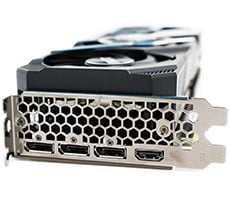
As expected from a workstation-class card, the FireGL V7600 is equipped with a pair of dual-link DVI connectors, which can power two 30” 2560 x 1600 LCD displays without breaking a sweat. Sitting between them is a 3-pin stereoscopic output port, which is a port that you either need or you don’t - it depends on your application. Multiple FireGL V7600 cards can be placed in the same system to increase your number of display outputs.

The card includes CrossFire 2.0 (internal) connectors, but does not include a CrossFire cable. ATI told us directly that these FireGL cards do not support Crossfire, and that they’ll work on FireGL CrossFire when users are demanding such a feature. CrossFire, along with SLI, isn’t in demand much in the professional level market, so we’re not surprised to see it left out of the mix. However, we never like to see features on a board which we can’t take advantage of due to cost cutting measures (using the same PCB for both graphics card lineups).


Crossfire 2.0 Connectors


PCI Express x16 Interface

Transparent
Testbed and 3D Studio Max 2008
Test System Details
Specifications and Revisions

  • Intel Core 2 Duo E6600 (2.4 GHz) Dual-Core
  • 4 x Kingston DDR2-800 CAS 4-4-4-15 Modules (4 GB Total)
  • 1 x eVGA nForce 650i Ultra Motherboard
  • 1 x Western Digital Raptor 74GB 10,000 RPM SATA Hard Disk
  • 1 x Plextor DVD+/-RW Serial ATA Optical Drive
  • 1 x Corsair HX620W 620W Modular Power Supply
  • Microsoft Windows XP Professional (32-bit)

  • ATI FireGL V7600 512 MB
  • Nvidia QuadroFX 4500 512 MB
  • Nvidia GeForce 8800 GTS 320 MB
OpenGL Modeling / Texturing Performance
SPECapc - 3D Studio Max 2008 (32-bit)


3D Studio Max 2008 is the latest variant of this extremely popular design suite. While SpecAPC for 3DS was built for a prior version of 3D Studio, it works just fine under 3DSMax 2008 as well. The test runs for a solid half hour or more, testing various aspects of the software. The test is timed, so lower numbers mean smoother 3D Studio Max performance. In this first test, the FireGL V7600 provides the best performance compared to our other Nvidia test cards, although only by a small margin.

Transparent
SPEC ViewPerf 10
Workstation OpenGL Performance
Spec Viewperf 10


The ViewPerf 10 suite showcases how much of a difference in OpenGL performance can be seen between workstation-class and gaming-class graphics cards. The Nvidia GeForce 8800 GTS, armed with a more modern GPU compared to the QuadroFX 4500, gets slaughtered in this test. In three of these four tests, the FireGL V7600 brings better performance than the QFX 4500 to the table. Ensight and Maya show huge performance gains, doubling the performance of the nearest priced QuadroFX card.

Transparent
SPEC ViewPerf 10 (Cont.)
Workstation OpenGL Performance
Spec Viewperf 10


The second group of four tests in the SPECViewperf 10 suite also look great for ATI. While the V7600 card suffers lackluster performance in Pro/ENGINEER, the other three workstation applications are runaway victories for the FireGL card. The performance of the consumer-level GeForce 8800 GTS card in these benchmarks is severely lacking.

Transparent
GPGPU Performance
General Purpose GPU Processing
GPU-Tech Monte Carlo GPU Computing Methods


Lower Numbers = Better Performance


Lower Numbers = Better Performance


Lower Numbers = Better Performance


General Purpose GPU computing is a market which is exploding lately, so we wanted to test these GPUs' abilities to handle complex mathematical algorithms through GPU processing. GPUTech’s benchmarks are timed, so the lower numbers equate to better GPGPU performance. In these three tests, the FireGL V7600 showcases better GPGPU performance compared to the QuadroFX 4500, but both of these cards are bested by the less expensive 8800 GTS card.

Transparent
GPGPU Performance (Cont.)
General Purpose GPU Processing
GPU-Tech Black and Scholes GPU Computing Method


Lower Numbers = Better Performance


Lower Numbers = Better Performance


Lower Numbers = Better Performance


Our second round of GPGPU benchmarks again show the FireGL V7600 and 8800 GTS cards fighting for the best performance levels, while the QuadroFX 4500 card falls behind. The QFX 4500 card could not complete the final benchmark, as it crashed the system every time we ran the test with this card.

Transparent
Cinebench and 3DMark06
Synthetic OpenGL Performance
Cinebench R10 OpenGL Test


In Cinebench R10’s OpenGL GPU performance benchmark, the V7600 bests the competing cards by a healthy margin.


Synthetic Gaming Performance
Futuremark 3DMark06


Gaming performance is also not too terrible with the FireGL V7600. Even with ATI’s workstation-tuned FireGL driver set, the card can deliver gaming performance which is not terrible for this type of card. Obviously, these numbers are much lower than ATI’s Radeon HD 2900 lineup, which features the same GPU, although the FireGL V7600 card runs at much lower clock speeds.
Transparent
Crysis
Gaming Performance
Crysis Demo


How about some real gaming benchmarks on these cards? Before you claim these numbers are irrelevant, keep in mind that a lot of game developers buy workstation-class cards, and they need to test titles on their machines as well, not just develop with them. In these tests, the 8800 GTS and FireGL V7600 offer similar performance, but both struggled to handle the GPU load of Crysis. ATI’s FireGL card gave texture errors throughout the benchmark, but rendered correctly, more or less. We certainly wouldn’t recommend a card like this for Crysis, but hey, it doesn’t run all that bad.

Transparent
Power Consumption
Total System Power Consumption
Measured at Idle and Full GPU Load Levels


The power consumption profile of the V7600 is pretty interesting. The Radeon HD 2900 XT lineup was lambasted for its power requirements, but at the FireGL V7600’s lower clock speeds, the board does surprisingly well. The power consumption levels between idle and load were the smallest with the V7600, and all in all, it consumes a surprisingly moderate amount of power.

Transparent
Conclusion


The FireGL V7600 card from ATI/AMD brings excellent workstation class performance down to the sub-$1000 price range. The numbers simply don’t lie. Nvidia’s QuadroFX 4500, which once dominated this market and sold for roughly $2,500, is now getting bested by nearly a 2x margin in many benchmarks by this $999 card. This is excellent news for anyone who requires top-notch high-end digital content creation performance, but can’t drop several thousand dollars on an ultra-high-end product. It would be short-sighted of us to not make a note that the QuadroFX 4500 card is over a year old, though.  Nvidia is preparing a follow-up card to fit in this price point in the very near future but specific details remain to be seen.

The FireGL V7600 card by itself is not without a few shortcomings.  While we were impressed by its raw performance and value, the card is significantly louder and creates more heat than other workstation cards we’ve tested. In a closed case environment, it’s unlikely that the noise will be a detriment, but when the card kicks up to its highest fan speed, it becomes very noticeable. The card is also double-width and requires an 8-pin PCI Express power connector, although these are fairly standard system requirements for a high-end workstation card today.

While noise is one concern, driver support and availability also pose other problems for this card. To date, we could not find this card on any store shelves, despite press releases about the board’s shipment hitting the web last month. Even if you wanted to get one of these cards, it’s nearly impossible at this time. And if you did manage to get your hands on one, as we did, you may quickly run into driver-related issues. The beta drivers we were provided with had some quirks, and there are no new drivers available yet. In addition, to date, this card does not have 64-bit drivers available, which is a huge roadblock for potential workstation buyers. We’re certain that 64-bit drivers will be included in the final shipping retail package, but at this point, we can’t provide any input on the matter until we have a chance to test them.

All in all, the FireGL V7600 gives ATI a much-needed shot in the arm for their FireGL lineup. It provides excellent performance at its price point, has modern GPU features like DirectX 10 and OpenGL 2.0 support. We feel comfortable that despite current maturity issues, it will be a solid product when it ships. We look forward to what Nvidia will counter with at this price point but for now ATI's FireGL V7600 looks to be a very competitive and compelling professional Workstation Graphics product.

  • Impressive Price/Performance Ratio
  • Modern GPU Feature Set (DX10, OGL2)
  • Long List of Software Certifications
  • Board and Driver Availability Issues
  • Heat Pipe Cooling System Too Loud
  • Exhausts Excessive Heat


Discuss This Article and Share Your Thoughts With Others!


Content Property of HotHardware.com