|
|
| Introduction and Specifications | ||||||
|
A short while after Dell purchased Alienware late last year, news broke that Hewlett Packard had acquired boutique system vendor Voodoo PC. Voodoo PC is best known for their high performance gaming PC's that feature custom cases, some with lavish paint jobs, unique cooling solutions, and impeccable wiring jobs. We evaluated a Voodoo Omen some time back and found it to be an excellent product. If you check out the Omen, you'll see why HP was interested in Voodoo. After HP's acquisition of Voodoo PC, many speculated that the company's entrance into the high-end gaming PC market was imminent. After all, why else would they have bought Voodoo, right? But since then, not much has changed. It seemed as if it was business as usual at both HP and Voodoo. HP was secretly working on their own gaming PC, however, and its codename was Blackbird. Despite what you may be thinking, the Blackbird wasn't being designed by the newly acquired engineers from Voodoo. In fact, the Blackbird project was well underway before the acquisition was finalized. Since Voodoo PC and HP joined forces, the two have colloborated and the Blackbird project has undergone changes. The final product actually bares a 'Voodoo DNA' badge within its enclosure as an homage to its clean interior and tight wiring job, but the machine is being brought to market strictly as an HP branded product. What we're going to be showing you today is the Blackbird 002 Gaming System - a fully customizable machine that's poised to do battle with the best gaming systems the industry has to offer...
The Hewlett Packard Blackbird 002 we received for evaluation was a pre-release version, that did not ship in full retail form. We did not receive the final packagaing, the machine's base / stand may have a different finish, and the machine was not loaded up with all of the software that it likely to accompany systems bought at retail. The features of the enclosure and the overall look of the machine should be identical to the machines available for purchase today. |
| HP Blackbird 002: Exterior |
|
In our initial briefing with representatives from Hewlett Packard, one of the first things said was that "benchmarks didn't matter anymore." HP wasn't trying to tell us that the Blackbird 002 would be a dog in the performance department, quite the contrary, but rather that as long as they used the same components, performance among the gaming PCs offered by different companies wouldn't vary all that much. A Core 2 Extreme QX6850 is a Core 2 Extreme QX6850 no matter who sells it to you. Instead of focusing on a just a select few hardware configurations and modding or customizing them for absolute peak performance and ending up with a system that would ultimately perform much like any other using the same parts, Hewlett Packard set out to build a fully customizable gaming machine that also happened to be low-maintenance and user-friendly. A decision was made to use standard components in the Blackbird 002. The motherboards, graphics cards, power supplies, and RAM available in the system are the same ones that you can purchase at retail. And potential consumers will be able to outfit their Blackbirds with Intel or AMD processors, and NVIDIA or ATI GPUs. The enclosure is unique and has some HP-specific features, but it can still accommodate most standard components. The first thing you’ll notice about the Blackbird 002’s enclosure is its trapezoidal shape. The machine is more slender at the front and gets thicker and broader in back. Both sides of the case feature high-gloss inserts that are removable and will eventually be customizable. There are honeycomb vents on one side to help cool the expansion cards in the rig, and on the other there are four holes that’ll accommodate a standard monitor mounting bracket. The machine is super-heavy, but should users decide to use it as a LAN party rig, an LCD can be mounted right to its side.
The front, back, top, and bottom of the case are wrapped in heavy fins that help dissipate heat generated from components in the system, and the entire assembly sits atop a curved pedestal that lifts the machine a few inches off the floor. Lifting the machine in this manner helps improve air intake and also reduces the amount of debris sucked into the system by its fans. Power and reset buttons are located just below the optical drive bays and are backlit for better visibility. The buttons themselves are flush with the surface to prevent accidentally hitting them and shutting down or restarting the machine. |
| HP Blackbird 002: Interior |
|
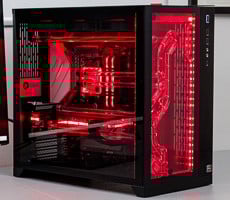
It’s while inspecting the Blackbird 002’s interior that you really begin to appreciate the work HP put into the machine’s user-friendly design. Opening the case and getting at its internals can be done with the flick of a finger, thanks to a simple latching mechanism on the front of the cases’ side panel. The panels are hinged and swing out of the way easily, and can also be removed if the need arises by simply lifting them up and off. The Blackbird 002 we received for evaluation was equipped with a self-contained liquid cooling system that cooled the processor and both graphics cards. We should note, however, that users will have the option to stick with air cooling if they so choose. The custom liquid cooling system comes by way of Asetek, the makers of the exotic Vapochill vapor-phase change cooler. We actually first encountered this Asetek liquid-cooling system at CES in 2006, and hinted at it in our coverage of the show, but couldn’t show you any pictures due to non-disclosure agreements. The nice things about this cooling system are that it is self contained and won’t need maintenance for years, and it’s easy to install and remove.
Lurking underneath the liquid cooling system in our Blackbird 002 were a Core 2 Extreme QX6850 processor, overclocked to 3.67GHz, and two GeForce 8800 Ultra cards running in SLI mode. The 4GB of RAM in the system was comprised of Corsair Dominator PC2-8500 memory and the motherboard was Asus’ excellent Striker Extreme. We’re not going to dwell on the actual hardware here, because the Blackbird 002 is fully customizable, but what you see pictured here will be offered as a “Dedication Edition” in a couple of weeks. The center zone where the expansion cards reside is capped by a hinged cover that also acts as reinforcement for the cards. The cover has flat metal springs that push down on the expansion cards and help keep them in place during transit and prevent “chip walk”. If you’ve ever moved a machine or even ordered a new rig and had it arrive with a loose expansion card, this is a feature you’ll appreciate. Another noteworthy feature of the Blackbird 002 is its hard drive mounting mechanism. There are five internal 3.5” hard drive bays that are all equipped with slide out trays. The trays slide into a PCB, which is in turn connected to the motherboard. This means that users who want to add (or remove) a hard drive simply need to slide it into one of the trays and plug it in. No messing with cables, and no disrupting the system’s internal wiring.
The standard components, the self contained liquid-cooling system, the expansion card retention bracket, and hard drive trays; we could go on for days talking about the user friendly features HP has incorporated in the Blackbird. But we thought it would be best to simply show you what we’re talking about. If you want to see how easy it really is to get into the Blackbird 002, check out the video linked above. It’s 12 seconds of geek-goodness... |
| Test Systems and SANDRA | |||||||||||
|
How the test system was configured: We tested the Blackbird 002 exactly as it came configured from HP. The system was shipped with its Core 2 Extreme QX6850 CPU pre-overclocked to 3.67GHz and Windows Vista Ultimate (32-bit edition) installed. NVIDIA's official Forceware 162.22 drivers came installed on the system along with the latest DX update, but the operating system itself was not fully patched. The only modification made to the Blackbird 002 was the installation of our benchmark software and games.
|
|
|
|
|
|
We began our testing with SiSoftware's SANDRA XI, the System ANalyzer, Diagnostic and Reporting Assistant. We ran three of the built-in subsystem tests that partially comprise the SANDRA XI suite with the HP Blackbird 002 ( CPU Arithmetic, Multimedia, and Memory Bandwidth) . All of the scores reported below were taken with the system running as configured by HP with a CPU clock speed of 3.67GHz.
For reference, we've included benchmark scores from our recent Core 2 Extreme QX6850 launch coverage. Please note, our test machines ran Windows XP Professional while the Blackbird 002 used Windows Vista.
In these low-level sub-system benchmarks, the Blackbird 002 obviously trounced the "stock" systems, thanks to its significant CPU clock speed advantage. In all of the tests, the Blackbird 002 is roughly 8% to 15% faster than the reference systems.
| Futuremark PCMark05 | |||||
|
For our second round of synthetic benchmarks, we ran the CPU and memory performance modules built into Futuremark's PCMark05 suite.
"The CPU test suite is a collection of tests that are run to isolate the performance of the CPU. The CPU Test Suite also includes multithreading: two of the test scenarios are run multithreaded; the other including two simultaneous tests and the other running four tests simultaneously. The remaining six tests are run single threaded. Operations include, File Compression/Decompression, Encryption/Decryption, Image Decompression, and Audio Compression" - Courtesy FutureMark Corp.
Once again, the factory overclocked Blackbird 002 clearly outpaced our quad-core Core 2 Extreme reference systems. The Blackbird 002's 670MHz+ CPU clock speed advantage gives it a 22% lead over the next fastest system here.
"The Memory test suite is a collection of tests that isolate the performance of the memory subsystem. The memory subsystem consists of various devices on the PC. This includes the main memory, the CPU internal cache (known as the L1 cache) and the external cache (known as the L2 cache). As it is difficult to find applications that only stress the memory, we explicitly developed a set of tests geared for this purpose. The tests are written in C++ and assembly. They include: Reading data blocks from memory, Writing data blocks to memory performing copy operations on data blocks, random access to data items and latency testing." - Courtesy FutureMark Corp.
The Blackbird 002's higher clocks also gave it a marked advantage in the PCMark05 memory performance module, where it outpaced the stock QX6850 and QX6800 based systems by 866 and 1252 points respectively. |
| LAME MT: MP3 Encoding | ||||
|
In our custom LAME MT MP3 encoding test, we convert a large WAV file to the MP3 format, which is a very popular scenario that many end users work with on a day-to-day basis to provide portability and storage of their digital audio content.
Our reference systems based on the Core 2 Extreme QX6850 and QX6800 finished our custom LAME MT encoding benchmark in the same amount of time due to their similar frequencies (2.93GHz vs. 3.0GHz). The Blackbird 002, however, thanks to its factory-overclocked 3.67GHz processor chewed through our LAME MT tests 5 (multi-threaded) and 7 (single-threaded) seconds faster than the stock systems. |
| Cinebench R9.5 and POV-Ray | ||||||||
|
Cinebench 9.5 is an OpenGL 3D rendering performance test based on Cinema 4D. Cinema 4D from Maxon is a 3D rendering and animation tool suite used by 3D animation houses and producers like Sony Animation and many others. It's very demanding of system processor resources and is an excellent gauge of pure computational throughput.
This is a multi-threaded, multi-processor aware benchmark that renders a single 3D scene and tracks the length of the entire process. The time it took each test system to render the entire scene is represented in the graph below, listed in seconds.
Like the LAME MT benchmark results on the previous page, our reference systems finished the Cinebench rendering passes in a similar amount of time, but the Blackbird 002 was measurably faster in both instances. In the single-threaded test, the Blackbird pulled ahead by about 8-10 seconds and in the multi-threaded test it led the stock systems by a full 3 seconds.
POV-Ray , or the Persistence of Vision Ray-Tracer, is a top-notch open source tool for creating realistically lit 3D graphics artwork. We tested with POV-Ray's standard included benchmarking model on all of our test machines and recorded the scores reported for each. Results are measured in pixels-per-second throughput.
In the multi-threaded, SSE2-enabled version of the POV-Ray benchmark, the HP Blackbird 002 outperformed the stock Core 2 Extreme QX6850 and QX6800-based systems by 17% and 20%, respectively. |
| 3DMark06 and F.E.A.R. | ||||||||
|
3DMark06's built-in CPU test is a multi-threaded "gaming related" DirectX metric that's useful for comparing relative performance between similarly equipped systems. This test consists of two different 3D scenes that are generated with a software renderer that is dependent on the host CPU's performance. This means that the calculations normally reserved for your 3D accelerator are instead sent to the central processor. The number of frames generated per second in each test are used to determine the final score.
As expected, the HP Blackbird 002 had no trouble outperforming the stock systems in 3DMark06's CPU benchmark. In this test, the Blackbird 002 was between 8% and 12% faster than our reference machines.
Next, we moved on to some in-game benchmarking with F.E.A.R. When testing processors with F.E.A.R, we drop the resolution to 640x480, and reduce all of the in-game graphical options to their minimum values to isolate CPU and memory performance as much as possible. However, the in-game effects, which control the level of detail for the games' physics engines and particle systems, are left at their maximum values, since these actually do place some load on the CPU rather than GPU.
F.E.A.R. is CPU and memory-bound when run at a low resolution, but despite the Blackbird 002's "win" here, it didn't finish all that far ahead of the stock system. The Blackbird 002's unpatched Vista OS and somewhat older video drivers certainly held it back here. |
| More 3DMark06 and F.E.A.R. | ||||||||||||
|
In these graphs, we've compared the performance of the Blackbird 002's GeForce 8800 Ultra's running in SLI mode to our own independant tests that used reference NVIDIA GeForce 8800 Ultra and GTX cards. Although the Blackbird 002 pulled off another victory, please note that our GPU test bed used only a Core 2 Extreme X6800. So despite its much higher clock speed, the Blackbird 002 only pulled ahead by a couple of hundred points.
Once again, the Blackbird 002 squeeked by our reference machines. With F.E.A.R. running in this configuration though, the test is much more GPU bound, hence the similar performance between the two GeForce 8800 Ultra SLI rigs. |
| Our Summary and Conclusion | ||||
|
Performance Summary:
As you would probably expect from a high-end gaming machine powered by Intel's fastest quad-core processor that's been overclocked by more than 22%, 4GB of Corsair's top of the line Dominator memory, and a pair of NVIDIA's flagship 8800 Ultra graphics cards, the Hewlett Packard Blackbird 002 is simply a high performance machine. When you cram as many high-end components into a machine like this, it can't help but be fast. And in a few of the tests the machine put up benchmark scores higher than any other machine we've tested to date.
Hewlett Packard is entering the high-end gaming PC market with a bang. In addition to the Blackbird 002's high performance, which is obviously a must in this space, the machine succeeds in a number of other key areas as well. If we look past the benchmark scores that will vary from configuration to configuration anyway, we still see a machine that outperforms its competition in a couple of ways. As we mentioned early on, HP designed the Blackbird 002 to be aggressive and user friendly. Whether you like the machine's appearance or not, there is no denying it looks like a beast. And its easy access design, low-maintenance cooling apparatus, and use of industry standard components set it apart as well. If you haven't already done so, go back a few pages and watch the video of us opening up the Blackbird 002. We open the machine, disengage the expansion card lock, remove a couple of separator panels, remove a hard drive and then plug it back in without any fuss or disrupting any cables. And we do it all in about 12 seconds. Hewlett Packard also assures us that the ordering process and support center for the Blackbird 002 will be geared for ease of use and user friendliness as well.
Ultimately, the Blackbird 002 is what HP designed it to be, a fully customizable, high performance gaming machine that also happens to be easy to access, upgrade, and work on. We're also told that pricing will be in-line with competitive offerings, further solidifying the Blackbird 002's appeal among other high-end gaming system. If you're in the market for a custom gaming PC, be sure to check out the Blackbird 002.
Discuss This Article and Share Your Thoughts With Others!
|