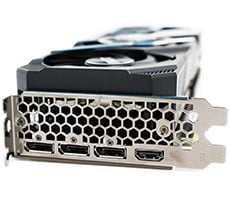
If you have ever been in the market for a graphics card, you are undoubtedly familiar with the constantly changing graphics card market. About every 8-10 months, new GPUs are introduced by NVIDIA and ATI, and after their introduction, dozens of graphics cards built by their add in board partners come to market. Because these add in board partners all use the same graphics chips supplied by the two major graphics card companies, they have to use their marketing savvy to create extra value and incentive for consumers to buy their products.
Over the years we’ve seen companies bundle the hottest new games, add new video connections, new cooling units, and even build their cards on unique colored PCBs. All of these strategies help to differentiate products from one another, and a company that has been doing this since their first line of X800 graphics cards is HIS, short for Hitech Information Systems. HIS has become widely known for using premium cooling solutions and pre-overclocking their graphics cards to provide a considerable amount of value and performance to gamers and enthusiasts alike.
Today we’ll be looking at one of the newest additions to the HIS product line, the ~$130 HIS Radeon HD 2600 Pro IceQ Turbo 512MB PCI Express graphics card. Join us as we take a closer look at the card and see how it stacks up to the competition in the $100-$150 graphics card space.


|
|
|
HIS Radeon HD 2600 Pro IceQ Turbo 512MB
|
|
Specifications & Features
|
|
|
Model Name
|
HIS HD 2600 PRO IceQ Turbo 512MB/256MB DDR2 PCIe
|
|
Chipset
|
Radeon HD 2600 PCIe Series
|
|
ASIC
|
Radeon™ HD 2600PRO GPU
|
|
Pixel Pipelines
|
120 stream processing units* (Unified)
|
|
Vertex Engines
|
120 stream processing units* (Unified)
|
|
Manu. Process (Micron)
|
65nm
|
|
Transistor
|
|
|
Fill Rate
|
|
|
Memory Size (MB)
|
512 / 256
|
|
Memory Type
|
DDR2
|
|
RAMDAC (MHz)
|
400
|
|
Engine CLK (MHz)
|
650
|
|
Memory CLK (MHz)
|
1050
|
|
Memory Interface (bit)
|
128
|
|
Memory Bandwidth
|
|
|
Max. Resolution
|
2560*1600
|
|
Bus Interface
|
PCI-Express x16
|
|
VGA
|
No
|
|
2nd VGA
|
No
|
|
DVI
|
Yes
|
|
2nd DVI
|
Yes
|
|
TV-out
|
No
|
|
HDTV (YPrPb component output)
|
No
|
|
Video-in
|
Yes
|
|
TV Tuner
|
No
|
|
FM Tuner
|
No
|
|
-
quipped with the strongest mainstream air-cooling technology – IceQ
-
Factory pre-overclocked Turbo speed
-
Gold-plated ports and black panel plate – HD concept
-
390 million transistors using 65nm fabrication process
-
Superscalar unified shader architecture
-
120 stream processing units
-
128-bit DDR2 memory interface
-
Comprehensive DirectX® 10 support
-
High-speed 128-bit HDR lighting
-
Up to 24x Custom Filter Anti-Aliasing
-
ATI Avivo™ HD Video and Display architecture
-
Built-in HDMI and 5.1 surround sound
-
Support for the ATI Radeon™ DVI to HDMI adapter
-
Unified Video Decoder (UVD) for Blu-ray™ and HD DVD
-
Equipped with the strongest mainstream air cooling technology – IceQ
-
Factory pre-overclocked Turbo at Brand-new HD concept - Black panel plate and gold-plated output ports to cope with the new “HD” concept of the new Radeon™ HD Series
-
HIS Radeon™ HD 2600 delivers remarkable gaming performance for Windows Vista™ and DirectX® 10
-
HIS Radeon™ HD 2600 features hardware HD video processing and HDMI with built-in 5.1 surround audio ATI Avivo™ HD technology delivers sharp images and vibrant color fidelity from playback of Blu-ray™ and HD DVDs movies
-
HIS Radeon™ HD 2600 delivers powerful graphics performance to enhance the stunning Windows Vista™ user experience
|
When we opened the HIS Radeon HD 2600 Pro IceQ Turbo’s box we found that the card shipped with a DVI to VGA adapter, an S-Video Cable, HDTV output cable, and an HDMI adapter. The HDMI adapter is a new addition to the Radeon HD 2000 series of graphics cards and allows you to output 5.1 audio and video to a HDMI ready television. Also included in the bundle is the standard user manual and driver disk, along with a paper that gives you access to Half-Life 2: Lost Coast and Half-Life 2: Deathmatch through Valve’s Steam service.




;)
;)

 Chipset

;)
;)