Corsair VX450W 450W Power Supply

It’s a fact that extremely large, high-wattage power supplies tend to get the most press online, as the vast majority of PSU manufacturers are caught up in the never-ending competition of trying to get the highest wattage products out there. While this competition has fostered innovation in this market, in addition to pushing down prices of lower-wattage power supplies, the negative effect that it’s had is that most people believe that ultra-high wattage power supplies are an absolute necessity with today’s mid-range to high-end systems.
This is a myth which power supply manufacturers are happy to let people to buy into, since they can see increased sales on high-dollar power supplies which are overkill in many circumstances. While it doesn’t hurt to get a power supply with an available wattage level higher than what is needed, in some cases we’re seeing people purchase power supplies with 4-5x the maximum power load level than their system requires. In the vast majority of system configurations on the market, even newer ones, you’ll be hard pressed to push past 400W of actual power usage. Unless you’re dealing with a couple of Radeon HD2900XT or 8800 Ultra graphics cards, it’s unlikely that you’ll even get close to touching 700-800W.
We’ve always held power supplies which are relatively low-wattage but extremely efficient at their rated level in high regard. Power supplies which simply do their job without the need for gimmicky features, simply providing clean power with close to inaudible noise levels, all without charging you an arm and a leg. Companies like Antec and SeaSonic have held down this market quite well over the past few years, although newcomer Corsair’s power supply units have been surprisingly solid. Their first units, the HX series, were a hit with an interesting modular cable configuration and ultra low noise levels for high-powered configurations.
Corsair is taking much of the same technology which was prevelant in their HX-series power supplies and bringing it down to a lower price point. Earlier this month, they introduced the VX-series power supply lineup. This simple linup consists of 450W and 550W units, and are targeted at single processor, single graphics card systems who want near inaudible noise levels, solid power, and a reliable manufacturer name. We recently got our hands on the 450W unit for a trial run.

Corsair's new VX450W sits in front of their prior generation HX620W.

Corsair VX450W Power Supply Unit
Features and Specifications
Extending Corsair’s legendary reputation in performance and quality, the new Corsair VX family of power supplies features the industry’s most efficient power management and ultra-quiet design for mainstream users. Unlike most power supplies in the market, the Corsair VX incorporates a single +12V power rail that delivers continuous power under heavy loads. This conservative design ensures reliable operation in today’s most demanding system configurations and adds compatibility for future platforms. The unique combination of rock solid performance and incredible value puts the Corsair VX family of power supplies in a class of its own. Ideal for home theater PCs and ENERGY STAR PCs, the VX line maximizes energy savings and minimum noise generation thanks to double-forward switching circuitry design. Each Corsair VX power supply is backed with an industry-leading 5-year warranty and 24/7 on-demand customer service.
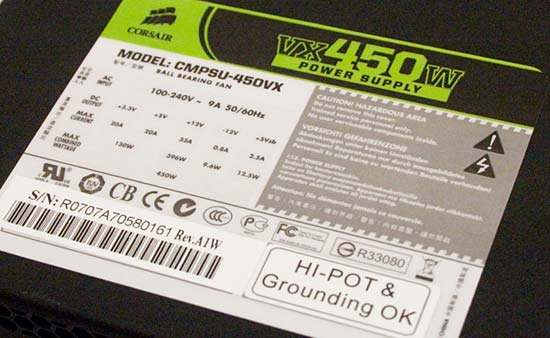
Corsair VX450W rail information graph
Specifications
|
Looking over the specifications, the VX450W has just about everything we would expect from a PSU of this caliber, although there are some interesting aspects which should be noted here.
The power supply’s rated 85% efficiency is a great selling point, as the industry’s focus on “green” power supplies has taken root with consumers. Corsair claims that their unit is efficient between 81-85% across all voltage levels, which means very little power is wasted and turned into excess heat. High-efficiency power supplies also consume less power themselves, which is good for your power bill. Corsair claims that a typical system using this power supply will use around 225 watts on load (which is a fairly solid estimation), and at this level, the power supply will be 85% efficient.
Corsair has opted for a single +12V rail on this model, which supports up to 33A and 396W off a single line, which an interesting design choice. There have been countless arguments online regarding the merits of single vs. dual (or quad) +12V lines for high-end systems. Our feeling is that for single GPU based systems, running everything off a single highly-rated +12V rail will be just fine, and our tests have shown that this does not present any issues.
Since the power supply is targeted at mid-range systems, only one 6-pin PCI Express graphics card power connector is included by default. If you want to run a multi-GPU system with this power supply, it’s certainly possible using Molex to PCIe power adapters, although if you’re going into multi-GPU territory, Corsair’s higher-wattage HX series are likely a better choice. While it only officially supports one graphics card, you’ve got a full server-grade set of Primary (24-pin) and Secondary (8-pin) +12V ATX connectors, meaning the system can handle single, dual, and quad-core based systems without issue. This unit can also be used for multi-processor systems, if need be, although this isn’t the market which Corsair is targeting here. Also note that the unit does not have EPS12V certification.