Intel Core i5-3470 Ivy Bridge Quad-Core CPU Review

Throughout all of our benchmarking and testing, we also monitored how much power our test systems consumed using a power meter. Our goal was to give you all an idea as to how much power each configuration used while idling and while under a heavy workload. Please keep in mind that we were testing total system power consumption at the outlet here, not just the power being drawn by the processors alone.
 |
|
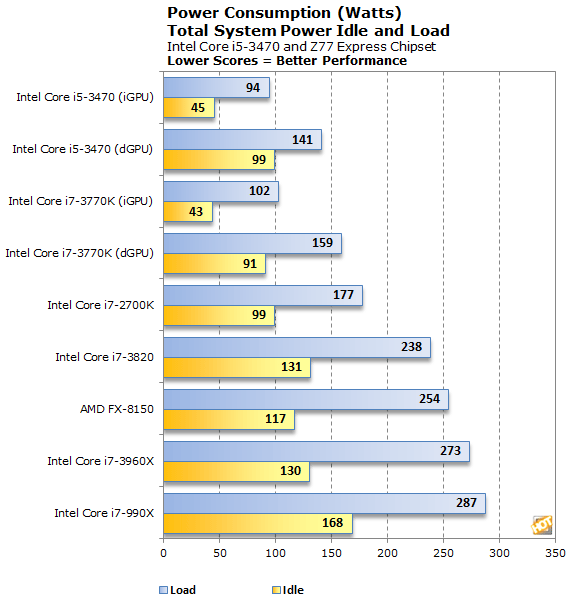
The Core i5-3470's power consumption characteristics where right in line with, albiet somewhat lower than, the Core i7-3700K. Idle power was slightly higher, but the Core i5-3470's load power was--as expected--somewhat lower.
 |
|
The Core i5-3470 is not a K-series processor, so it is not fully unlocked, but there are still some sizable performance gains to be had by overclocking. As we've mentioned, the Core i5-3470’s maximum multiplier can be set to only four bins higher than its peak Turbo multiplier. Since the base clock is 100MHz and the Core i5-3470 has a peak Turbo frequency of 3.6GHz, its max stock Turbo multiplier is 36. Through overclocking, that multiplier can be increased to 40, for a peak Turbo frequency of 4.0GHz. Manipulating the base clock can also add a bit more juice, however, to the tune of an additional 5-7%.
;)
Using only the stock Intel air cooler and a modest .1v bump in voltage, we were able to take the Core i5-3470 up to 4.2GHz using a multiplier of 40 and a base clock of 106MHz. Ivy bridge has shown to have much more headroom available than what we've achieved, so as long as you've got decent cooling and a good motherboard, pushing the i5-3470 to its limit should be no problem.
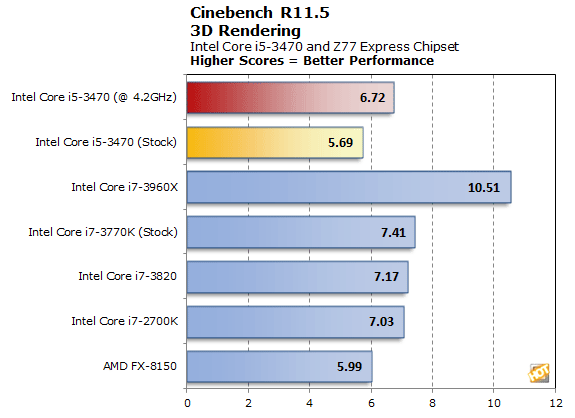
While we had the Core i5-3470 overclocked, we re-ran the Cinebench multi-threaded benchmark and saw a nice increase in performance. The CPU wasn't able to catch the HT-enabled Core i7-2700K, but it was nipping at its heals.

We also monitored power consumption while the Core i5-3470 was overclocked and saw a moderate 47W increase in power consumption.