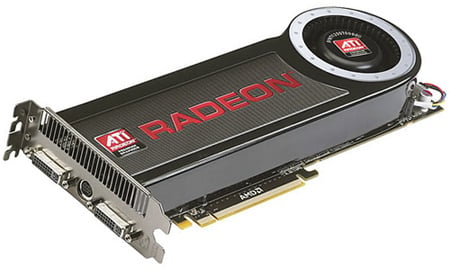
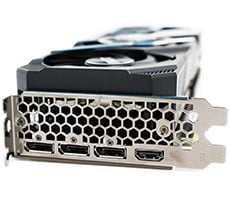
NVIDIA’s and AMD’s graphics board partners usually take differing approaches when releasing factory overclocked variants of each company’s respective high-end GPUs. When NVIDIA launches a new part for example, their board partners typically have factory overclocked versions at the ready, and at launch, it’s sometimes easier to find overclocked cards than stock reference models. AMD’s board partners, however, don’t usually take the same approach. When AMD launches a new ATI Radeon, the first batch of cards to hit typically follow the reference design to the letter, and custom, factory overclocked models don’t arrive until some time later.
That’s what happened with the Radeon HD 4870 X2. At launch, just about every Radeon HD 4870 X2 available at retail had the exact same features and specifications. But more recently, a few board partners have introduced factory overclocked variants that take the performance of what is already the fastest graphics card available up a notch. We’ve actually got two of them in house, the Asus EAH4870X2 TOP and the MSI R4870X2-T2D2G-OC, and plan to show you just how much extra performance each has to offer over standard reference cards.

ATI Radeon HD 4870 X2
|
|
|
AMD ATI Radeon HD 4800 Series |
|
Specifications and Features | |
- 956 million transistors on 55nm fabrication process
- PCI Express 2.0 x16 bus interface
- 256-bit GDDR3/GDDR5 memory interface
-
Microsoft DirectX 10.1 support
- Shader Model 4.1
- 32-bit floating point texture filtering
- Indexed cube map arrays
- Independent blend modes per render target
- Pixel coverage sample masking
- Read/write multi-sample surfaces with shaders
- Gather4 texture fetching
-
Unified Superscalar Shader Architecture
-
Dynamic Geometry Acceleration
- High performance vertex cache
- Programmable tessellation unit
- Accelerated geometry shader path for geometry amplification
- Memory read/write cache for improved stream output performance
-
Anti-aliasing features
- Multi-sample anti-aliasing (2, 4 or 8 samples per pixel)
- Up to 24x Custom Filter Anti-Aliasing (CFAA) for improved quality
- Adaptive super-sampling and multi-sampling
- Gamma correct
- Super AA (ATI CrossFireX configurations only)
- All anti-aliasing features compatible with HDR rendering
-
Texture filtering features
- 2x/4x/8x/16x high quality adaptive anisotropic filtering modes (up to 128 taps per pixel)
- 128-bit floating point HDR texture filtering
- sRGB filtering (gamma/degamma)
- Percentage Closer Filtering (PCF)
- Depth & stencil texture (DST) format support
- Shared exponent HDR (RGBE 9:9:9:5) texture format support
- OpenGL 2.0 Support
- ATI PowerPlay
- Advanced power management technology for optimal performance and power savings
- Performance-on-Demand
- Constantly monitors GPU activity, dynamically adjusting clocks and voltage based on user scenario
- Clock and memory speed throttling
- Voltage switching
- Dynamic clock gating
- Central thermal management – on-chip sensor monitors GPU temperature and triggers thermal actions as required
- Avivo HD Video and Display Platform
- 2nd generation Unified Video Decoder (UVD 2)
- Enabling hardware decode acceleration of H.264, VC-1 and MPEG-2
- Dual stream playback (or Picture-in-picture)
-
Hardware MPEG-1, and DivX video decode acceleration
- Motion compensation and IDCT
-
ATI Avivo Video Post Processor
- New enhanced DVD upconversion to HD new!
- New automatic and dynamic contrast adjustment new!
- Color space conversion
- Chroma subsampling format conversion
- Horizontal and vertical scaling
- Gamma correction
- Advanced vector adaptive per-pixel de-interlacing
- De-blocking and noise reduction filtering
- Detail enhancement
- Inverse telecine (2:2 and 3:2 pull-down correction)
- Bad edit correction
- Full score in HQV (SD) and HQV (HD) video quality benchmark
-
ATI CrossFireX Multi-GPU Technology
- Scale up rendering performance and image quality with two GPUs
- Integrated compositing engine
- High performance dual channel bridge interconnect
The specifications above list the main features and benefits of the RV770 GPU that is the foundation of the Radeon HD 4800 series. Keep in mind, however, that there are two RV770 GPUs on Radeon HD 4870 X2 cards, each coupled to 1GB of GDDR5 RAM, for a grand total of 2GB of frame buffer memory. We've gone into detail on the Radeon HD 4870 X2 in the past, so we won't cover the architecture again here, but if you'd like more information about the technologies employed on the Radeon HD 4870 X2, here are a few links to some of our previous coverage:
In our Radeon HD 4850 and 4870 launch article, we write at length about the RV770 GPU and in the 4870 X2 piece we explain how the dual GPUs are implemented on the card. Those two articles explain many of the more technical details we won't be going into again here.
| |