|
|
| Introduction & Specifications | |||||
If you want high-performance PC gaming action in a portable package, a laptop
equipped
with a GeForce Go 7 series chip has been your best bet for the last year or so. From the modest GeForce Go 7600 to the
monstrous
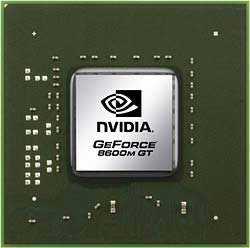
GeForce Go 7950 GTX, NVIDIA has most mobile gaming needs covered. If you were really serious, you could even get SLI in a (barely) mobile platform. However, with several highly anticipated DirectX 10 titles right around the corner, many mobile gamers have been eagerly awaiting DX10 capable GPUs for notebooks, a luxury that desktop gamers have enjoyed since November '06 with the release of the GeForce 8800 series. Today marks an industry first of sorts, for mobile DX10 capable graphics, with NVIDIA's new mobile graphics line-up, the GeForce 8M Series. The GeForce 8M Series offers many of the same features as NVIDIA's desktop GeForce 8 series. The initial line-up of GeForce 8M series GPUs contain 289 million transistors and just like its desktop counterparts, the GeForce 8M will offer full DX10 support, hardware HD video decoding courtesy of NVIDIA's 2nd generation PureVideo technology, and a fully unified shader architecture. We've already talked at great length about the GeForce 8 series' architectural features and benefits in the past, so we won't go into detail again here.
Below we have summarized some of the GeForce 8M series' key features for your convenience.
The GeForce 8M GPUs differ from their desktop-bound 8800 series
brethren
in one significant way, the per-clock shader performance has been tweaked and greatly improved. In the GeForce 8800, each stream processor can calculate four texture addresses and perform eight filtering operations per clock while each stream processor in GeForce 8M series GPUs can calculate eight texture addresses and perform eight filtering operations per clock. This allows a greater number of unique texture locations to be sampled.
As it is a mobile part, the GeForce 8M employs significantly more sophisticated power management features than its desktop counterparts. To realize this, the GeForce 8M series is equipped with NVIDIA's seventh generation PowerMizer power management technology. One of PowerMizer's more interesting features is the ability to allow the user to control system performance and battery consumption based on their needs. New in the seventh generation is support for Vista's power management features, like activity-based switching and adaptive clocking which dynamically adjusts GPU power and active features based on current operational needs, without any user intervention. PowerMizer 7.0 also implements SmartDimmer 2.0, which dynamically modulates backlight lamp power. The second generation of SmartDimmer offers more efficient power usage and smoother transitions than before. |
| 8M Series Line-up, Speeds and Feeds |
The GeForce 8M series will initially consist of five devices, the GeForce 8600M GT, 8600M GS, 8400M GT, 8400M GS and the 8400M G. The 8400M series is meant for mainstream and thin-and-light notebooks while the 8600M is designed for full-size performance oriented laptops. Both flavors of the GeForce 8600M will use the G84M core, a mobile version of the G84 core used by the 8600 GTS and 8600 GT mid-range desktop parts. While all three versions of the 8400M will use the G86M core, a mobile version of the value-oriented G86 core used by the GeForce 8500, 8400 and 8300 desktop parts. Besides the previously mentioned differences in the GPU core, NVIDIA's five new mobile parts will also differ in core, shader and memory frequency. The number of stream processors available will also differ between models. The 8600Ms will boast up to 512MB of GDDR3 memory while the 8400M will be equipped with DDR2. The entire GeForce 8M line-up will use NVIDIA's various MXM form factors and be integrated directly into some notebook designs as well. We've summarized the main differences between the five parts being announced today in the table below.
Compared to the GeForce Go 7 series , the new GeForce 8M probably won't be setting any performance milestones. Until NVIDIA releases some high performance parts for the 8M series, the GeForce Go 7950GTX is still king of the hill when it comes to pure mobile graphics processing power. However, the mid-range and value solutions presented by the 8M series should bring affordable, low power DirectX 10 support to the notebook market. NVIDIA claims the new 8M series will outperform the GeForce Go 7 series by about 50% in several more recent titles. Performance is greatly improved for applications that make use of HDR, such as Rainbow Six Vegas and Oblivion. According to NVIDIA, both of these games see up to a 50% improvement in performance compared to current mid-range GeForce Go 7 parts. |
| DX10 In Action and The Wrap-up | ||||||
|
As we've already mentioned, the main advantage of the GeForce 8M series over the GeForce Go 7 series is native DirectX 10 support. GeForce 8M series GPUs will render next-gen DX10 games as they were meant to be seen. We've posted a couple of screenshots of the upcoming DX10 title 'Age of Conan: Hyborian Adventures' to show you exactly what we mean. On the left are images taken when the game is in DirectX 9 mode while the images on the right were taken under DirectX 10. (Click any of the images for an enlarged view)
DirectX 10
implements
significantly more sophisticated high dynamic range (HDR) rendering, denser vegetation, greater viewing distances and better lighting models.
The difference in image quality is obvious. While Age of Conan certainly looks good in DirectX 9 mode, it looks absolutely stunning in DirectX 10. The images on the right appear much more photo-realistic, with smoother textures and more realistic lighting.
Despite the lack of a high-end model at the moment, the new GeForce 8M series looks very promising. The 8400M will bring DirectX 10 graphics capability and hardware HD video decoding to thin-and-light as well as value oriented mainstream notebooks while the 8600M will provide full-size performance notebooks with ample power for gaming. Unfortunately , the much anticipated mobile version of the GeForce 8800 is not part of the initial GeForce 8M line-up but we are confident that NVIDIA hasn't forgotten the DTR lovers out there. NVIDIA's five new mobile parts are very similar to their desktop counterparts in terms of their features and specifications and they will likely perform similarly too. With several DirectX 10 games around the corner, it seems NVIDIA is right on time with their GeForce 8M series.
Discuss This Article In HotHardware's PC Hardware Forum...
|