|
|
| The Asus EN8800GTS 320MB |
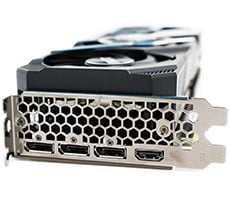
The GeForce 8800 GTS 320MB shares many of the same features as the 8800 GTX, but the two cards physically differ in a number of ways. For one, the 8800 GTS is built upon a shorter 9" PCB. GTS cards also requires less power; NVIDIA recommends a 400W PSU that can supply 26A on its 12V rails. As such the GTS has only one 6-Pin PCI Express power receptacle, whereas the more powerful GTX has two. The GTS also has only a single SLI edge connector, so at some point in the future the GTX is likely to offer a few additional features when running in SLI mode. What you see pictured above is Asus' take on the 320MB GeForce 8800 GTS, the aptly named EN8800GTS/HTDP/320M. Underneath the card's cooler, which is identical to the one used on other GTS cards save for the custom Asus decal, lies a G80 GPU clocked at 513MHz and 320MB of GDDR3 memory clocked at 1584MHz. Please note that the 320MB GTS has the same 96 stream processors enabled in the GPU as the 640MB cards, and its memory has the same 320-bit interface. The GTX, however, has 128 stream processors and a 384-bit memory interface. The 320-bit memory interface means the GTS is outfitted with 10, 32-bit DRAMs. The PCB does have pads for 12, however. So, there is a possibility that future, unannounced GeForce 8800 series cards with 384-bit memory interfaces may use this PCB design. Like other GeForce 8800 GTS 320MB cards, Asus' EN8800 GTS features a pair of dual-link DVI outputs and an HD/TV video output. The cooler is two-slots wide, with a barrel fan that sucks air in from within the system, and exhausts it out of the case through vents in its mounting bracket. The fan is variable speed and will spin up or down based on the temperature of the GPU. We found it to be relatively quiet most of the time, because it rarely spun up to full speed, even after an extended benchmark session. |
| Our Test System and 3DMark06 | ||||||||||||||
HOW WE CONFIGURED THE TEST SYSTEMS: We tested all of the graphics cards used in this article on an EVGA nForce 680i SLI based motherboard powered by a Core 2 Extreme X6800 dual-core processor and 2GB of low-latency Corsair RAM. The first thing we did when configuring the test system was enter the BIOS and set all values to their default settings. Then we manually configured the memory timings and disabled any integrated peripherals that wouldn't be put to use. The hard drive was then formatted, and Windows XP Pro with SP2 and the October DX9 update was installed. When the installation was complete, we then installed the latest chipset drivers available, installed all of the other drivers necessary for the rest of our components, and removed Windows Messenger from the system. Auto-Updating and System Restore were also disabled, the hard drive was defragmented, and a 1024MB permanent page file was created on the same partition as the Windows installation. Lastly, we set Windows XP's Visual Effects to "best performance," installed all of the benchmarking software, and ran the tests.
The Asus EN8800GTS finished right where you'd expect to in the 3DMark06 benchmark. The Asus card performed on-par with a reference GeForce 8800 GTS 320MB, but behind the higher-clock XFX GeForce 8800 GTS XXX Edition. Considering the card's approximate $300 price tag, its interesting to see it blowing past the Radeon X1950 XTX and even the dual-GPU powered 7950 GX2. |
| FarCry v1.4 | ||||||
We saw a similar trend to 3DMark06's with our custom FarCry benchmark. Here again, the Asus EN8800GTS falls inline with the reference GeForce 8800 GTS, just behind the factory overclocked XFX model. Regardless of its placement though, all of the cards put up triple digit framerates at both resolutions which somewhat negates the performance advantage at these resolutions. |
| Need For Speed: Carbon | ||||||
We saw more of the same with Need For Speed: Carbon. Asus' card performed on-par with the reference model, but it wasn't quite as fast as XFX's XXX Edition. All of the 8800 series cards, however, held onto significant performance advantages over the previous generation Radeon and GeForce 7 cards. |
| Half Life 2: Episode 1 | ||||||
From this point forward in this article, we tested all of the cards are standard and XHD resolutions. As you can see, the increased demands put on the EN8800GTS, resulted in a somewhat different performance trend. At the lower resolutions, it fell in-line with our previous tests, but once the resolution was increased above 1920x1200, the card's smaller frame buffer held it back, and its performance suffered because of it. |
| F.E.A.R. v1.08 | ||||||
The performance trend in the F.E.A.R. benchmark mirrored those of our custom Half Life 2: Episode 1 test on the previous page. The Asus EN8800GTS was a strong performer at the lower resolutions, but its framerate dropped off considerably at the higher resolutions. The performance drop at XHD resolutions was so significant (again, due to its relatively small 320MB frame buffer) that the 7900 GTX and X1950 XTX were able to pull ahead of it. |
| Quake 4 v1.3 | ||||||
The performance trend we witnessed in virtually all of our previous benchmarks played out again in our custom Quake 4 test. Here's the Asus EN8800GTS once again finished alongside the reference GeForce 8800 GTX 320MB card and just behind XFX's higher-clocked model. And once again at the higher XHD resolutions, framerates dropped off quite a bit. |
| Prey v1.2 | ||||||
Because both games are based on the same engine, the results from our custom Prey benchmark look much like the Quake 4 results on the previous page. Overall, the framerates are lower in Prey due to the more demanding nature of the graphics, but the trend remains virtually unchanged. |
| Overclocking the Asus EN8800GTS | ||||
|
For our next set of performance metrics, we spent a little time overclocking the Asus EN8800GTS using the clock frequency slider available within NVIDIA's Forceware drivers, under the "Performance" menu after installing the nTune performance application.
To find each card's peak core and memory frequencies, we slowly raised their respective sliders until we begun to see visual artifacts on-screen while running a game or benchmark, or until our test system was no longer stable.
Asus EN8800GTS:
Stock = 513MHz GPU / 1584MHz Memory
When all was said and done, we were able to take the Asus EN8800GTS up from its default GPU core and memory frequencies of 513MHz / 1584MHz. all the way up to 648MHz / 1880MHz, increases of 135MHz and 296MHz (DDR), respectively. While we had the card overclocked, we re-ran a couple of benchmarks at 1600x1200 to show you all just how performance had increased. As you can see, the performance increases were quite significant. They allowed the Asus EN8800GTS to pull ahead of the XFX card by a few FPS in both tests. It wasn't quite enough of a boost to catch the more powerful 8800 GTX, but who cares. Free performance is free performance. |
| Our Summary and Conclusion | ||||
Performance Summary: The Asus EN8800GTS/HTDP/320M performed on-par with a similarly clocked 320MB GeForce 8800 GTS reference card, but behind a pre-overclocked card from XFX. Overall, its performance was better than previous generation high-end GeForce 7 and Radeon X1950 cards, especially at resolutions of 1920x1200 and lower. At ultra high resolutions, the card's smallish 320MB frame buffer holds it back in some more demanding games, like Half Life 2: Episode 1 and F.E.A.R., for example.
We like the Asus EN8800GTS/HTDP/320M on many different levels. This card, and other similarly configured GeForce 8 series cards, satisfy the needs of a large segment of the market in our opinion. Their performance is high enough at mainstream resolutions that its worth upgrading to a card like this from virtually any last-gen product, and you'd end up with the added benefits of full HDCP and DX10 support, a better video engine, and a more complete feature set overall, that includes things like CSAA and higher quality anisotropic filtering. Asus' interpretation of the 320MB GeForce 8800 GTS in particular is a fine choice due to its price, good overclockability, and well appointed software bundle that includes two full games and a full version of the popular benchmarking tool 3DMark06. At about $300, the Asus EN8800GTS does fall at the upper end of the price range for standard clocked 320MB GeForce 8800 GTS cards by about $25, but the software bundle does offset the slightly higher price. Asus' warranty is also shorter than some others at 3 years, and it is not transferable, so that is something to take into consideration as well. Overall though, we suspect anyone in the market for a graphics card in this price range will be pleased by the Asus EN8800GTS/HTDP/320M. This card is fast, has plenty of next-gen features, and it's relatively affordable.
|