|
|
| Introduction & Specifications | ||||||
The fastest single graphics card in the world. This is the goal that NVIDIA was shooting for when they conjured up the GeForce 7950 GX2. Some might argue that a GeForce 7950 GX2, however, with its double stacked dual GPU powered PCB design, is anything but a single graphics card. We'd remind you that it does drop into a single PCI Express Graphic slot, no matter how you slice it. In fact there's room for two and yes, for Quad SLI. In our GeForce 7950 GX2 launch article, we showed you that the 7950 is essentially a pair of GeForce 7900GTs, goosed up a bit in clock speed and then outfitted with 512MB of GDDR3 RAM. Asus was the first to ship to our labs their version of the GeForce 7950GX2, right after the launch. Though our launch card was shipped to us from XFX, that didn't stop us from configuring the new Asus card along side XFX's for some Quad SLI action. In the pages ahead we'll show you Asus' EN7950GX2 in detail, along with its single card performance and what happens when you pair two 7950GX2s together.
Asus bundled in a solid assortment of extras with the EN7950GX2, including one major game title, King Kong, which is also emblazoned on the outside of the box. Fitting, since certainly the card within could easily be considered a modern day "King Kong" of the 3D Graphics world in and of itself. Beyond this title, Asus also includes a no-name title that we've seen in their previous bundles -- SnowBlind -- and Splendid Video Enhancement software. Finally, the obligatory PCI Express power adapter cable, DVI-VGA converters and a high-def component output cable were included in this kit as well. |
| The Card Up Close |
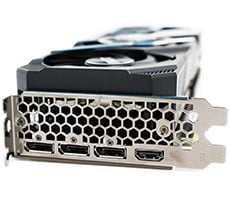
For the amount of available horsepower and on-board resources the Asus GeForce EN7950GX2 has to offer, its size is surprisingly compact. Even with two honkin' big GPUs and a full 1GB of RAM (512MB per PCB), the card doesn't expand beyond the dimension of a standard two-slot design. It's also actually significantly shorter than its predecessor, the GeForce 7900 GX2, an OEM only variant that never made it to the mainstream market. The Asus EN7950GX2 employs a standard reference design from NVIDIA with no modifications whatsoever. The turbine fans used are relatively quiet and we didn't hear them spin up to any offensive level during our entire battery of extensive benchmark runs. The two PCBs with their high-end GPUs attached do get a bit warm though. Specifically we measured temps with an infrared thermometer gun at a couple of spots on the backside and front of the card and registered temps in the 160oF range, which is alarming to say the least. Never once did the card exhibit instability though, whether in single card SLI mode or Quad SLI with two cards baking in the system. Regardless, if you are considering any GeForce 7950 GX2 variant, from Asus or others, make sure you have adequate ventilation in your chassis to keep ambient air temps inside your case within reasonable limits. The two circuit boards that comprise a single Asus EN7950GX2 are connected, as are all 7950GX2s with a tiny edge connector-style circuit board that routes signals sent from the NVIDIA PCI Express Switch that resides on the primary base card. The top GPU card plugs into the base card mezzanine style and the 48 lane PCI Express Switch allows for a full SLI configuration in a single X16 PEG slot on the motherboard. This NVIDIA PCIe Switch is not a trivial piece of silicon as it must perform high speed inter-GPU communications as a link back to the root CPU complex on the motherboard. These operations are extremely latency sensitive and NVIDIA's engineering prowess is to be applauded as the switch performs very well offering flawless, full SLI connectivity, which equates to a pair of X8 PCIe connections to each GPU and then aggregated back down to a single X16 connection in the PEG slot. |
| Splinter Cell: Chaos Theory | ||||||
Getting quickly to the point, we do not have Quad SLI numbers for you here since quite simply, Quad SLI was not working for this game engine. There was no gain in frame-rate what-so-ever with a pair of GeForce 7950 GX2s but certainly a single 7950 GX2 has its merits with single card multi-GPU rendering.
Once again the Asus EN7950GX2 shows it's the fastest single card in the heat, clocking in as expected right on top of our 7950 GX2 reference numbers. A pair of Radeon X1900s in CrossFire mode turn out to be the fastest dual-GPU configuration all around and the 7900 GTX in SLI a close second. However, we would question the expense of one of these dual card setups, when a single GeForce 7950 GX2 like the Asus card can give you completely playable performance up through 1920 res with AA and Aniso turned up high. |
| HL2: Lost Coast with QuadSLI | |||||||||
In our Half Life 2 : Lost Coast level testing, we ran things a bit differently between our NVIDIA and ATI-based test machines. Since even Half Life's HDR-enabled Lost Coast level doesn't tax these high end graphics cards all that much, we decided we would not only turn up the resolution but turn up AA levels a bit as well.
Below we have screen shots for you of two different sampling patterns from NVIDIA and ATI that result in very comparable image quality production. For NVIDIA, 8Xs AA means doing a 4X Multi-Sample AA process on each card and then a 2X Super-Sample. For ATI, 10X SAA (Super AA mode) means blending a pair of 4X Multi-Samples and then applying a 2X Super-Sample. So, in short, these two patterns are as close to comparable as you get for anything higher than 4X AA between NVIDIA and ATI cards but don't take our word for it, see for yourselves in the screen shots below.
Though we would consider ourselves complete "pixel snobs", we are hard pressed to call one image better than the other in the above 8Xs and 10X SAA shots. Image quality for both setups looks completely stunning actually with minimal aliasing, great texture quality and HDR lighting. Incidentally, we asked NVIDIA if their products are specifically capable of rendering HDR with AA turned on in Half Life 2: Lost Coast and this is what we were told. "There are many ways to accomplish AA and HDR in applications. Some games like Half Life 2 Lost Coast use an integer-based HDR technique, and in such games, the GeForce 6 and GeForce 7 chips can render HDR with MSAA simultaneously using that method. The GeForce 6 and GeForce 7 series GPUs do not support simultaneous multisampled AA (MSAA) and FP16 (floating point) blending in hardware (the method used in 3dMark 2006 for example)." Finally,on another side note, in the far right shot, we can see that a Quad SLI setup does AFR of SFR (Alternate Frame Rendering of Split Frame Rendering) to load-balance the rendering process in HL2: Lost Coast, so we do have Quad SLI numbers for you here.
At high res. and super high AA mode, the Quad SLI setup, powered by the Asus EN7950GX2 coupled with our stock GeForce 7950 GX2 card, in Quad SLI mode, showed the best overall performance, besting the next fastest config, a single EN7950GX2, by about 22%. This is hardly the type of 2X gain one would expect from adding another 2 GPUs for available rendering resources but that's AFR of SFR mode for you. NVIDIA will only really realize full potential of Quad SLI when they get the majority of game engines running in full Quad AFR SLI mode. Beyond that, the Asus EN7950GX2 blows any single card out of the water at any level and even competes with an X1900 CrossFire setup with high levels of AA enabled. |
| F.E.A.R. with QuadSLI | ||||||||||||
F.E.A.R. is another game engine that does take advantage of Quad SLI but we'd also encourage you to focus more on single 7950 GX2 scores here as well.
Here the EN7950GX2 even took the Radeon X1900 CrossFire setup to task, edging out a the dual slot setup by a small 3fps margin--impressive to say the least. In terms of single card performance the Asus EN7950GX2 has a 38%+ performance lead over any card in this test. For an average retail price of around $150 more though, it can be said that you get what you pay for with the GeForce 7950 GX2. Both standard SLI and CrossFire setups were no match for Quad SLI 7950s at these settings. A pair of 7950 GX2s is about 13% faster than a pair of GeForce 7900 GTX cards. Still not quite the performance gain we were looking for but impressive none-the-less. Once again we also fired up super high quality AA modes for each GPU base in the test, 8Xs AA for NVIDIA cards and 10X SAA for ATI cards, which again we feel is the level playing field option we could go with beyond 4X AA rendering. Of course we have screen shots for you to pick through as well, so you can decide which looks better or if things are on par visually as well.
It was a bit difficult getting screen-shots lined up perfectly in this fast moving test, so we took several frames for comparison. These are actual screens from the performance test that is built into F.E.A.R. Again, in our humble opinion it's a very close match-up, comparing NVIDIA's 8Xs sample AA versus ATI's 10X SAA. However, looking at the texture surfaces on the light fixture above in these shots, an object you would probably hardly notice during game play, there is a slight image quality advantage for NVIDIA, at least according to our eyesight.
At these super high AA settings, at 1600X1200 resolution, even the Asus EN7950GX2 has problems handling the rendering workload in F.E.A.R. Dropping in another GeForce 7950 GX2 card certainly helps matters but frankly the Radeon X1900 CrossFire setup is probably the most impressive turn-out in this test. Regardless, the GeForce 7950 GX2 and Asus' version of the card, do remain playable for the most part. |
| Quake 4 with QuadSLI | ||||||
If you're looking for a Quad SLI performance showcase, perhaps Quake 4 is it, since it is currently the only game engine we're aware of (aside from maybe the Doom3 engine) that supports Quad AFR rendering in Quad SLI configurations. More details ahead.
At 1600 and 1920 resolution the EN7950GX2 obliterates any single card score in this test and even takes on an ATI Radeon X1900 CrossFire setup--a combination that will set you back at least $300 more than the average price of one GeForce 7950 GX2 card. In fact, in Quake 4 we actually see the best scaling of performance yet for the GeForce 7950 GX2, versus the 7900 GTX SLI setup we've compared it to.
As you can see by the dual vertical load-balancing indicators in the Quake 4 screen-shot above, Quad SLI is running in Quad AFR mode, which is the most efficient method of load balancing for a pair of these cards in virtually any game engine.
The Quad SLI setup containing the Asus EN7950GX2 is some 35% faster than even a pair of Radeon X1900 cards. Unfortunately, we weren't able to test a GeForce 7900 GTX SLI combination but it would suffice to say that the performance of this pair would fall somewhere in between a GeForce 7950 GX2 and the Quad SLI pair of 7950 GX2s. A single GeForce 7950 GX2 isn't what we would call all that playable at this resolution and 8Xs AA setting but at 1600X1200 resolution you should have no issue. |
| Oblivion with QuadSLI | |||
Elder Scrolls IV Oblivion has to be one of the most talked-about games on the market right now and for good reason, the 3D visuals in this game are nothing short of amazing.
Below we have tested with Oblivion running FRAPS, following an identical path in the same map area for all cards. Variability was kept to a minimum wherever possible but with this style of benchmarking some level of accuracy is lost in our opinion. Regardless, we think you can still get a decent gauge on actual game-play performance.
Here again we have somewhat interesting results with Oblivion, depending on your perspective. These scores were recorded in the Sanctum level, an indoor environment that has lush lighting characteristics. We enabled HDR and kept AA off to level the playing field for all cards tested. As you can see the Asus EN7950GX2 was the fastest single card overall by about a 12% margin over the Radeon X1900 XTX and even about 10% over a CrossFire setup. However, this test showed all cards tightly coupled performance-wise and even the Quad SLI setup, which was working in AFR of SFR mode, was only marginally faster. The interesting note is that Quad SLI did show a peak frame-rate of almost 2X that of a single GeForce 7950 GX2, lending promise for Quad SLI performance to come, in future driver releases perhaps. |
| Overclocking the Asus EN7950GX2 | ||||
As we neared the end of our testing, we spent a little time overclocking the Asus EN7950GX2 using the clock frequency slider available within NVIDIA's Forceware drivers, after enabling the "Coolbits" registry tweak. To find the card's peak core and memory frequencies, we slowly raised their respective sliders until we begun to see visual artifacts on-screen while running a game or benchmark. Please note that the GX2's GPUs have to be overclocked in tandem, and not individually. The peak clock speed attainable by the "slower" of the two GPUs will determine the maximum overclock.
This test is important from the perspective of comparing Asus' EN7950GX2 to XFX's card, which come overclocked out of the box at 570MHz core and 775MHz on its memory interface. Though Asus' card comes factory set at reference GeForce 7950 GX2 speeds, it certainly has plenty of headroom for overclocking. In fact, it overclocked right up to the levels we saw from our overclocking efforts with the XFX card in our launch article. As we noted before however, these cards get really hot under pressure and we wouldn't recommend pushing the card past the 570MHz range at its core just to get a couple more fps. The jump from stock speed to 570/775 is certainly worth it though, while gaming with F.E.A.R. |
| Performance Summary & Conclusion | ||||
Performance Summary:
At the time of publication for this article, the Asus EN7950GX2 is listed on the high side of the GX2 price range, dropping in at $609 at ZipZoomFly, which was the lowest price according to our PriceGrabber engine. But in actuality, the EN7950GX2 is listed for more than that at numerous other resellers and is actually priced at $619 on the ZipZoomFly site. At that price, there are other 7950 GX2 offerings from eVGA, XFX and Gigabyte that fall in for a bit less, some approaching the $560 price range. Why price points vary so much between cards is a mystery to us frankly, since virtually every card we've seen so far, has the exact same NVIDIA reference design behind its build. One area to consider seriously though is warranty and Asus is strong in that regard, offering a full 3 years to the end user. We'd encourage anyone looking at one of these new, slightly toasty-to-the-touch cards, to make sure you are fully aware of the available warranty for the card. Better safe than sorry. Pricing aside, the Asus EN7950GX2 is a fine example of a GeForce 7950 GX2 card. It's built with standard Asus quality under the hood, comes with a great game bundle and rocks just about any high end gaming scenario you could throw at it currently. We're giving it a HotHardware.com Heat Meter rating of 9. If pricing falls in check at a later date, we'd also reserve the right to upgrade this product to an Editor's Choice.
|