|
|
| A Closer Look, Acoustics, Thermals And Test Setup | |||||||||
Hard Drives can be sexy, right? If that's the case then may we suggest getting out a bit more? There's this bright yellow thing in the sky sometimes that's kind of nice. People are OK too, really. All kidding aside, we have a bit of show-and-tell for you here and Western Digital decided to up the ante a bit on appearance as well, with a version of the new Raptor dubbed "Raptor X".
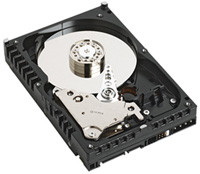
First, what might not be obvious to you, resides in the picture of the back side of the drive above. The absence of the tiny Marvell 88I8030 Parallel ATA to SATA bridge chip indicates this version of the Raptor has true "native" Serial ATA electronics within. Also above we've given you a look at Western Digital's special SATA cable assemblies that have a fantastic locking mechanism providing much better secured connectivity with the cable at the drive end of the connection. The other end needs to remain a standard SATA plug to maintain cross-platform compatibility, but regardless the drive side of the cable has a far superior connector design, even if it's only available by WD and fits only on their drives. And can you blame them? These cables will be bundled in with full retail box versions of the drive but not with bare OEM units. Then of course, last but not least is the Raptor X, pictured in all its geek-sexy glory. The only thing that differentiates this drive from the non-windowed version you see above, is its clear polycarbonate window. This version of the drive retails for $50 more than the standard Raptor WD1500 ($349 versus $299 MSRP) but for those of you with cold-cathode lighting, windowed side-panels and low-rider-pimped-rig-techno-bling, it certainly is macktastic yo! Errr, or something like that anyway. It is pretty cool to watch the platters spin with the heads tracking back and forth. Just make sure you're super careful not to scratch the window. The material does seem to be rather prone to scratches from even the slightest abrasion. A Note On Acoustics And Thermals: We've spent many hours testing these new WD1500 Raptors and also took note of the drive's performance relative to thermal radiation and noise levels. Suffice it to say that this drive is very much on par with the WD740GD Raptor drive in both of these areas. We actually took an infrared temperature meter to the WD1500 drives and compared surface temps under load versus the WD740 and a pair of 250GB Maxtor DiamondMax 10 drives. Both the WD740 and WD1500 series Raptors recorded max temps in the 105o - 109oF range under a full load HD Tach Write test. The WD1500 actually exhibited the highest reading in one area of its casing where temps hit a peak of 109oF, while the WD740 topped out around 105o - 107oF. The DiamondMax 10 drives were the coolest of the bunch, but not by much, registering in at 102oF or so. All of our testing was done on an open air test bench, so thermals enclosed in a system chassis will undoubtedly be higher if proper air circulation isn't supplied. Regardless, we would characterize both the WD1500 and WD740 drives as middle of the road in terms of their thermals. They're 10K RPM drives that generate a bit more heat than most 7200 RPM drives but the variance is not that significant. On the acoustics side of the equation, subjectively we would offer that the WD1500 and WD740 are also very similar. These drives do have an audible whine on spin up and spin down that is perhaps more pronounced than many 7200 RPM drives but again we wouldn't classify their noise levels as offensive, even for those of you that are hell-bent on a super quite system. By comparison, the 7200RPM DiamondMax 10 drives we tested along side the WD1500 Raptors, list a 25 - 38db acoustic specification, while Western Digital lists 29 - 36db (idle to seek noise levels) for the WD1500 series. We would concur with these specs. The Raptor WD1500 has ever so slightly louder spindle and motor acoustics than some 7200 RPM drives but under seek operations the heads are relatively quiet. These new Raptors are pretty much middle of the pack as far as noise is concerned as well. At least on our humble opinion.
Our test methodology for all drives we benchmarked was fairly straight forward. In tests like HD Tach, we installed the drives and left them completely unpartitioned and unformatted. This allowed us to utilize HD Tach's Write performance test feature as well. For our SANDRA File System and PCMark05 Hard Disk tests, we were required to partition and format all volumes whether in single or RAID 0 array configurations. For single drives tests we set up a standard Windows XP NTFS partition, and then formatted the drives leaving them completely blank. For RAID arrays we utilized nVIDIA's RAID BIOS menus to configure a striped RAID 0 array with the default "maximum performance" 64K stripe size. Partitions were then configured with a 16K cluster size, formatted and again left completely blank for testing. Our OS and all benchmarks were installed on a separate Western Digital Raptor WD360. |
| SiSoft SANDRA File System Tests | ||||
We began our testing with SiSoftware's SANDRA File System benchmark module. This test's method of hard disk performance analysis it what we would consider a "light duty" consumer-level evaluation tool. The folks in IT would have your head for recommending a drive based solely on SANDRA File System test results. However, the benchmark is a popular utility within the performance PC enthusiast community and it does give a decent quick swag at high-level throughput characteristics of the total storage subsystem, which of course includes HD controllers and other associated system components.
SANDRA's Random, Sequential and Buffered read statistics show a commanding lead for the new WD1500 Raptor. We'd place more stock in the Random and Sequential Read tests since standard desktop and gaming application file access places moderate to high loads in these areas. The Raptor WD1500 is showing a 42% Random Read advantage over its smaller sibling and about 35% over the Maxtor drive, with about 19 - 25% better performance in Sequential Reads.
Write performance of the Raptor WD1500 scales about the same with the exception of Buffered Writes which are pretty much all over the map. Again buffered reads and writes are representative of performance with short bursts of data and thus not as representative of typical real-world performance, though Maxtor's DiamondMax 10 perhaps makes more efficient use of their on-board cache memory than the Raptors do according to this benchmark.
SANDRA's Drive Index rating is probably the most familiar score to many of you reading here and clearly this benchmark shows the new Raptor WD1500 series as the leader far and away, whether in single drive or RAID 0 installations. For what it's worth, this is the fastest RAID 0 performance we've recorded with SANDRA to date, utilizing standard SATA hard drives. |
| PCMark05 Hard Disk Drive Tests | ||||
Next up is PCMark05 from FutureMark Corp. We specifically used only the HDD Test module of this benchmark suite to evaluate all the drives and configurations we tested versus the new Raptor WD1500. We consulted Futuremark's white paper on PCMark05, for an understanding of what this test component entails and how it calculates its measurements.
Courtesy, FutureMark Corp. - General Hard Disk Drive Usage: This trace contains disk activities from using several common applications. Virus Scanning: Virus scanning is a critical task in today's PC usage. As the major bottleneck of scanning
Our detailed PCMark05 tests show the Raptor WD1500 significantly ahead of the WD740 Raptor, and even more so versus the 7200RPM DiamondMax 10. Furthermore RAID 0 configurations with the WD1500 show an increase in performance for WinXP start-up and general usage on the order of 20-25% (RAID 0 versus single drive performance compared between just the WD1500 series installations). Our PCMark05 Virus Scan test, again a test that is representative of almost exclusively read performance, the clear winners are the 16MB cache enabled drives, in this case the Raptor WD1500 and the DiamondMax 10.
PCMark05's overall Hard Disk Drive test scores are representative of a weighting of two other tests in addition to the tests we've given detail for above, specifically File Write and Application Loading. PCMark05 shows the Raptor WD1500 to be ~ 20% faster than the Raptor WD740 and ~ 38% faster than the DiamondMax 10 drive. RAID 0 performance scales down a bit to the 10 - 28% range respectively. |
| HD Tach 3.0.1.0 Benchmarks | ||||
The four HD Tach metrics that we sampled for each drive are Random Access, which is largely dependent on spindle speed of the drive, Read Average, Write Average and Burst Read throughput. Again Read and Write Average scores are what we would consider the most meaningful to the end user. Whereas Burst Read is typically tied the drives on-board caching and SATA interface speed.
Simply put, the new Raptor WD1500 once again "kicks it up a notch" on its little brother WD740 and pretty much out-classes the DiamondMax 10, as far as Average Read/Write performance goes. Burst Read performance did fall slightly in favor of the Maxtor drive but only by a hair. Perhaps a firmware tweak or two down the road will bring even better burst performance for the Raptor WD1500, but then again slightly higher burst throughput typically doesn't equate to higher tangible end user performance. |
| Quake 4 Level Load Time Tests | ||||
Practical? Yes. Indicative of a complete end user experience? Probably not. But regardless we've included a gaming test where we simply measure the time it took to load up Quake 4's first level when starting a new game for the first time. In this test we re-booted the system each time since Quake 4's engine tends to cache levels a bit even though you have dropped out to the desktop. The scores below represent worst-case level load times based on a reboot of Windows XP and a few minutes of stabilization time, waiting for XP to load all its associated drivers, etc.
So there you have it, a RAID 0 array has very little impact on actual level load times in this particular game engine, versus a single drive array. Beyond that we see the prowess of the Raptor WD1500's 10K RPM spindle speed and it's 16MB cache buffer. A few seconds spared waiting for levels to load may afford you one more death-dealing exchange with the baddies but perhaps what may be more important would be potentially more responsive texture and map loads during live game-play. |
| Benchmark Analysis Wrap-up And The Rating | ||||
Benchmark Analysis:
In short, we'd challenge any other drive manufacturer out there today to offer a standard SATA drive that can compete with this new Western Digital Raptor in terms of performance. The WD1500 series Raptor is simply, in a word, impressive. Those of you looking for the fastest file system, OS and application performance will be thoroughly impressed with Western Digital's third generation Raptor. It may be smallish versus some of the larger current generation SATA drives on the market, but plugged into a high-end system as the main OS drive and supported by a second storage element (internal or external) for mass storage, this new Raptor makes all the sense in the world. Sports Car-like random read/write performance coupled with a 10K RPM spindle speed, 16MB cache and the latest storage command queuing algorithms, adds up to enthusiast-class storage excellence; not to mention what these drives could do in a server environment, as lower cost alternatives to traditional SCSI 320 offerings. After all, WD does technically classify the Raptor WD1500 as a "high performance enterprise" drive, so we can't forget that target market either can we? (wink, wink) With an MSRP of $299 for the windowless WD1500 and $349 for the Raptor X (street prices are already dipping below these marks), we're confident the drives will be a big hit in the mainstream Performance Desktop market. We can't say enough about the Raptor WD1500, the drives are just that good. With comparatively higher costs versus many 7200 RPM drives, to the tune of almost 2 times the price in some case, we'll have to stop short of a perfect score for the new Western Digital Raptor WD1500 series but you can bet your barracuda we're giving them an Editor's Choice.
Discuss This Article In HotHardware's PC Hardware Forum Right Now!
|