|
|
| The Contenders | ||||
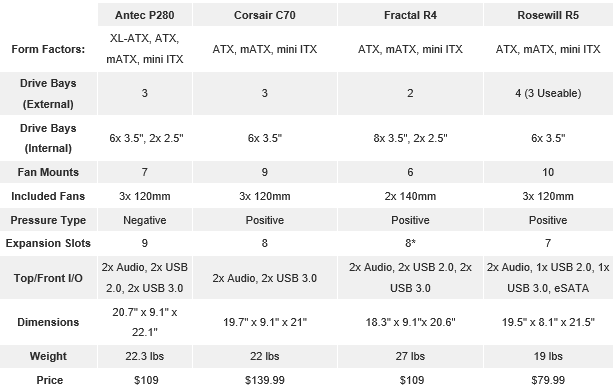
| Today we're reviewing a series of mid-tower cases at a variety of affordable price points. These four cases are all marketed towards enthusiasts and ship with what were once considered upscale options, including external water cooling mounts, multiple 120mm fans, screwless installation, removable case vents, and board cutouts for third-party heatsink installation. That's great news if you're tired of seeing full towers get all the high-end love from case manufacturers, but it makes the prospect of picking a single enclosure a bit daunting. We've rounded up options from Antec, Corsair, Fractal, and Rosewill and we'll start with their spec sheets.
One of the specs we've included is whether the case is configured for positive or negative air pressure by default. The term refers to the air pressure inside the case relative to the room it resides in.
|
| Corsair Vengeance C70 |
| I'm not overly fond of the styling on the military green Corsair Vengeance C70. It combines a military green color with button designs that seem to be trying a bit too hard. The total effect feels a bit overdone, like something meant to appeal to 14 year old boys and obsessed COD players. If you served in the military and are looking for a case that reminds you of it, this obviously doesn't apply to you. The other issue with the color is practical -- military-green faceplates for the rest of your peripherals are hard to come by, and Apple has yet to offer a camouflage iPhone. Since Corsair offers the C70 in black and white, I'm not going to spend too much time bemoaning the green flavor here. We'll focus on specs and other aspects of design. The C70 is a midrange case that's meant to appeal to more value-conscious buyers, but it's still the most expensive model we tested. The slide panels attach via prominent side clips for easy removal and re-attachment. The C70 gets the nod for easiest case to open of the models we tested; while none of the options were difficult to open, the large side latches on the C70 are especially easy to use. The front is no-nonsense (and no drive door). The power and reset buttons are on the top at the far right and left, with a pair of audio jacks and two USB 3.0 ports between them. The entire top is left open for venting, save for a pair of handles fore and aft. The rubberized grips work well if you need to transport the box -- they aren't triumphs of ergonomic comfort, but they're far better than gripping bare metal. There are grommets installed in each of the screw slots to keep a radiator quiet. The internal case presentation follows the no-nonsense motif Corsair laid out elsewhere. The drive bays and their associated fans are removable if you like (this adds GPU space) and there's plenty of room for back-of-the-board cabling. The six drive bays are a bit more sparse than other options, but the screwless mounting is welcome. One odd bit to note is that the bay shields at the front of the case are mounted *extremely* securely. As in, we had to remove the front of the case to have a hope of budging them. I'm not fond of the green C70's styling, but it's easy to work in. Cable management options are good and I really like the side panel clips. Noise levels are a bit higher than some of the other cases, however -- there's not the same level of noise dampening foam in between components and the outside world. |
| Fractal Design R4 |
| The Fractal R4 is an evolution of the Fractal R3. There are some design differences between this midtower and the other cases we've included here, including an unusually small number of 5.25" drive bays. Where other mid-towers offer 3-5 5.25" bays, the Fractal R4 offers just two. There's a method to this madness. By shucking a number of bays, the R4's central fans are able to direct a larger volume of cooler air at the CPU heatsink. There's a three-speed fan controller on the inside of the case as well, a nifty feature that allows end-users to adjust fan speeds and system noise on the fly without re-wiring anything. Fractal also ships the system with removable insulated panels that block off the 120mm fan mounts. This allows users to reduce system noise by covering panels they aren't using, and can actually improve cooling efficiency by ensuring that air flows through the case in an optimal manner. The center set of drives can be removed, further clearing room for the front intakes. With the 3.5" bays installed, the Fractal R4 can mount a total of 10 drives (5 in the top bay, 3 below, and two 2.5" SSDs to the back of the motherboard. Here you can see the eight expansion slot, one located laterally on the motherboard rather than vertically. This is a nifty idea for moving things like USB brackets out of the way. There are times when the headers for these parts interfere with multi-GPU or other PCIe configurations; being able to move the slot mounted adapter could make it easier to tuck the hardware in an out of the way. The Fractal R4 offers a number of nice features and plenty of cable management options. I like the 7+1 design for slots and the fact that I/O ports have moved to the top (and are less likely to get whacked in high-traffic areas). There's only two fans, but the 140mm size ensures they don't need to spin very quickly to keep the system cool. |
| Test Results, Conclusion |
Our testbed was a Core i7-2700K on an Intel DP67BG2 motherboard with 8GB of RAM and an AMD Radeon 6870. Systems were benchmarked by waiting 15 minutes after boot and after 30 minutes of running Prime 95 in stress test mode. Cases were tested using their default fan configurations. ![]() The idle results are all fairly close, but the load figures don't paint the Corsair Vengeance C70 in a very favorable light. The Rosewill's less-than-cutting edge performance is easier to justify since it's the cheapest case in this roundup by a fair margin.
Noise: Unfortunately, the only data I can present on noise levels is subjective -- my sound level meter isn't sensitive enough to pick up noise below 50dB, and all these cases were well below that threshold. The Antec P280 was the quietest case we tested, though the Fractal R4 was only slightly louder. The Vengeance C70 was noiser than either of these two, which makes sense -- it lacks the drive door or pre-installed foam padding that dampen sound in the other two chassis. The Rosewill was slightly louder than the Corsair. None of these cases are loud, however, by any reasonable definition of the term. If you sit several feet from the back of your case, you may not notice the difference. If, however, your goal is to build the quietest system you can afford, you'll want to look at the Fractal R4 or the Antec P280.
The Corsair C70 is a well built case with some nice features, but it didn't fare very well in our round-up. We've seen a number of excellent chassis from the company, from the Carbide 400R and 500R that we reviewed last year, to the 700 and 800D I reviewed a few years back, but the C70 isn't quite in the same league. The C70 is a high-quality case, that will serve its users well, but there are some more enticing options for similar or less money.
The Rosewill R5 wins a nod as a budget product with up-market features. True, you can save more money by going with something in the "Plain beige box" variety, but the R5 does a decent job of boxing above its weight class and pay grade. The fan controller is a nice touch if you like tweaking system volume by hand. If you need a nice case with some high-end features on a budget, we can recommend it.
Personally, if I had to pick between the Fractal R4 and the P280, I'm not sure which I'd choose. I like the P280's drive door, finish, and weight, but I also like the Fractal's 7+1 PCI port design, the 140mm fans, and the fact that the I/O ports are on top (and out of the way). I prefer positive pressure designs to negative ones too, so I'd ultimately end up tinkering with the Antec P280's build before I used it. Which you pick comes down to brand and style preferences, I think. Either is a worthy choice.
|