|
|
| Introduction and Specifications | ||||
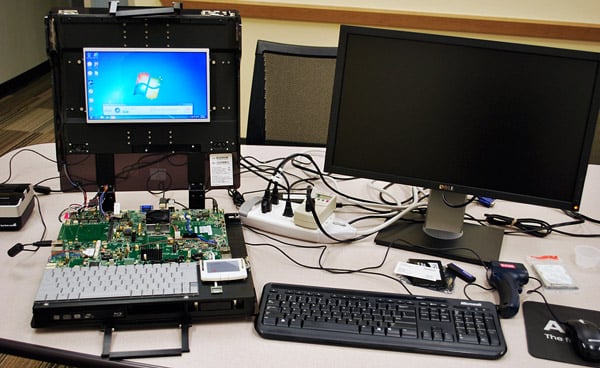
However, before we let you run wild with the performance characteristics of AMD's upcoming E-350 Fusion processor, we should torture you a bit longer and delay things just slightly again with a bit of backdrop on the current status of the chip and our test conditions. We spent time on site at AMD's Austin, Texas campus running tests on first generation AMD Zacate silicon. Our test machine was far from a production build, but instead consisted of an engineering reference design motherboard. The performance data you'll see on the following pages is preliminary and based on a version of the chip that has in fact already gone through yet another optimization spin. Of course, ecosystem hardware and software partners are also bringing the chip up as well, so there should likely be more performance that can be wrung out of the chip prior to its launch. That said, AMD obviously felt comfortable enough to give us direct hands-on time with a Brazos system based on their new chip, so what you'll be seeing here we'll estimate to be within perhaps 90 to 95% of the final system's performance and power profile.
The version of the chip we looked at specifically was the higher-end 18 Watt chip that will be branded as the E-350 Fusion processor. This incarnation of Fusion goodness runs at 1.6GHz. The 9 Watt version, codenamed Ontario, will be coming to market in Q1 2011. The E-350 has dual "out of order" X86 cores built on a 40nm process technology, with a total of 1MB of L2 cache (512KB per core). The chip also supports full X86-64 extensions and sports a 64-bit FPU as well. On die is also a single channel DDR3 memory controller that is rated up to a 1066MHz interface speed and supports up to two DIMM slots. Finally of course, is AMD's DX11-capable graphics core; specifically a Radeon HD 6310, which also incorporates AMD's new generation UVD3 video decode block that can be found on the recently launched Radeon HD 6800 family of graphics processors. Paired with the Hudson IO controller chip, or Southbridge, and a few miscellaneous interface chips for things like Gigabit Ethernet and USB3 and you have essentially our full test platform for this performance preview. Speaking of which, let's detail all of our test systems for you, next. |
| Test Systems and PCMark Vantage | |||||||||||
![]() Test System Configuration Notes: Testing Zacated at AMD's facility wasn't completely ideal, so we had to make due with the available test system we had as well as reference performance numbers you'll see in the coming benchmark graphs. The first thing to note is that AMD configured their Zacate/Brazos systems with a Micron C300 SSD, which not only allowed us to install our benchmark suite that much faster but in tests that were storage subsystem dependent, afforded Zacate a significant advantage in IO response time. As such we decided to fire up a fresh set of benchmark numbers on two low power mobile platforms we had currently in house -- Intel's Atom D525 1.8GHz dual-core with NVIDIA's Ion 2 and AMD's previous generation Turion II Neo K625 with discrete Radeon HD 4225 graphics. All told these test systems should provide a good relative metric to measure Zacate and the Brazos platform's performance versus similarly equipped hyper-mobile platforms.
First up, we ran our test systems through Futuremark’s latest system performance evaluation tool, PCMark Vantage. PCMark Vantage runs through a host of different usage scenarios to simulate different types of workloads including High Definition TV and movie playback and manipulation, gaming, image editing and manipulation, music compression, communications, and productivity. Most of the tests are multi-threaded as well, so the tests can exploit the additional resources offered by a quad-core CPU.
With our first test we see some interesting data. The AMD Zacate E-350 processor trails the dual core Atom D525 by about 12% in our productivity tests but shows itself to be slightly faster than the dual core Atom in all other tests, except for the gaming test, where Zacate's integrated GPU offers over 2X the performance, and in the communications test where it shows 40% more throughput. Finally, the Turion II Neo K625's more midrange architecture allows it to stretch its legs a bit more over the Zacate and Atom dual-core low power chips here. |
| H.264 Video Encoding and LAME MT Audio Encoding | ||||||||
The x264 benchmark measures how fast a system can encode a short, DVD quality MPEG-2 video clip into a high-quality H.264 HD video clip. The application reports the compression results in frames per second for each pass of the video encoding process, and it is threaded so it can take advantage of the additional resources afforded by multi-core processors.
H.264 HD video encoding shows AMD's Zacate E-350 and Intel's Atom D525 neck and neck, while the previous generation AMD Turion II Neo K625 offers a bit more horsepower. Again, the Turion II is AMD's current generation equivalent to Intel's CULV processor line-up but it's really not in the same power consumption class as Atom or Zacate.
In this test, we created our own 223MB WAV file (a hallucinogenically-induced Grateful Dead jam) and converted it to the MP3 format using the multi-thread capable LAME MT application in single and multi-thread modes. Processing times are recorded below, listed in seconds. Shorter times equate to better performance. Here AMD's new low power chip shows it's decidedly more powerful than a dual core Atom processor at 1.8GHz and almost able to catch its cousin, the Turion II dual-core. In reality a more competitive race might be served up better by an Intel CULV processor-based system but with AMD's notebook price target of sub $399, it's hard not to compare it to something in the netbook (Atom) class of machines.
|
| Cinebench and POVRay 3D Rendering | ||||||||
Cinebench R10 is an OpenGL 3D rendering performance test based on Cinema 4D from Maxon. Cinema 4D is a 3D rendering and animation tool suite used by 3D animation houses and producers like Sony Animation and many others. It's very demanding of system processor resources and is an excellent gauge of pure computational throughput.
This is a multi-threaded, multi-processor aware benchmark that renders a single 3D scene and tracks the length of the entire process. The rate at which each test system was able to render the entire scene is represented in the graph below.
In the OpenGL portion of Cinebench, Zacate excels past both NVIDIA's Ion 2 GPU, as well as the Radeon HD 4225 in the Turion II-based notebook we tested. This test speaks clearly in terms of how AMD intended to partition the chip, in terms of standard processing and graphics processing resources. The chip is about 6% faster than a dual-core 1.8GHz Atom CPU in this test but about 30% faster than a dual-core Atom with Ion 2 solution, from a graphics standpoint currently. And by the way, thanks to our bud, Nate, over at Legit, for his help with this one.
POV-Ray , or the Persistence of Vision Ray-Tracer, is an open source tool for creating realistically lit 3D graphics artwork. We tested with POV-Ray's standard 'all-CPU' benchmarking tool on all of our test machines, and recorded the scores reported for each. Results are measured in pixels-per-second throughput; higher scores equate to better performance. ![]()
POV-Ray shows much the same in raw CPU throughput here for Zacate and the results are similar to what we saw in the Lame MT test, with a smaller spread however. |
| 3DMark Vantage | ||||
The performance trend with 3DMark Vantage is definitely a foreshadow of things to come on the graphics side of the equation and very much in line with what we expected to see in terms of traditional CPU throughput as well. In this case, Zacate just edges out the Atom D525 1.8GHz dual core chip for both CPU performance and versus the companion NVIDIA Ion 2 GPU in GPU performance and the total 3DMark score. It's impressive to see just how robust AMD's on-die GPU block is at this early stage of the game. |
| 3D Gaming: ET: Quake Wars and Left 4 Dead 2 | ||||
For our next set of tests, we moved on to some in-game benchmarking with Left 4 Dead 2 and Enemy Territory: Quake Wars. When testing processors with L4D2 or ET:QW, we dialed things in to moderate to maximum resolution for the LCD panel that was available in each test case. Since these are more entry-level game tests on highly mobile platforms, we left anti-aliasing turned off and image quality settings set from moderate to high levels where possible.
In our custom Left 4 Dead 2 benchmark, AMD's Zacate dual core processor with integrated, on-die Radeon HD 6310 graphics, was able to keep pace nicely with the NVIDIA next gen Ion-infused Atom D525 system and handily out-perform AMD's previous generation discrete solution. In the Enemy Territory: Quake Wars test, we see another case of driver optimizations that needs to take place for AMD's unreleased Brazos platform and Zacate processor. You'll also note we're missing some higher resolutions for the other test systems here in spots, due to panel resolution limitations at test time. Regardless, Zacate's GPU trails Ion 2 here by a significant margin, but it's not surprising, given the pre-release stage the system is in and the fact that OpenGL-based game engines are a dying breed now and likely lower on AMD's hit list as a result. |
| System Power Consumption | ||||
Throughout all of our benchmarking and testing, we monitored how much power our Brazos test systems consumed using a power meter. Our goal was to give you all an idea as to how much power the base platform configuration used while idling and while under a heavy workload. Please keep in mind that we were testing total system power consumption at the outlet here, not just the power being drawn by the processors alone.
Also, we should note the AMD Brazos reference platform system we tested was equipped with a USB3 IO chip from NEC, as well as a few other bells and whistles that drive power requirements up by a couple of Watts or so. In reality, if anything, these numbers are on the high side for the Zacate/Brazos test setup.
If there is one test that best frames the other performance metrics we've assembled for AMD's new low power chip, it's this one. We've illustrated in the previous pages, across a number of different test scenarios, just how Zacate and Brazos stack up in terms of performance. Now if we couple that data with the conservative power consumption data you see here, things become even more impressive for AMD's new chip and platform. Also, we decided to throw in a few more reference systems here that we had in our database just to give you a bit more resolution. In all cases the display was not factored into the power draw and we turned off the panel of the Acer Aspire 1551 Turion II powered notebook. In short, AMD's Brazos platform and their Zacate processor consume significantly less power than a dual core Atom/Ion2 solution at idle and under load. In addition, at idle, Zacate even consumes a lot less power than a standard single core Atom design. In notebooks and netbooks this equates to one thing; extended battery life. We'd also offer that again, the power consumption measurements here are very conservative, comparatively for Zacate. The reference board we tested definitely wasn't optimized for power consumption. Without a doubt, Brazo and AMD's Zacate E-350 processor offer excellent performance-per-watt efficiencies that will likely have Intel on its toes in a big way moving forward. |
| Our Summary and Conclusion |
Performance Summary: There are three high-level areas of performance we can consider when looking back through the benchmark data for AMD's Zacate platform: general CPU performance, graphics/multimedia performance and performance-per-watt. In terms of general CPU performance, this early engineering sample of Zacate proved itself to be faster than a 1.8GHz dual-core Atom processor across the board and in some tests, like our Lame MT audio encoding test, it was significantly faster. On the GPU side of things, Zacate performs a lot like a dual-core Atom system backed up by NVIDIA's Ion 2 chip, only Zacate does this all on a single chip/die and at decidedly lower power consumption at idle and under load. To us, that looks like a hat-trick.
We''ll bring this preview to a close with another reminder that we should call your attention to again. The image below shows you the environment that we tested AMD's new chip in and its reference platform. Obviously, the build you see here is far from retail, though reportedly retail-ready products (notebooks) are not far off and expected to ship this quarter. So, in other words, from here things can only get better for the AMD Brazos mobile platform and their Zacate processor, and they already look really strong.
We'll of course reserve final judgment until we can get full production release notebook product in, based on this new AMD Fusion technology for mobile platforms but to say we're encouraged and even excited would be an understatement. In a target price range of $400 or less and with best-of-class netbook-like power consumption, Zacate puts AMD squarely back in the ultralight computing game versus Intel. What AMD has been able to achieve in single 19mm2 chip package is nothing short of impressive. Zacate has a GPU engine that is capable of the kind of performance that NVIDIA has made a business of empowering Intel Atom processors with for a better over all experience. And it also has a CPU engine that sips power like Atom but with a measurable performance-per-watt advantage over Intel's latest dual core Atom chip. No matter how you slice it, taking on a combined Intel and NVIDIA solution from a performance standpoint is a tall order in any product segment but to do it successfully and with less power consumption and theoretically lower cost as well, is a proverbial win-win. End users will benefit from this AMD advancement on a lot of levels, not the least of which is raising the competitive bar once again. We'll have more Zacate-based notebook coverage in the months ahead but for now, the question remains what will Intel's next move bring? A Sandy Bridge may be just around the corner but what's next for Atom or CULV offerings remains to be seen. |